


























Views
Downloads
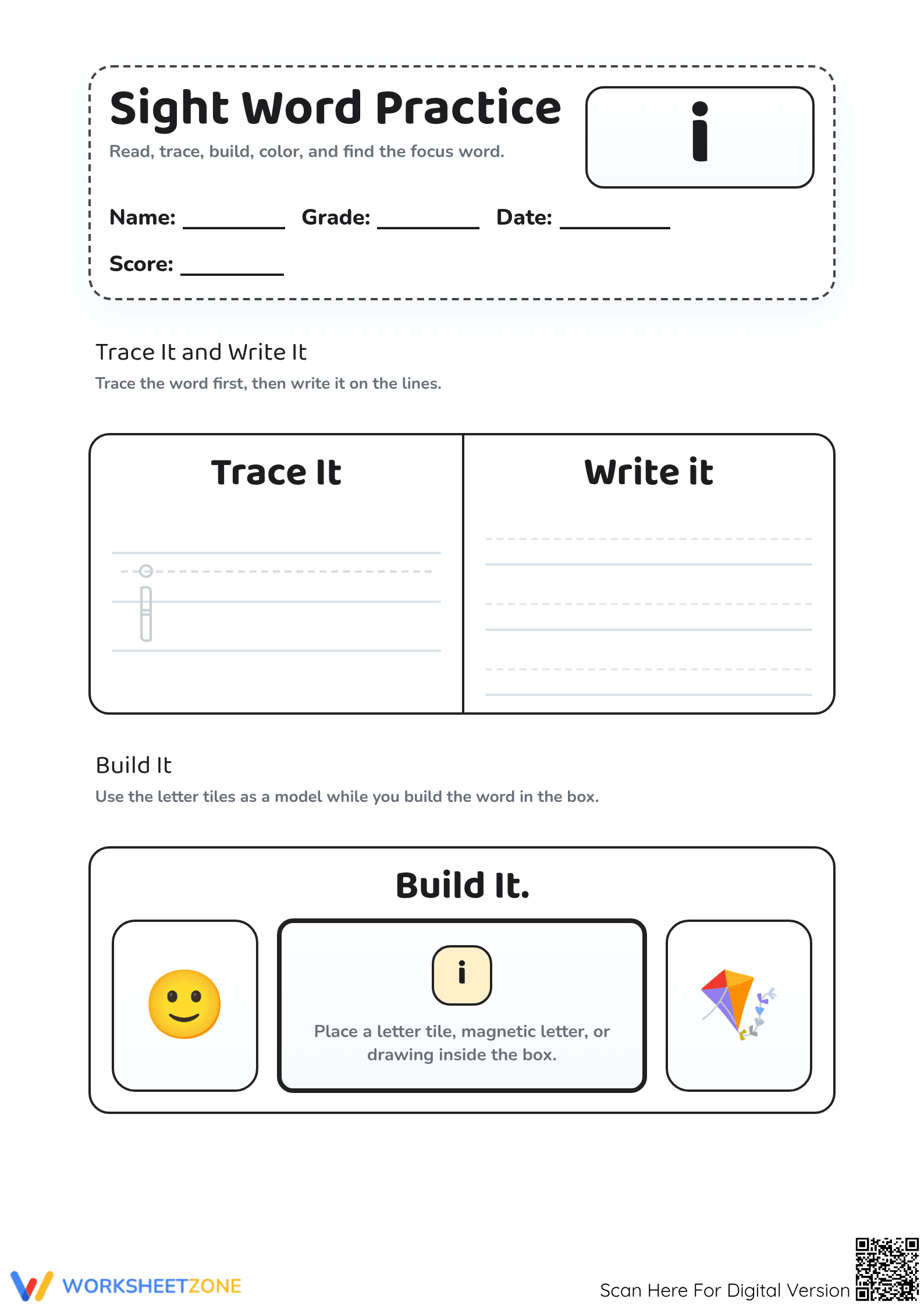


Grade K Sight Word 'i' — Printable No-Prep Worksheet
Paste this activity's link or code into your existing LMS (Google Classroom, Canvas, Teams, Schoology, Moodle, etc.).
Students can open and work on the activity right away, with no student login required.
You'll still be able to track student progress and results from your teacher account.
Mastering the high-frequency word "i" is a pivotal step in early literacy for Preschool and Kindergarten students. This worksheet facilitates orthographic mapping through five activities that build automaticity and student confidence. By focusing on one essential word, learners achieve mastery without being overwhelmed by complex phonetic rules or unfamiliar vocabulary.
At a Glance
- Grade: K · Subject: ELA
- Standard:
CCSS.ELA-LITERACY.RF.K.3.C— Read common high-frequency words by sight- Skill Focus: Sight Word Recognition
- Format: 2 pages · 5 problems · Answer key included · PDF
- Best For: Daily morning work and literacy centers
- Time: 10–15 minutes
What's Inside
This two-page PDF includes a progression of tasks to solidify word recognition. Students engage with the target word through tracing and independent writing. The "Build It" section encourages tactile learning, while "Color the Word" adds creative engagement. Finally, the "Find It" activity requires students to distinguish the word "i" from similar distractors.
Zero-Prep Workflow
Integrate this resource into your daily routine in under two minutes. Print the two-page document for each student in the class. Distribute the sheets along with crayons for the coloring and finding sections. Review the completed work using the included answer key for immediate feedback. This process makes it an ideal choice for substitute plans.
Standards Alignment
This resource aligns with the `CCSS.ELA-LITERACY.RF.K.3.C` standard, focusing on reading common high-frequency words by sight. By providing multiple exposures, the worksheet supports the development of the mental lexicon and foundational writing skills. Both standard codes can be copied directly into lesson plans, IEP goals, or district curriculum mapping tools.
How to Use It
Deploy this worksheet during a literacy center rotation or as a morning work assignment. Use the "Find It" section as a formative assessment; observe if students can identify the word "i" quickly among distractors. This activity typically takes 10 to 15 minutes to complete depending on the student's proficiency level.
Who It's For
This worksheet is designed for Preschool, Kindergarten, and Grade 1 students beginning their reading journey. It provides support for ELL students and those requiring intervention. For optimal results, pair this resource with a predictable text or a sight word anchor chart displayed in the classroom for reference.
According to the RAND AIRS 2024 analysis of early literacy instruction, explicit exposure to high-frequency words is a foundational pillar for developing reading fluency in primary grades. This worksheet targets the CCSS.ELA-LITERACY.RF.K.3.C standard, which requires students to recognize and read common sight words by sight without relying on phonetic decoding. By integrating five distinct modalities—tracing, writing, building, coloring, and identifying—this resource ensures that learners with different processing styles can successfully internalize the word 'i' as a stable lexical unit. Research by Fisher & Frey (2014) supports this multi-sensory approach, noting that repetitive engagement with high-frequency vocabulary during the orthographic mapping phase significantly reduces cognitive load during later complex text interactions. This specific resource provides the structured repetition necessary for Preschool and Kindergarten students to achieve automaticity, serving as a critical bridge between letter-sound identification and fluent sentence reading in early childhood classrooms.


