


























Views
Downloads
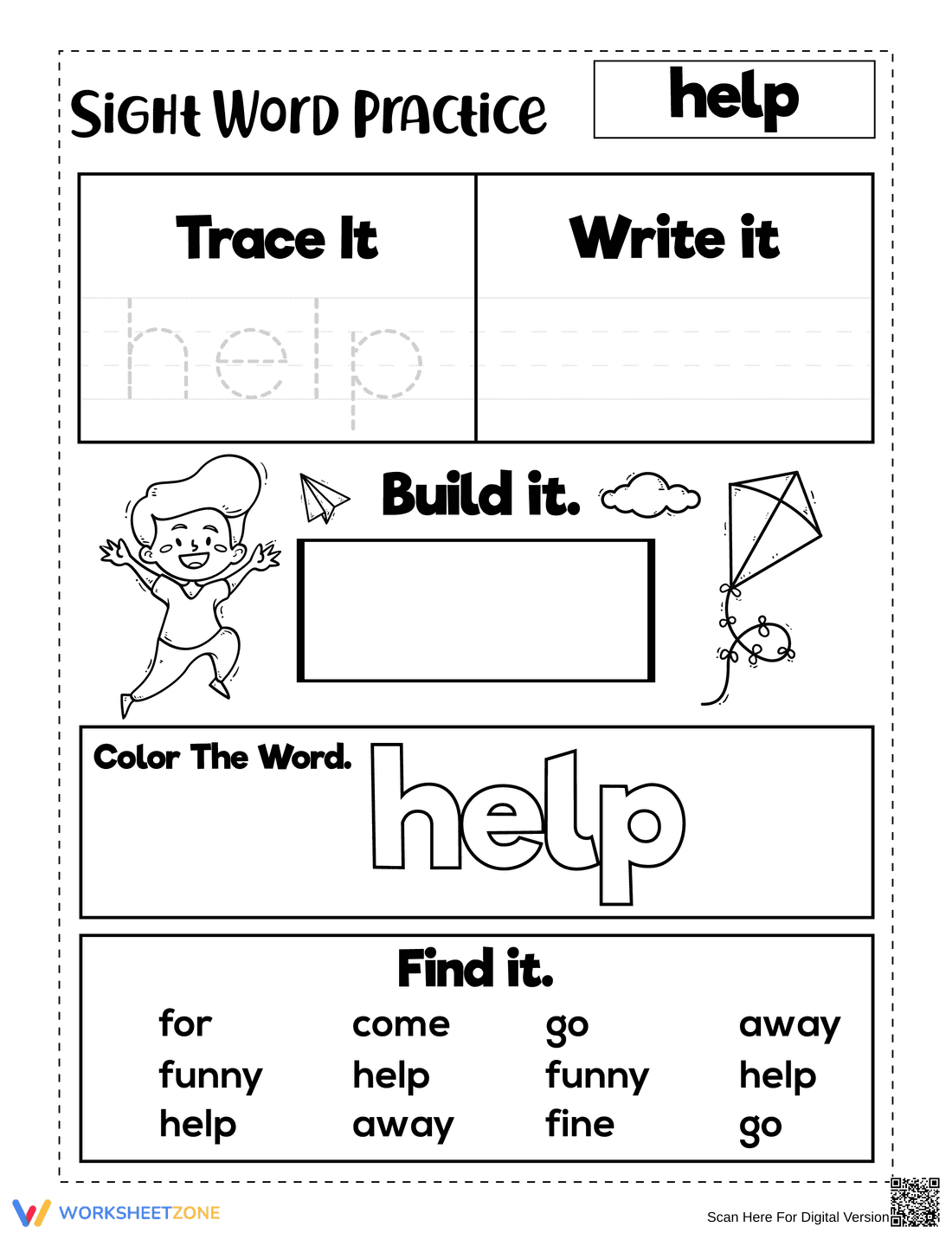

Sight Word "help" Practice | Essential Grade K-1 ELA
Paste this activity's link or code into your existing LMS (Google Classroom, Canvas, Teams, Schoology, Moodle, etc.).
Students can open and work on the activity right away, with no student login required.
You'll still be able to track student progress and results from your teacher account.
This Kindergarten and Grade 1 sight word worksheet provides targeted practice for the high-frequency word "help." Students engage in multisensory activities to master spelling and recognition, ensuring they can identify the word automatically in connected text. It serves as a foundational tool for early literacy development and reading fluency.
At a Glance
- Grade: K-1 · Subject: ELA
- Standard:
CCSS.ELA-LITERACY.RF.K.3.C— Read common high-frequency words by sight- Skill Focus: Sight word "help"
- Format: 1 page · 5 tasks · Answer key included · PDF
- Best For: Morning work or literacy centers
- Time: 10–15 minutes
The worksheet features five distinct modalities: tracing, independent writing, building (cut/paste or letter tiles), coloring for visual memory, and a "find it" word search. This single-page PDF is designed for clarity, using large fonts and intuitive icons that allow young learners to work with minimal teacher intervention.
The zero-prep workflow is designed for busy classrooms. First, print the single-page PDF (30 seconds). Second, distribute to students during center rotations or as a bell-ringer (1 minute). Third, review the "Find It" section together to check for accuracy (1 minute). Total teacher preparation time is under 2 minutes, making it an ideal sub-plan resource.
This resource aligns with `CCSS.ELA-LITERACY.RF.K.3.C`, which requires students to read common high-frequency words by sight. By engaging with the word "help" through multiple cognitive paths, students move from phonetic decoding to orthographic mapping. This standard code can be copied directly into lesson plans, IEP goals, or district curriculum mapping tools.
Use this worksheet during the "You Do" phase of a gradual release lesson after introducing the word on an anchor chart. It also functions as a formative assessment; observe the "Write It" section to check for proper letter formation and the "Find It" section to gauge visual discrimination speed. Completion typically takes 10 to 15 minutes.
This is designed for Preschool, Kindergarten, and Grade 1 students, including English Language Learners who need repetitive exposure to core vocabulary. It pairs naturally with a "help" themed leveled reader or a classroom word wall. The simple layout supports students with fine motor challenges through the large coloring and tracing areas.
According to the RAND AIRS 2024 report, multisensory engagement with high-frequency words significantly reduces the time required for students to reach automaticity. This worksheet utilizes the "Trace, Write, Find" sequence, which aligns with evidence-based practices for orthographic mapping. By focusing on the specific word "help" through five distinct tasks, the resource ensures that students move beyond simple memorization toward permanent lexical storage. The inclusion of CCSS.ELA-LITERACY.RF.K.3.C ensures that the practice is not just busywork but a direct contribution to the foundational reading skills required for early elementary success. Educators can rely on this structured approach to provide the 10–15 minutes of daily sight word exposure recommended by Fisher & Frey (2014) for developing fluent readers in diverse classroom settings.


