


























Views
Downloads
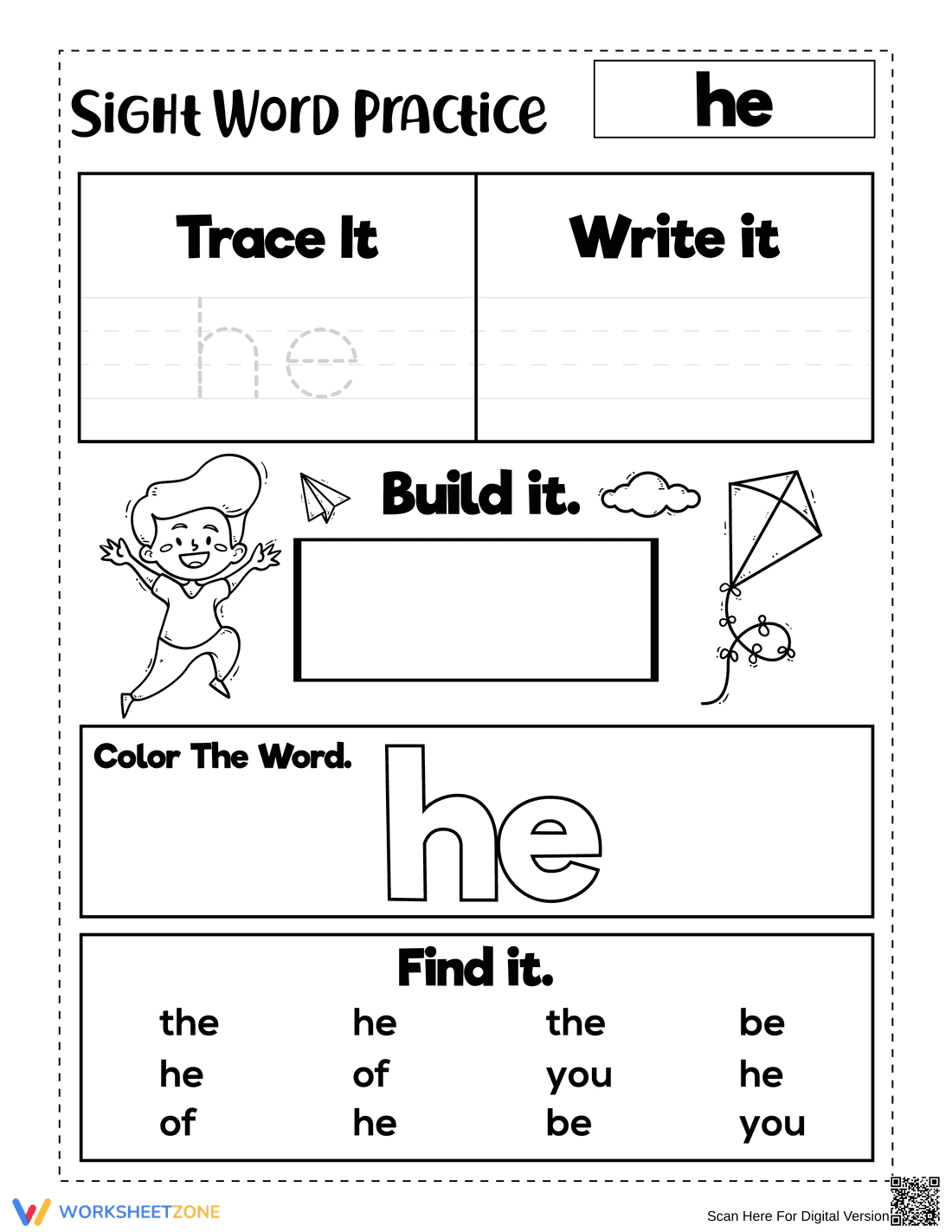

Sight Word "he" Worksheet | Grade K-1 Essential
Paste this activity's link or code into your existing LMS (Google Classroom, Canvas, Teams, Schoology, Moodle, etc.).
Students can open and work on the activity right away, with no student login required.
You'll still be able to track student progress and results from your teacher account.
This sight word "he" worksheet provides early learners with a multi-sensory approach to mastering high-frequency vocabulary. By engaging in tracing, writing, and identifying the word, students build the orthographic mapping skills necessary for fluent reading. This resource ensures students can recognize "he" instantly in various contexts, supporting overall literacy development and foundational reading success.
At a Glance
- Grade: Kindergarten · Subject: ELA
- Standard:
CCSS.ELA-LITERACY.RF.K.3.C— Read common high-frequency words by sight- Skill Focus: Sight word recognition ("he")
- Format: 1 page · 5 tasks · Answer key included · PDF
- Best For: Morning work or literacy centers
- Time: 10–15 minutes
Inside this single-page PDF, you will find five distinct activities designed to reinforce word recognition. Students start by tracing the word "he" on primary lines, followed by independent writing to solidify motor memory. A "Build it" box allows for tactile interaction or letter-tile placement, while a "Color the Word" section provides a creative break. Finally, a "Find it" word search grid tests visual discrimination among similar high-frequency words like "be" and "the."
The zero-prep workflow is designed for maximum efficiency in busy classrooms. First, print the single-page PDF (30 seconds). Next, distribute the sheets to students during your literacy block or as a transition activity (1 minute). Finally, review the "Find it" section as a whole group to check for accuracy (1 minute). This resource is a perfect sub-plan addition because it requires no prior instruction or specialized materials.
This worksheet aligns with `CCSS.ELA-LITERACY.RF.K.3.C`, which requires students to read common high-frequency words by sight. It also supports `CCSS.ELA-LITERACY.L.K.1.A` by encouraging the legible formation of letters through guided tracing and independent writing. Both standard codes can be copied directly into lesson plans, IEP goals, or district curriculum mapping tools to ensure instructional compliance.
Use this worksheet during small-group instruction to monitor letter formation and word recognition in real-time. Alternatively, assign it as a formative assessment after introducing the word "he" through a shared reading text. Observe if students can distinguish "he" from "be" or "the" in the "Find it" section to gauge visual discrimination mastery. Completion typically takes 12 minutes for most Kindergarten students.
This resource is ideal for preschool, kindergarten, and first-grade students who are beginning their journey with Dolch or Fry sight words. It is particularly helpful for English Language Learners (ELLs) who benefit from repetitive, structured practice. Pair this worksheet with a "he" themed anchor chart or a simple decodable reader to reinforce the word in context and build confidence in emerging readers.
According to the RAND AIRS 2024 report on foundational literacy, repetitive exposure to high-frequency words through multi-modal tasks significantly improves reading fluency in early childhood settings. This worksheet targets the sight word "he" using the CCSS.ELA-LITERACY.RF.K.3.C standard, which emphasizes the importance of automaticity in word recognition. By combining kinesthetic tracing with visual discrimination tasks, the resource aligns with research-backed strategies for orthographic mapping. Fisher & Frey (2014) highlight that such structured practice helps bridge the gap between isolated word recognition and fluent text reading. Educators can utilize this 1-page tool to provide the 15 to 20 exposures often required for a student to internalize a new sight word. The inclusion of "Find it" and "Build it" tasks ensures that students are not just memorizing a shape but are actively processing the letter-sound relationships within the word "he."


