


























Views
Downloads

Sight Word "be" Worksheet | Essential Grade K-1 ELA
Paste this activity's link or code into your existing LMS (Google Classroom, Canvas, Teams, Schoology, Moodle, etc.).
Students can open and work on the activity right away, with no student login required.
You'll still be able to track student progress and results from your teacher account.
This sight word "be" worksheet provides foundational literacy practice for early learners. Students engage with the high-frequency word through multisensory activities designed to move the word from short-term recognition to long-term orthographic mapping. By completing the five structured tasks, children build the muscle memory and visual discrimination skills necessary for fluent reading.
At a Glance
- Grade: Kindergarten · Subject: ELA
- Standard:
CCSS.ELA-LITERACY.RF.K.3.C— Read common high-frequency words by sight- Skill Focus: Sight word recognition and spelling
- Format: 1 page · 5 problems · Answer key included · PDF
- Best For: Independent literacy centers and morning work
- Time: 10–15 minutes
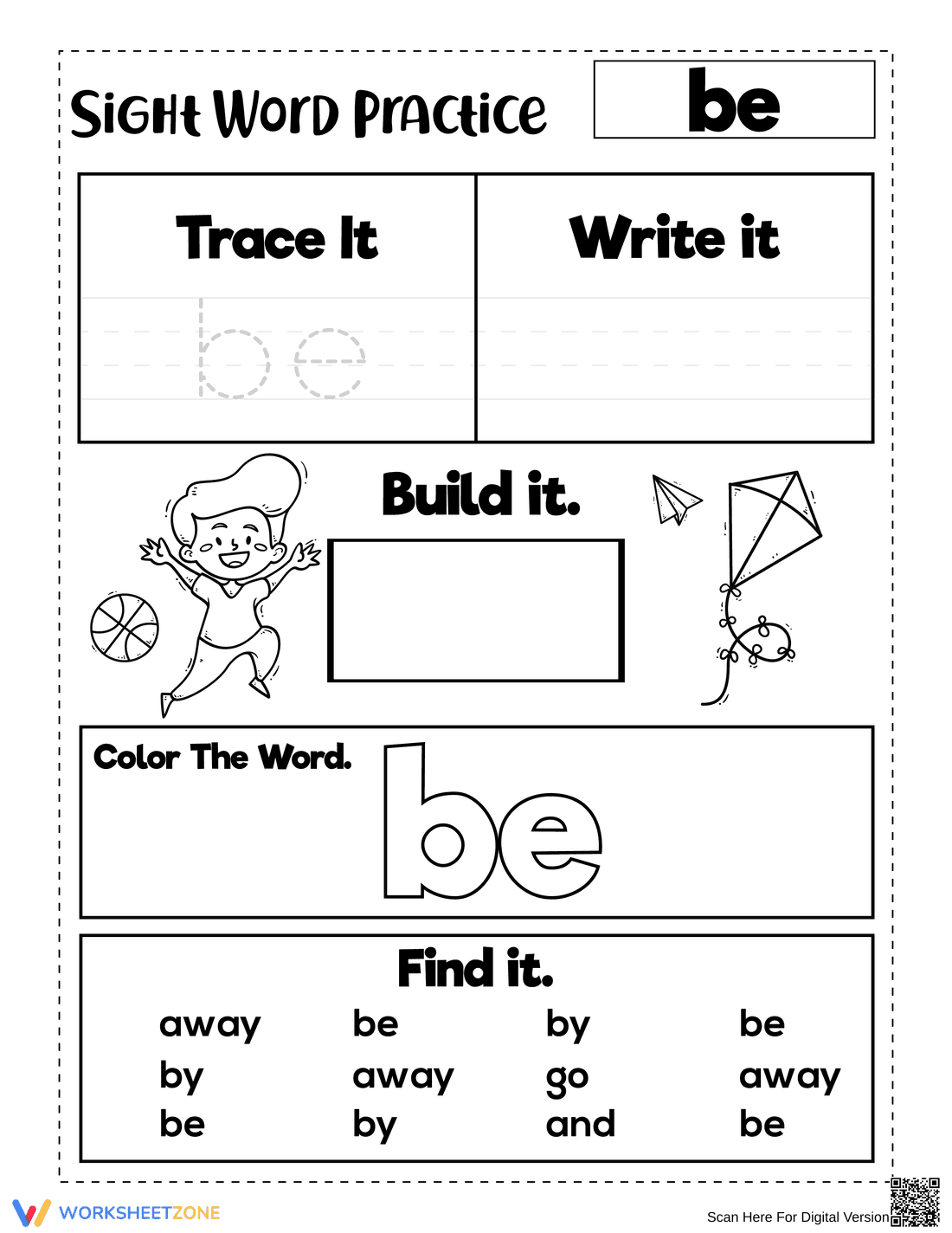
This single-page PDF features five distinct modalities for learning the word "be." It includes a "Trace It" section with guided dashed lines, a "Write It" box for independent production, a "Build It" area for tactile or letter-box construction, a large "Color The Word" graphic for visual engagement, and a "Find It" word bank for discrimination practice. The layout is clean and distraction-free, ensuring students stay focused on the target word.
The zero-prep workflow for this resource is designed for maximum efficiency in busy classrooms. Teachers can print the single-page PDF in less than 30 seconds. Distribution takes approximately 1 minute during transition periods. Reviewing the completed work is instantaneous, as the "Find It" section allows for a quick visual check of student accuracy. Total teacher preparation time is under 2 minutes, making it an ideal choice for sub plans or unexpected schedule changes.
This resource is specifically aligned to `CCSS.ELA-LITERACY.RF.K.3.C`, which requires students to read common high-frequency words by sight (e.g., the, of, to, you, she, my, is, are, do, does). By isolating the word "be," the worksheet ensures targeted mastery without overwhelming the learner. This standard code can be copied directly into lesson plans, IEP goals, or district curriculum mapping tools.
Use this worksheet as a "Morning Work" activity to settle students as they enter the classroom, providing a quiet, focused start to the day. Alternatively, place it in a literacy center after direct instruction on the "be" verb. During the "Find It" task, observe if students are scanning left-to-right, which serves as a formative assessment of their tracking skills. Completion typically takes 10 to 15 minutes depending on the student's fine motor speed.
This activity is ideal for Preschool, Kindergarten, and 1st-grade students who are beginning their journey with Dolch or Fry sight word lists. It is particularly effective for English Language Learners (ELLs) who benefit from the visual and repetitive nature of the tasks. Pair this with a high-frequency word anchor chart or a leveled reader featuring the word "be" to reinforce the skill in context.
Research from RAND AIRS 2024 emphasizes that multisensory engagement with high-frequency words significantly improves retention in early childhood literacy. This worksheet targets the sight word "be" through the CCSS.ELA-LITERACY.RF.K.3.C standard, which focuses on the automaticity of word recognition. By combining tracing, writing, and visual discrimination, the resource supports the orthographic mapping process essential for reading fluency. Studies indicate that students who master high-frequency words in Kindergarten are better prepared for the complex decoding tasks required in later grades. This resource provides the structured, repetitive exposure needed to move "be" into a student's permanent sight vocabulary. The inclusion of a "Find It" task specifically addresses visual scanning and discrimination, which are critical precursors to fluent sentence reading. Educators can rely on this evidence-based approach to supplement their core phonics and reading curriculum effectively.


