


























Views
Downloads
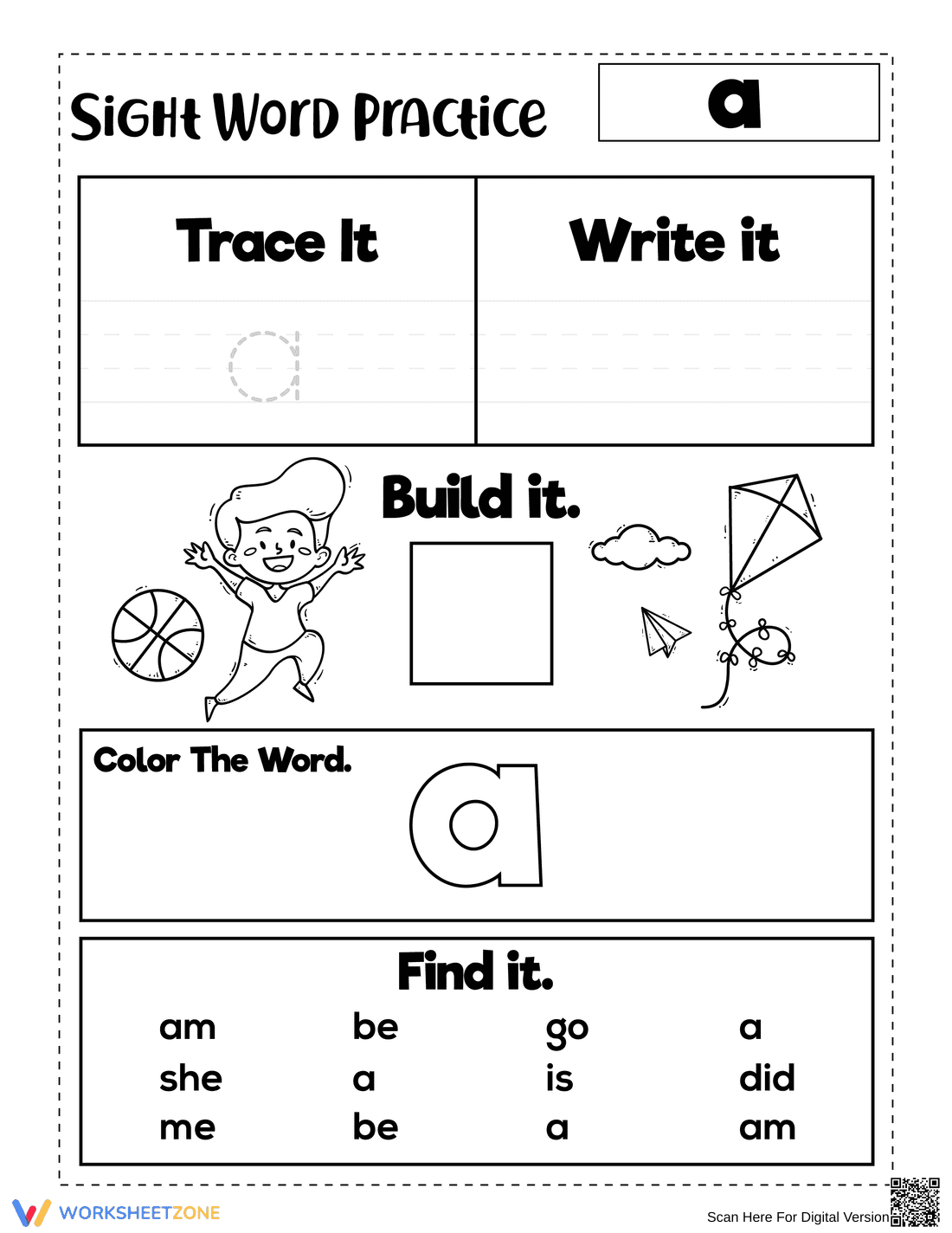

Sight Word "a" Worksheet | Grade K-1 Printable
Paste this activity's link or code into your existing LMS (Google Classroom, Canvas, Teams, Schoology, Moodle, etc.).
Students can open and work on the activity right away, with no student login required.
You'll still be able to track student progress and results from your teacher account.
This printable sight word "a" worksheet provides foundational literacy practice for early learners. By engaging with the word through multiple sensory modalities, students develop the automaticity required for fluent reading. This resource ensures young readers can identify, write, and locate this high-frequency word in various contexts, building the confidence necessary for early sentence construction and reading comprehension.
At a Glance
- Grade: Kindergarten · Subject: ELA
- Standard:
CCSS.ELA-LITERACY.RF.K.3.C— Read common high-frequency words by sight- Skill Focus: Sight word recognition and formation
- Format: 1 page · 5 tasks · Answer key included · PDF
- Best For: Morning work or literacy centers
- Time: 10–15 minutes
This comprehensive 1-page PDF features five distinct activities designed to reinforce word recognition. Students begin with "Trace It" and "Write It" sections to master letter formation. The "Build It" and "Color The Word" sections provide tactile and visual engagement, while the "Find It" word search grid challenges students to discriminate the target word from other common sight words like "am," "be," and "go."
Zero-Prep Workflow
- Print: Select the single-page PDF and print enough copies for your group (30 seconds).
- Distribute: Hand out the sheets during your literacy block or as a quiet transition activity (1 minute).
- Review: Briefly check the "Find It" section as a whole group to ensure visual discrimination accuracy (1 minute).
Total teacher preparation time is under 2 minutes, making this an ideal sub-plan or emergency filler for early childhood classrooms.
Standards Alignment
This resource is aligned to `CCSS.ELA-LITERACY.RF.K.3.C`, which requires students to read common high-frequency words by sight (e.g., the, of, to, you, she, my, is, are, do, does). It also supports foundational writing standards by encouraging correct letter orientation and spacing. Both standard codes can be copied directly into lesson plans, IEP goals, or district curriculum mapping tools.
How to Use It
Use this worksheet during the "You Do" phase of a gradual release lesson after introducing the word "a" on an anchor chart. It serves as an excellent formative assessment; observe students during the "Find It" task to identify those struggling with visual discrimination. Expected completion time ranges from 10 to 15 minutes depending on the student's fine motor proficiency.
Who It's For
This activity is tailored for preschool, kindergarten, and first-grade students who are beginning their reading journey. It is particularly effective for English Language Learners (ELLs) who benefit from repetitive, multi-sensory exposure to high-frequency vocabulary. Pair this worksheet with a simple decodable reader or a sight word "a" flashcard set for a complete instructional unit.
According to the RAND AIRS 2024 report on foundational literacy, multi-sensory engagement with high-frequency words is a critical component of early reading success. This worksheet targets CCSS.ELA-LITERACY.RF.K.3.C by requiring students to read common high-frequency words by sight through five distinct cognitive tasks. Research by Fisher & Frey (2014) emphasizes that "word work" which combines tracing, writing, and visual discrimination helps solidify orthographic mapping in the developing brain. By providing structured practice for the word "a," this resource helps bridge the gap between isolated letter recognition and fluent sentence reading. Educators can utilize this 1-page PDF to ensure that 100% of their students achieve mastery of this essential anchor word. The inclusion of a "Find It" discrimination task specifically addresses the need for students to distinguish similar-looking words, a key milestone identified in recent NAEP reading proficiency frameworks.


