


























Views
Downloads
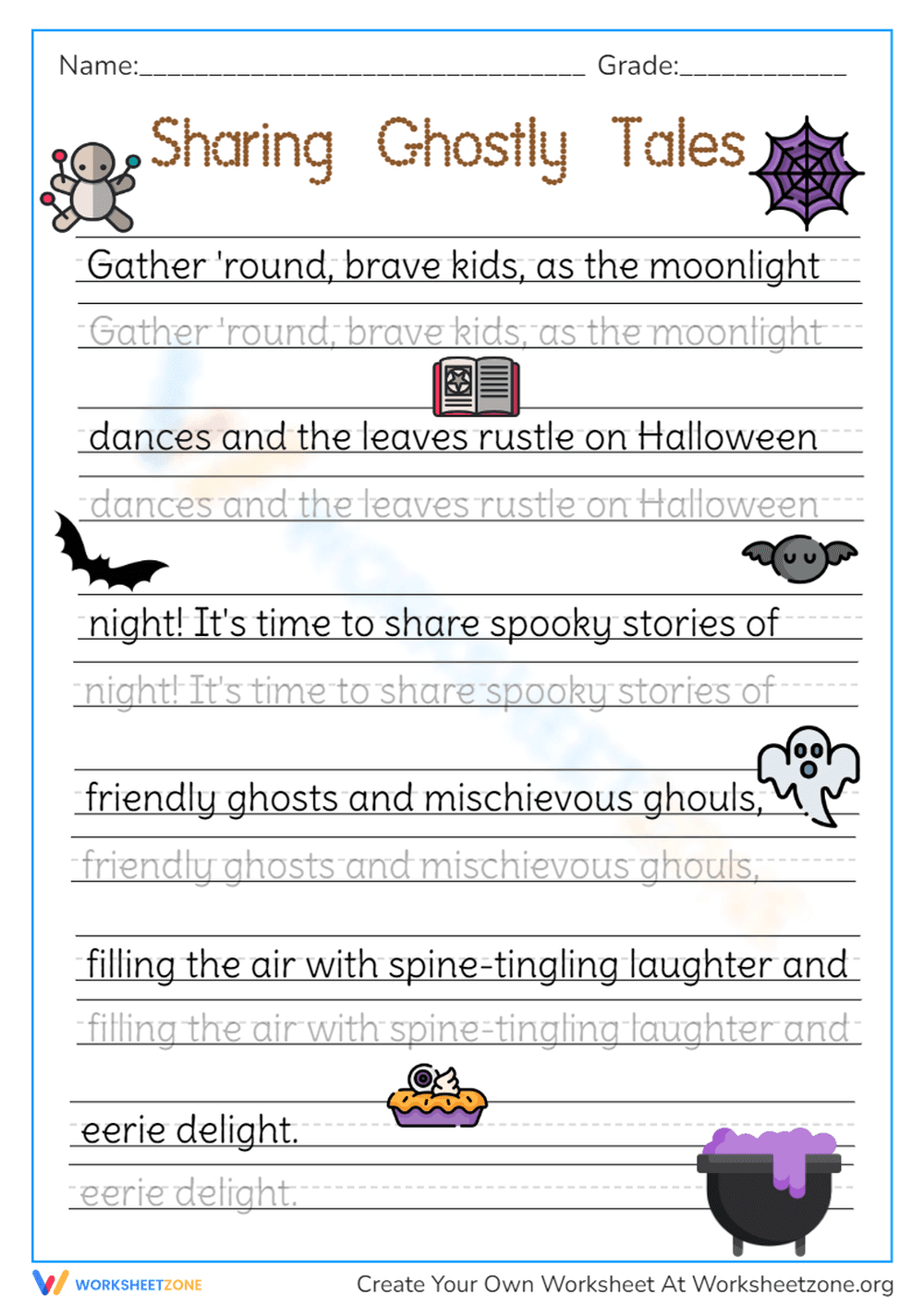

Handwriting Tracing Worksheet | Grade 1 Printable
Paste this activity's link or code into your existing LMS (Google Classroom, Canvas, Teams, Schoology, Moodle, etc.).
Students can open and work on the activity right away, with no student login required.
You'll still be able to track student progress and results from your teacher account.
This printable handwriting worksheet helps early learners practice proper letter formation and sentence spacing. Students trace a fun, Halloween-themed paragraph to build fine motor control and print legibility. The engaging text keeps young writers focused while they develop essential foundational literacy skills.
At a Glance
- Grade: 1 · Subject: English
- Standard:
CCSS.ELA-LITERACY.L.1.1.A— Print all upper- and lowercase letters- Skill Focus: Handwriting and tracing
- Format: 1 page · 5 tracing tasks · PDF
- Best For: Morning work or centers
- Time: 10–15 minutes
This single-page resource features a short, descriptive paragraph about a spooky but friendly Halloween night. The text is broken down into five manageable lines. Each line of solid black text is immediately followed by a dotted, light-gray version of the exact same sentence. Students trace over the dotted letters, using the solid text above as a visual guide for proper height, spacing, and alignment on the primary writing lines.
This resource is designed for immediate classroom implementation with absolutely no teacher setup required.
- Print (30 seconds): Generate the PDF and print a class set directly from your computer.
- Distribute (1 minute): Hand out the sheets along with sharpened pencils. No extra materials are needed.
- Review (30 seconds): Briefly remind students to trace carefully and stay on the dotted lines.
The entire preparation process takes under two minutes, making this an excellent option for emergency sub plans or quick morning work transitions.
This activity is aligned to CCSS.ELA-LITERACY.L.1.1.A, requiring students to print all upper- and lowercase letters accurately. By tracing complete sentences, learners also practice appropriate spacing between words and basic punctuation placement. Both standard codes can be copied directly into lesson plans, IEP goals, or district curriculum mapping tools.
Teachers can utilize this tracing activity as a calming morning work assignment as students arrive and settle into the classroom. It also serves as an effective independent literacy center station while the teacher conducts guided reading groups. As a formative assessment tip, observe students while they trace to ensure they are forming letters from top to bottom rather than bottom to top. Expect students to complete this task within a 10 to 15-minute timeframe.
This resource is primarily designed for kindergarten and first-grade students developing their fine motor skills and print legibility. It provides excellent scaffolding for learners who struggle with freehand writing and need the physical guide of dotted lines. Pair this worksheet with a read-aloud of a friendly ghost story to connect the handwriting practice to a broader literacy context.
Developing automaticity in handwriting is a critical component of early literacy that directly impacts future writing fluency and reading comprehension. When students practice to print all upper- and lowercase letters, as outlined in CCSS.ELA-LITERACY.L.1.1.A, they reduce the cognitive load required for basic transcription. This allows them to allocate more mental resources to idea generation and complex sentence construction in later grades. According to Fisher & Frey (2014), explicit instruction and repeated guided practice in foundational skills like letter formation are essential for building confident, capable writers. Tracing activities provide the necessary motor memory repetition in a low-stakes, highly supported format. By integrating thematic elements, such as this Halloween narrative, educators can maintain student engagement while delivering the rigorous, repetitive practice required for mastery of these essential physical writing skills.


