


























Views
Downloads
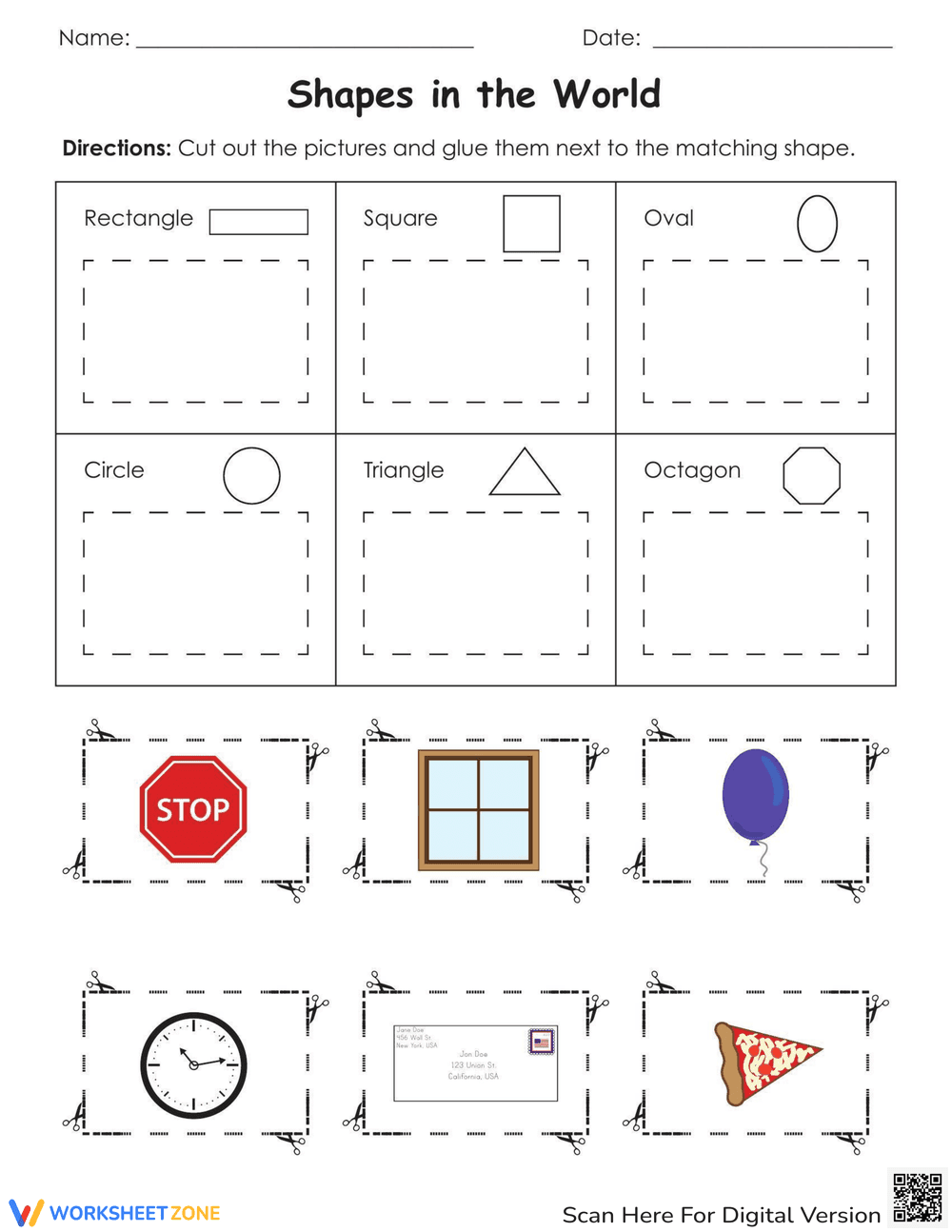

Kindergarten 2D Shapes — Printable No-Prep Worksheet
Paste this activity's link or code into your existing LMS (Google Classroom, Canvas, Teams, Schoology, Moodle, etc.).
Students can open and work on the activity right away, with no student login required.
You'll still be able to track student progress and results from your teacher account.
This printable geometry worksheet helps kindergarten and first-grade students identify and classify two-dimensional shapes in everyday objects. By matching real-world items like clocks and stop signs to geometric categories, learners build essential spatial reasoning skills and connect abstract math concepts to their daily environment.
At a Glance
- Grade: Kindergarten · Subject: Math
- Standard:
K.G.A.2— Correctly name shapes regardless of their orientations or overall size- Skill Focus: 2D shape identification in real-world objects
- Format: 1 printable page · 6 cut-and-paste problems · Answer key included · PDF format
- Best For: Independent practice, math centers, or morning work
- Time: 10–15 minutes
This one-page activity features six sorting boxes labeled with geometric names: rectangle, square, oval, circle, triangle, and octagon. Each box displays a shape drawing as a visual anchor. Students cut out six real-world illustrations at the bottom—including a clock, pizza slice, and stop sign—and glue them into the correct boxes. An answer key is included.
Zero-Prep Classroom Workflow
This activity requires under two minutes of teacher preparation. First, print the single-page PDF for each student. Next, distribute the sheets with scissors and glue, allowing students to work independently for ten to fifteen minutes. Finally, review completed sheets as a group or use the included answer key for rapid assessment. This layout is perfect for emergency sub plans.
Standards Alignment
This activity aligns with Common Core standard K.G.A.2, requiring students to name shapes regardless of orientation or size. It also supports standard K.G.A.1 by describing environmental objects using shape names. Both standard codes can be copied directly into lesson plans, IEP goals, or district curriculum mapping tools.
How to Use It
Use this worksheet as a formative assessment after direct instruction on shapes. Observe whether students correctly identify the octagonal stop sign or confuse the oval balloon with the circular clock. Alternatively, assign this activity as morning work or a math center task. Students typically complete the cutting and gluing within ten to fifteen minutes.
Who It's For
This worksheet is designed for kindergarteners learning geometry, but serves as a review for first graders. For students needing support, pair this activity with concrete classroom manipulatives. Challenge advanced learners to label the number of sides and vertices on each cut-out shape before gluing them down.
This early geometry resource targets the core kindergarten skill of identifying two-dimensional shapes in real-world contexts, directly supporting the Common Core State Standard K.G.A.2. According to the Fisher & Frey (2014) framework for gradual release of responsibility, tactile sorting activities bridge the gap between guided instruction and independent mastery. By physically manipulating and categorizing everyday objects like clocks, envelopes, and stop signs, young learners develop spatial reasoning and visual discrimination. Research indicates that connecting abstract geometric concepts to familiar environmental objects enhances long-term retention and mathematical vocabulary acquisition in early childhood education. This structured, one-page cut-and-paste worksheet provides teachers with an efficient tool to assess student understanding of shape attributes, ensuring all learners meet foundational geometry benchmarks before progressing to complex spatial tasks. This resource serves as a reliable diagnostic tool for identifying misconceptions in shape recognition.


