


























Views
Downloads

Essential Possessive Pronouns Worksheet | Grades 2-4
Paste this activity's link or code into your existing LMS (Google Classroom, Canvas, Teams, Schoology, Moodle, etc.).
Students can open and work on the activity right away, with no student login required.
You'll still be able to track student progress and results from your teacher account.
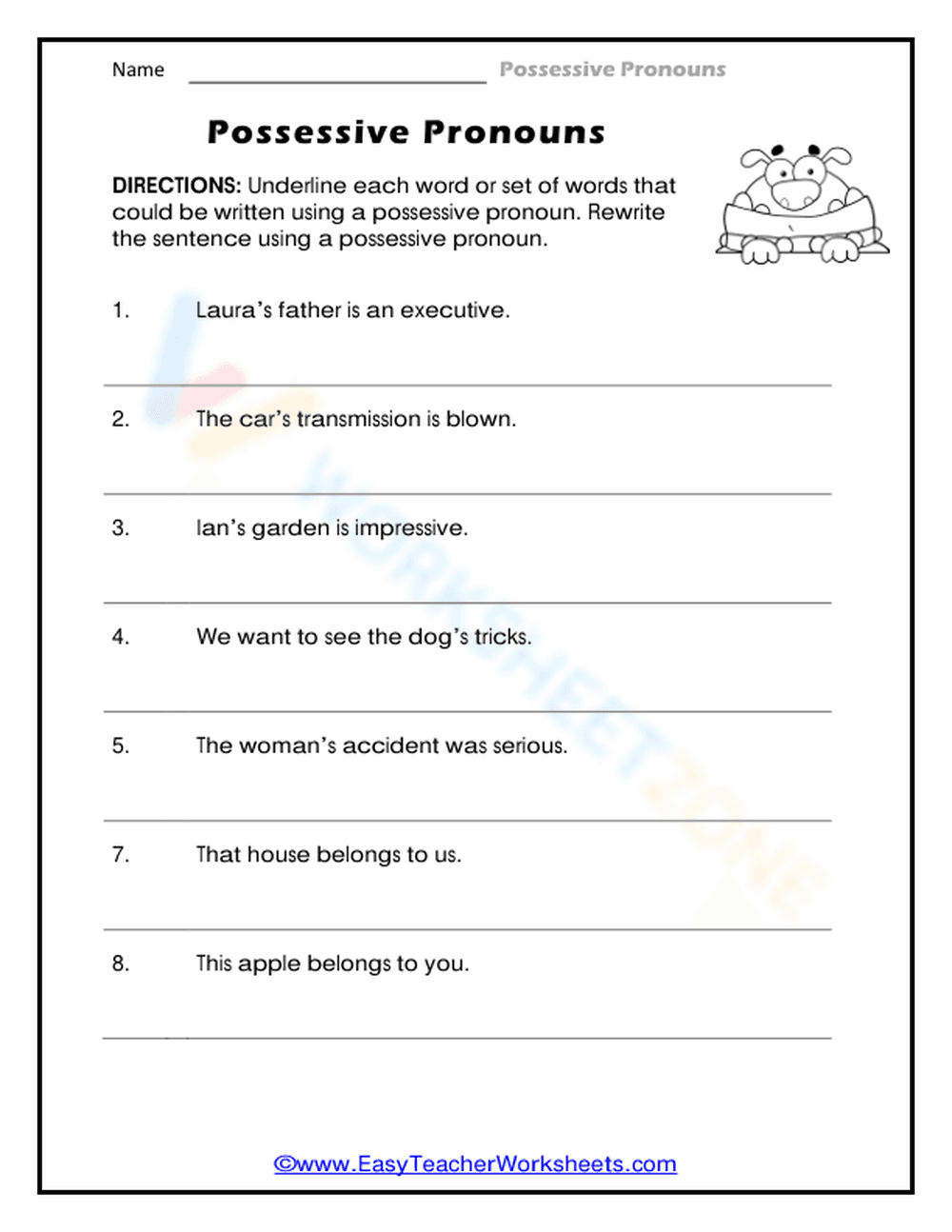
This possessive pronouns worksheet helps students in grades 2-4 master the art of replacing repetitive nouns with concise pronouns. By identifying possessive relationships in sentences and rewriting them, learners build grammatical fluency and improve sentence variety. This resource provides clear, direct practice that transforms abstract grammar rules into tangible writing skills for elementary students.
At a Glance
- Grade: 2-4 · Subject: English Language Arts
- Standard:
CCSS.ELA-LITERACY.L.1.1.D— Use personal, possessive, and indefinite pronouns in sentences correctly- Skill Focus: Possessive Pronouns
- Format: 1 page · 7 problems · Answer key included · PDF
- Best For: Independent grammar practice and homework
- Time: 10–15 minutes
Inside this single-page PDF, you will find a focused set of seven sentence-transformation tasks. Each task requires students to underline a possessive noun or phrase and then rewrite the entire sentence using the correct possessive pronoun. The layout is clean and spacious, featuring a friendly cartoon character to keep students engaged, and includes a full answer key for rapid grading.
The zero-prep workflow for this resource is designed for maximum efficiency. First, print the single-page worksheet for your entire class in under 1 minute. Second, distribute the copies (1 minute) and provide a brief overview of possessive pronouns. Finally, review the completed work using the included answer key in under 2 minutes. With a total teacher prep time of less than 2 minutes, this is perfect for emergency sub plans.
This resource is directly aligned with CCSS.ELA-LITERACY.L.1.1.D, which requires students to use personal, possessive, and indefinite pronouns. It also supports higher-grade standards involving sentence structure and clarity. By focusing on the mechanics of possessives, the worksheet ensures students meet foundational language requirements. This standard code can be copied directly into lesson plans, IEP goals, or district curriculum mapping tools.
Use this worksheet as a formative assessment after an introductory lesson on pronouns. As students work through the seven sentences (10–15 minutes total), walk around and observe if they correctly identify the gender and number of the original subject to choose the appropriate pronoun; this provides an immediate window into their logical reasoning. It also serves as an excellent "do-now" activity at the start of a writing workshop.
This practice sheet is designed for elementary students in grades 2, 3, and 4 who are developing their core grammar skills. It is particularly helpful for English Language Learners (ELLs) who need structured repetition to understand pronoun-antecedent agreement. Pair this resource with a possessive pronouns anchor chart or a short reading passage to see these skills applied in a broader literary context.
Effective grammar instruction relies on the gradual release of responsibility, moving from identification to application. According to Fisher & Frey (2014), structured practice with specific language conventions like CCSS.ELA-LITERACY.L.1.1.D is essential for developing writing stamina in elementary learners. This worksheet addresses possessive pronouns by requiring students to actively transform sentences, a method proven to increase retention compared to simple multiple-choice exercises. Research from the RAND AIRS 2024 report suggests that targeted, single-page grammar interventions help reduce cognitive load, allowing students to focus on one specific skill until mastery is achieved. By isolating possessive pronoun usage, teachers provide the support needed for complex sentence construction. This tool ensures that students can accurately substitute pronouns for possessive nouns, a critical step toward more sophisticated academic writing in later grades.


