


























Views
Downloads

Sentence Unscramble Worksheet | Grade 3 ELA Printable
Paste this activity's link or code into your existing LMS (Google Classroom, Canvas, Teams, Schoology, Moodle, etc.).
Students can open and work on the activity right away, with no student login required.
You'll still be able to track student progress and results from your teacher account.
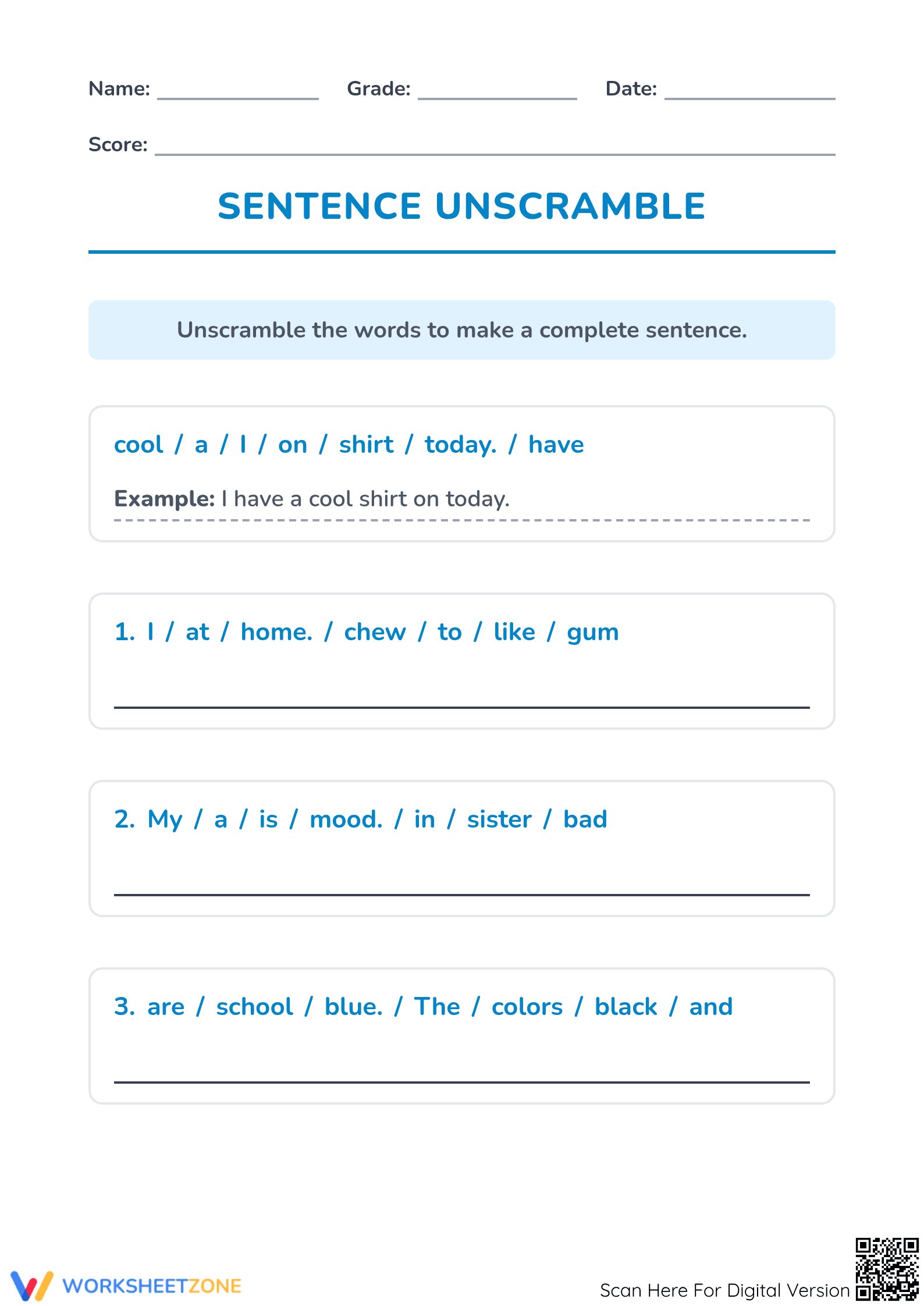
This sentence unscramble worksheet provides targeted practice for third graders developing their understanding of syntax and sentence structure. By rearranging jumbled words into logical, grammatically correct statements, students strengthen their foundational writing skills while simultaneously reinforcing their recognition of common "oo" spelling patterns in context.
At a Glance
- Grade: 3 · Subject: ELA
- Standard:
CCSS.ELA-LITERACY.L.3.1— Produce simple, compound, and complex sentences.- Skill Focus: Sentence Structure and Syntax
- Format: 2 pages · 7 problems · Answer key included · PDF
- Best For: Independent practice and literacy centers
- Time: 10–15 minutes
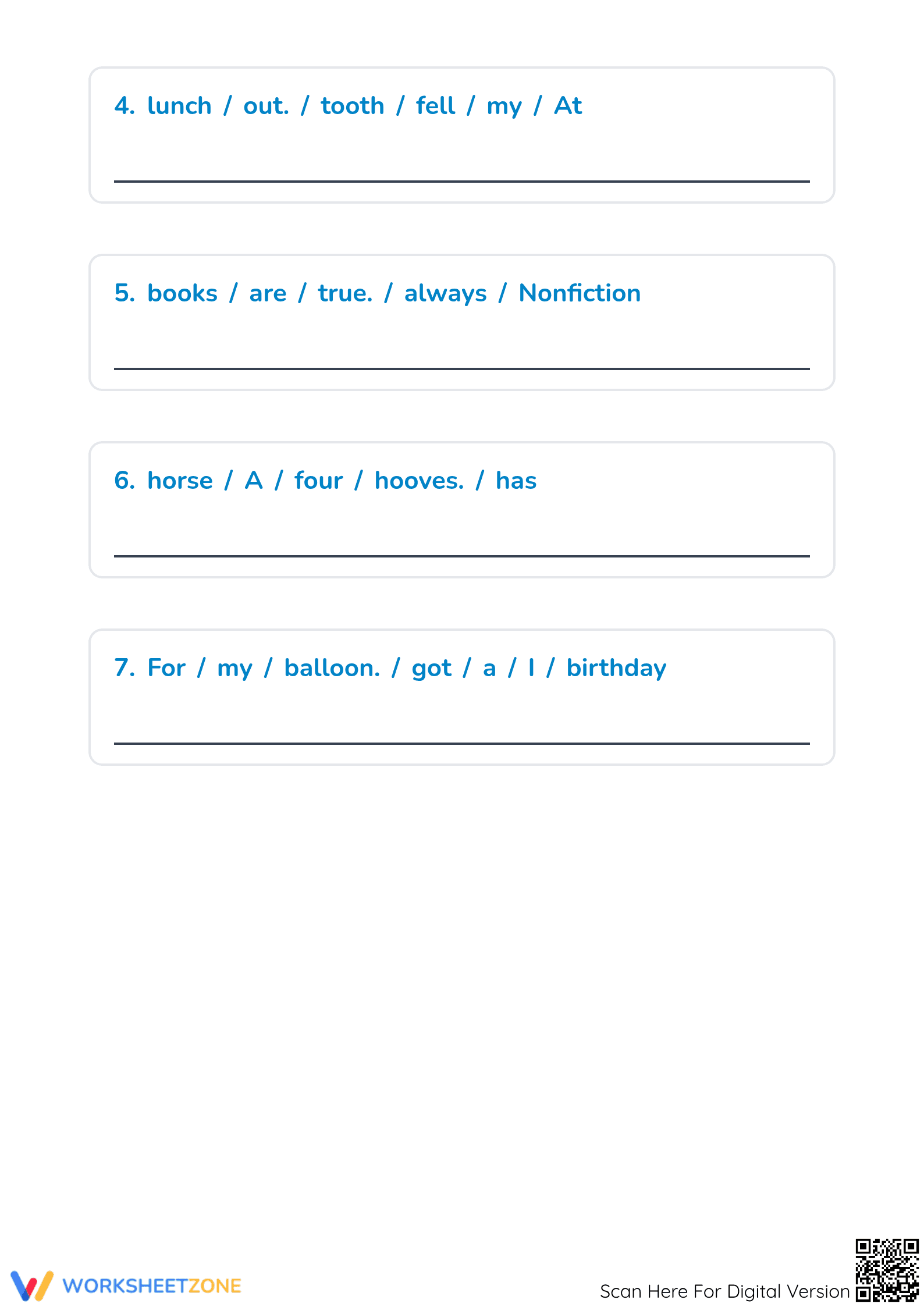
This resource features two pages of focused syntax exercises. Students are presented with a clear, worked example followed by seven distinct sentence-building tasks. Each problem provides a set of scrambled words, many featuring the "oo" vowel team, which learners must sequence correctly on the provided writing lines. A complete answer key is included to support quick grading or peer review.
This activity follows a structured approach to building sentence-level competence:
- Guided practice: The worksheet opens with a fully worked example, demonstrating exactly how to transform a fragmented list of words into a coherent thought.
- Supported practice: The first few problems use shorter, highly familiar vocabulary words to build student confidence with basic subject-verb-object structures.
- Independent practice: Later problems introduce slightly longer phrases and varied punctuation, challenging students to apply their syntax knowledge independently.
This gradual-release model ensures students understand the expectations before tackling the core I Do, We Do, You Do progression.
This resource is aligned to CCSS.ELA-LITERACY.L.3.1, which requires students to demonstrate command of the conventions of standard English grammar and usage when writing or speaking. It also supports spelling and vocabulary development by integrating specific vowel teams into the sentence contexts. Both standard codes can be copied directly into lesson plans, IEP goals, or district curriculum mapping tools.
Deploy this worksheet during morning work routines to activate students' grammatical thinking before a main writing block. It also serves as an excellent literacy center activity where students can physically write out the sentences after manipulating word cards. As a formative assessment tip, observe whether students naturally look for the capitalized word to start their sentence and the punctuation mark to end it. Expect most third graders to complete this activity within 10 to 15 minutes.
This activity is designed for third-grade general education students, but it is highly effective for English Language Learners (ELLs) who need explicit practice with English word order. For differentiation, teachers can highlight the capitalized word and punctuation mark for students needing extra scaffolding. Pair this worksheet with a direct instruction lesson on sentence types or a phonics anchor chart focusing on the "oo" sound.
Mastering syntax through activities like unscrambling sentences is a critical component of early literacy development. When students practice CCSS.ELA-LITERACY.L.3.1 to produce simple, compound, and complex sentences, they build the cognitive pathways necessary for fluent reading and writing. According to Fisher & Frey (2014), explicit instruction and repeated practice with sentence-level construction significantly improve students' overall reading comprehension and written expression. By manipulating word order, learners internalize grammatical rules rather than just memorizing them. This targeted practice helps bridge the gap between isolated phonics knowledge and practical application in connected text. Providing structured opportunities to sequence words correctly ensures that students develop the automaticity required for higher-order writing tasks in later grades, making this foundational syntax work essential for long-term academic success.


