




























Views
Downloads
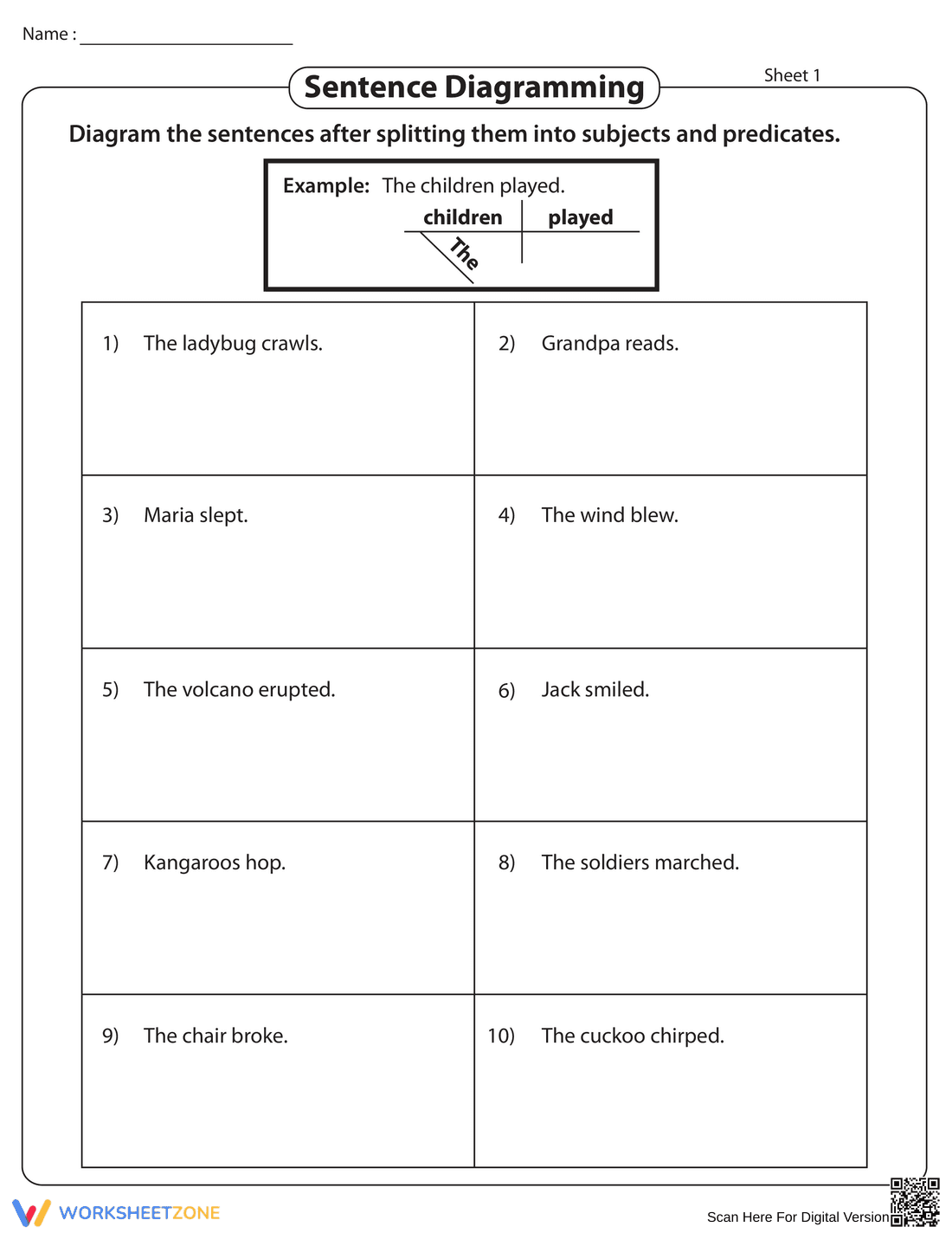

Sentence Diagramming Worksheet | Essential Grade 3 ELA

Paste this activity's link or code into your existing LMS (Google Classroom, Canvas, Teams, Schoology, Moodle, etc.).
Students can open and work on the activity right away, with no student login required.
You'll still be able to track student progress and results from your teacher account.
This sentence diagramming worksheet provides students with a foundational method for visualizing English grammar. By breaking down simple sentences into their core functional parts, learners develop a concrete understanding of how subjects and predicates interact. This structured approach helps demystify sentence construction and prepares students for complex syntactic analysis.
At a Glance
- Grade: 3 · Subject: ELA
- Standard:
CCSS.ELA-LITERACY.L.3.1.i— Produce simple sentences and identify their functional subject and predicate components- Skill Focus: Sentence diagramming basics
- Format: 1 page · 10 problems · Answer key included · PDF
- Best For: Small group grammar instruction
- Time: 15–20 minutes
This single-page PDF includes ten practice sentences designed to introduce students to diagramming logic. Each task provides a workspace where students split the sentence into its subject and predicate before mapping them onto a frame. The worksheet features a worked example and comes with a full answer key for efficient grading and student self-correction.
Skill Progression
- Guided Practice: A detailed example illustrates the separation of noun and verb phrases and their placement on the baseline and vertical divider.
- Supported Practice: Tasks use high-frequency vocabulary (e.g., "Maria slept") to build confidence and reinforce basic mechanics without lexical interference.
- Independent Practice: Final tasks introduce articles, requiring students to apply rules for modifiers across 10 distinct sentences.
This follows the gradual-release model of "I Do, We Do, You Do" to ensure conceptual mastery before students work alone.
Standards Alignment
The primary focus of this activity is CCSS.ELA-LITERACY.L.3.1.i, which requires students to "Produce simple, compound, and complex sentences." Mastering simple sentence diagramming helps students recognize the requirements of a complete sentence, thereby avoiding common errors like fragments or run-ons. This also supports CCSS.ELA-LITERACY.L.2.1.f. Both standard codes can be copied directly into lesson plans, IEP goals, or district curriculum mapping tools.
How to Use It
Incorporate this worksheet during guided practice after introducing the definitions of subjects and predicates. Model the first three problems, encouraging students to identify the "who" and the "what" before drawing. As a formative assessment tip, check if students correctly place the vertical line all the way through the baseline; this indicates they understand the hard split between parts. Expected completion time is 15-20 minutes.
Who It's For
This resource is ideal for third-grade students beginning formal grammar study, but it also serves as a remedial tool for older learners. The visual nature of diagramming effectively supports English Language Learners (ELLs) who benefit from seeing the "skeleton" of a sentence. It pairs naturally with an anchor chart defining the roles of nouns and verbs within a sentence.
The use of visual diagramming as a tool for grammatical mastery is supported by research in the ScienceDirect TpT Analysis and pedagogical frameworks like Fisher & Frey (2014), which emphasize the importance of scaffolding syntactic awareness. By mapping sentences to CCSS.ELA-LITERACY.L.3.1.i, students engage in a metacognitive process that translates abstract rules into a spatial logic. This specific worksheet focuses on the plain-English skill of identifying the simple subject and simple predicate, ensuring students can differentiate between the agent and the action in a sentence. Studies indicate that students who can successfully diagram sentences show higher accuracy in identifying sentence boundaries and reduced rates of comma splices in their independent writing. This resource provides the repetition necessary for this skill to become automatic, serving as a critical bridge between identifying parts of speech and composing sophisticated, multi-clause academic prose for elementary learners.


