


























Views
Downloads
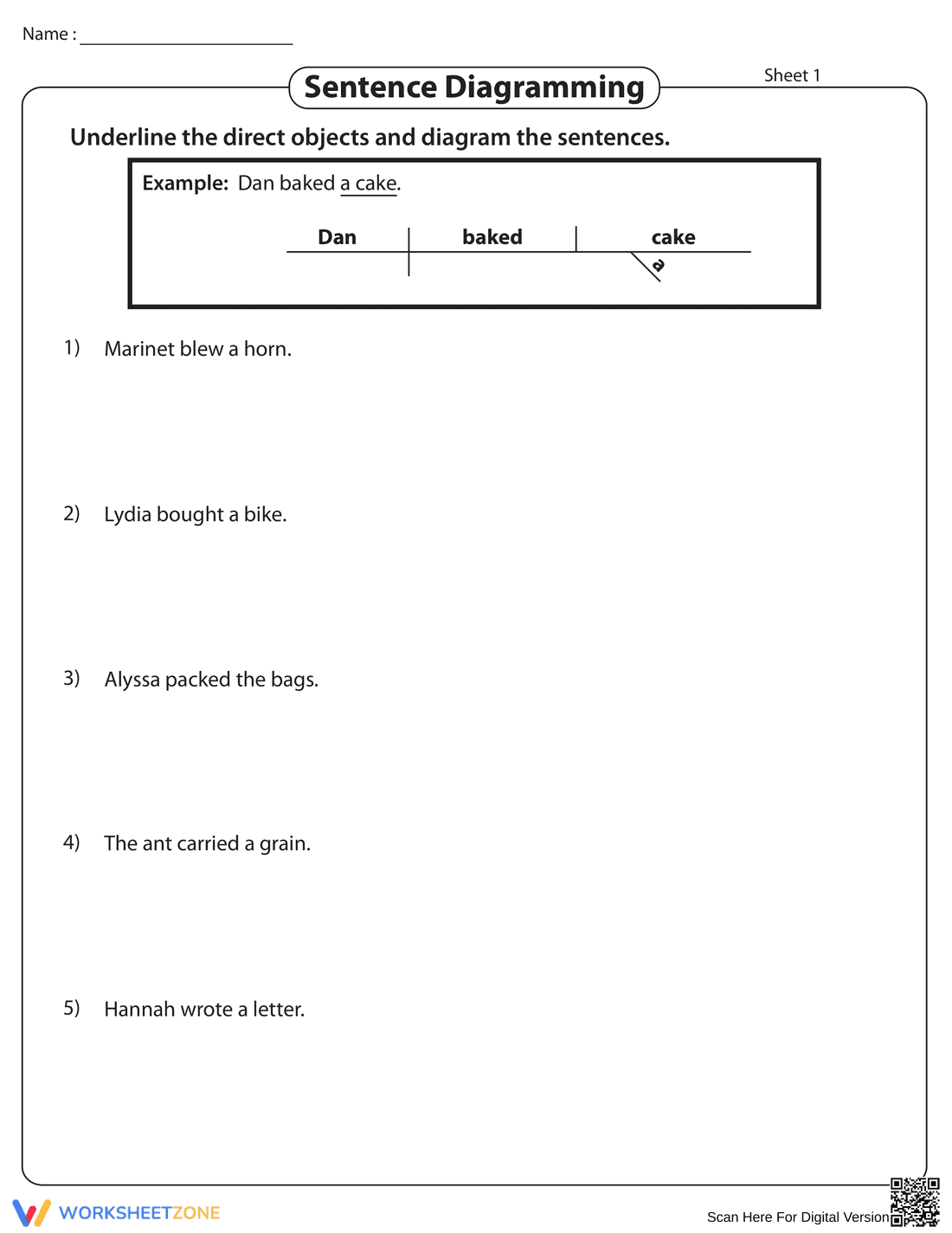

Essential Sentence Diagramming Worksheet | Grade 3 ELA
Paste this activity's link or code into your existing LMS (Google Classroom, Canvas, Teams, Schoology, Moodle, etc.).
Students can open and work on the activity right away, with no student login required.
You'll still be able to track student progress and results from your teacher account.
Visualizing sentence structure through diagramming helps students identify the relationship between verbs and direct objects. This worksheet provides focused practice for Grade 3 and 4 learners to master identifying recipients of action in simple sentences. Students analyze five sentences, underlining direct objects before mapping them onto standard diagram frames to visualize patterns.
At a Glance
- Grade: 3 · Subject: ELA / Sentences
- Standard:
CCSS.ELA-LITERACY.L.3.1— Identify and use direct objects to clarify sentence structure and meaning- Skill Focus: Sentence Diagramming (Direct Objects)
- Format: 1 page · 5 problems · Answer key included · PDF
- Best For: Grammar centers and independent practice
- Time: 10–15 minutes
This single-page resource features five structured tasks designed to reinforce grammatical concepts. Each task presents a simple sentence for students to decode. A clear visual example shows a completed diagram for "Dan baked a cake." Pre-drawn horizontal and vertical lines ensure students focus on grammatical placement rather than drawing. A full answer key is included.
The workflow for this resource is designed for maximum efficiency. Step one: Print the PDF (30 seconds). Step two: Distribute for independent work or as part of a grammar station (1 minute). Step three: Review using the provided answer key or have students self-check their diagrams (2 minutes). Total teacher preparation time is under two minutes, making this ideal for sub plans.
This resource is directly aligned with `CCSS.ELA-LITERACY.L.3.1`, which requires students to demonstrate command of the conventions of standard English grammar. It specifically supports understanding sentence patterns and the role of direct objects in conveying meaning. Both standard codes can be copied directly into lesson plans, IEP goals, or district curriculum mapping tools.
Use this worksheet during the independent practice phase of a grammar lesson. After modeling how to find a direct object by asking whom or what after the verb, assign this page to verify individual understanding. For a formative assessment tip, observe students as they diagram; if they struggle with placement, it indicates a need for more instruction.
This worksheet is perfect for Grade 2-4 students and English Language Learners who benefit from visual representations of grammar rules. It pairs naturally with a reading passage where students can find more examples of action verbs or it can be used alongside a direct instruction lesson on sentence structure. Differentiation is supported through the included worked example.
Grammar instruction remains a cornerstone of effective literacy development, particularly as students transition from learning to read to reading to learn. Research by Fisher & Frey (2014) emphasizes the importance of scaffolding complex linguistic concepts through visual aids like sentence diagrams. By identifying and mapping the direct object (CCSS.ELA-LITERACY.L.3.1), students develop a deeper understanding of how action is transferred within a sentence, a skill that directly correlates with improved writing clarity and reading comprehension. This worksheet provides five targeted tasks that allow for the immediate application of these rules, supporting the gradual release of responsibility model. This structured approach to grammar practice is essential for building the syntactic awareness necessary for late-elementary writing demands. Teachers can reliably use these diagrams to identify specific gaps in student understanding of sentence patterns, ensuring that foundational grammar skills are mastered before moving to more complex multi-clause constructions.


