


























Views
Downloads
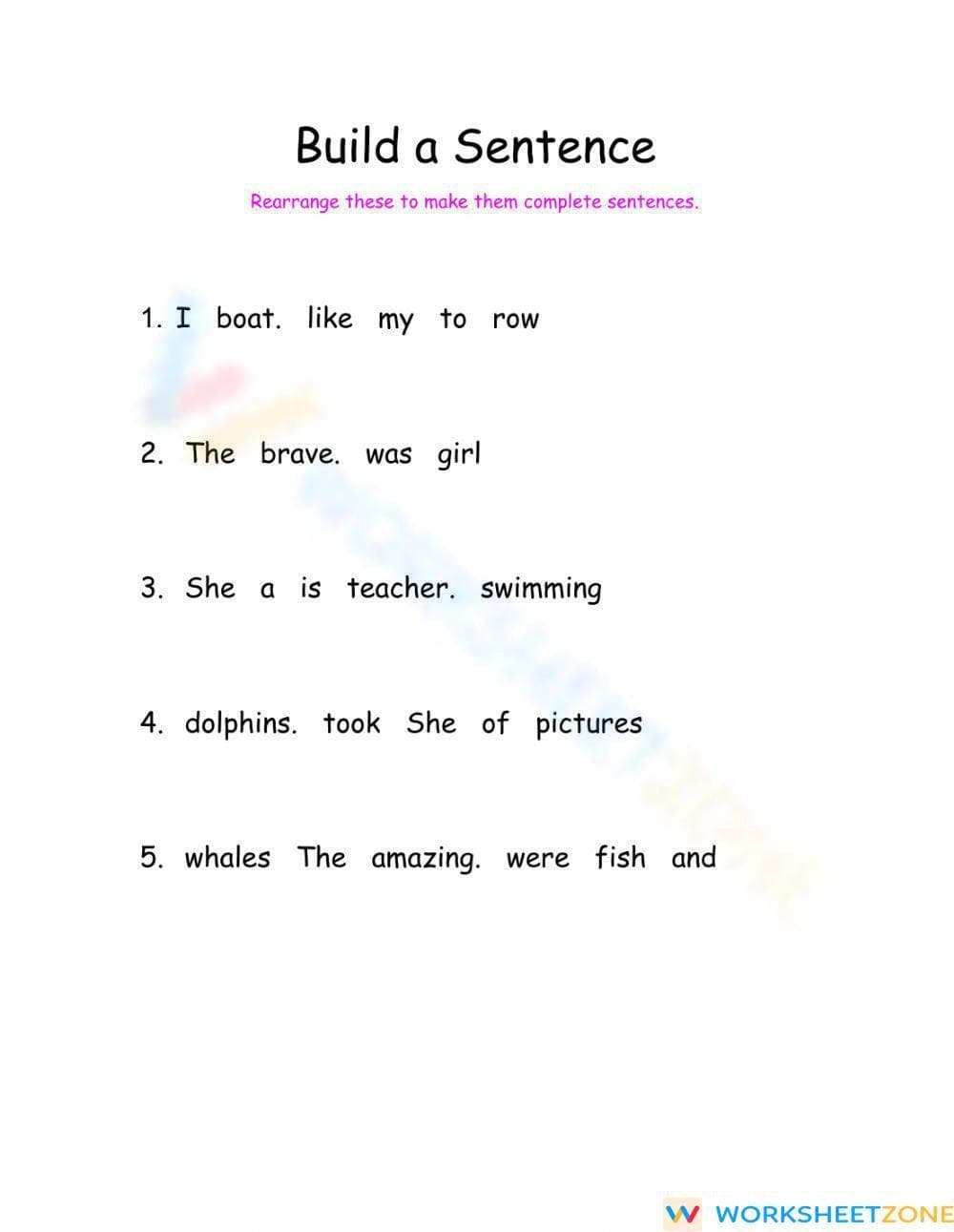

Printable Sentence Building Practice | Grade 2-5 ELA
Paste this activity's link or code into your existing LMS (Google Classroom, Canvas, Teams, Schoology, Moodle, etc.).
Students can open and work on the activity right away, with no student login required.
You'll still be able to track student progress and results from your teacher account.
This Sentence Building worksheet is an essential resource for Grade 2 through 5 students to master syntax and grammar. By rearranging scrambled words into coherent sentences, learners develop a practical understanding of word order. This activity strengthens reading comprehension and writing clarity through focused, hands-on practice, helping students bridge the gap between simple vocabulary and sophisticated academic expression.
At a Glance
- Grade: 2-5 · Subject: English Language Arts (ELA)
- Standard:
CCSS.ELA-LITERACY.L.2.1.F— Produce, expand, and rearrange complete simple and compound sentences- Skill Focus: Sentence Construction and Word Order
- Format: 1 page · 5 problems · Answer key included · PDF
- Best For: Grammar warm-ups and literacy centers
- Time: 10–15 minutes
What's Inside
Inside this printable worksheet, you will find a structured one-page layout featuring five specific sentence-building tasks. Each task presents a jumbled set of words that students must rearrange to form a grammatically correct sentence. The clean design ensures students stay focused on the challenge, making it a reliable tool for assessment. A full answer key is included.
Zero-Prep Workflow
The workflow is designed for maximum efficiency. Step one: Print the single-page PDF in under thirty seconds. Step two: Distribute the worksheets during your literacy block or as a quick morning starter. Step three: Review sentences as a class to provide immediate feedback. Total teacher preparation time is under two minutes, making it a perfect emergency sub plan or last-minute enrichment activity.
Standards Alignment
This worksheet is aligned to CCSS.ELA-LITERACY.L.2.1.F, which requires students to "Produce, expand, and rearrange complete simple and compound sentences." By engaging with scrambled sentences, students apply their knowledge of subject-verb-object patterns to achieve clarity. This standard code can be copied directly into lesson plans or IEP goals to ensure compliance and simplify the progress monitoring process.
How to Use It
Use this worksheet as a formative assessment after direct instruction on sentence types. It is effective during the "Independent Practice" phase of a gradual release model. Teachers should observe students as they work, noting common errors in verb placement as a quick formative check. The expected completion time of fifteen minutes fits easily into a crowded ELA schedule or rotation.
Who It's For
This resource is ideal for elementary students in Grades 2-5 solidifying their understanding of English sentence mechanics. It serves as an excellent differentiation tool for English Language Learners (ELLs) who need explicit practice with syntax. Pair this worksheet with an anchor chart on sentence parts to provide a comprehensive learning experience for all students in your classroom.
Mastering the ability to rearrange and produce complete sentences is a critical milestone in early literacy development. Research from RAND AIRS 2024 emphasizes that structured, repetitive practice with syntax significantly improves overall writing quality and syntactic awareness in elementary learners. By engaging with these five targeted tasks, students internalize the rhythmic and logical patterns of the English language, which reduces the cognitive load during independent drafting and creative writing. This worksheet provides a clear, evidence-based pathway for students to demonstrate mastery of CCSS.ELA-LITERACY.L.2.1.F while building the confidence needed for more complex academic writing. The focus on rearrangement specifically challenges students to think critically about how word choice affects meaning and clarity, a skill that translates directly to better reading comprehension across all subjects. By deconstructing sentences, students develop a deeper appreciation for language mechanics, ensuring they are prepared for the increasing demands of upper-elementary writing assignments. This resource serves as a foundational step toward achieving academic success.


