




























Views
Downloads

Essential Segment & Angle Addition Postulate Worksheet

Paste this activity's link or code into your existing LMS (Google Classroom, Canvas, Teams, Schoology, Moodle, etc.).
Students can open and work on the activity right away, with no student login required.
You'll still be able to track student progress and results from your teacher account.
This comprehensive geometry resource bridges basic geometric definitions with algebraic application. Focusing on Segment and Angle Addition Postulates, it helps middle school students develop logical frameworks for high school proofs. Students progress from simple numeric missing-length calculations to complex multi-step algebraic equations, fostering a deep understanding of part-whole relationships.
At a Glance
- Grade: 7–8 · Subject: Geometry
- Standard:
CCSS.MATH.CONTENT.7.G.B.5— Use angle relationships and equations to solve for unknown values in geometric figures- Skill Focus: Segment and Angle Addition Postulates
- Format: 3 pages · 20 problems · Answer key included · PDF
- Best For: Homework, assessments, or guided geometry practice
- Time: 30–45 minutes
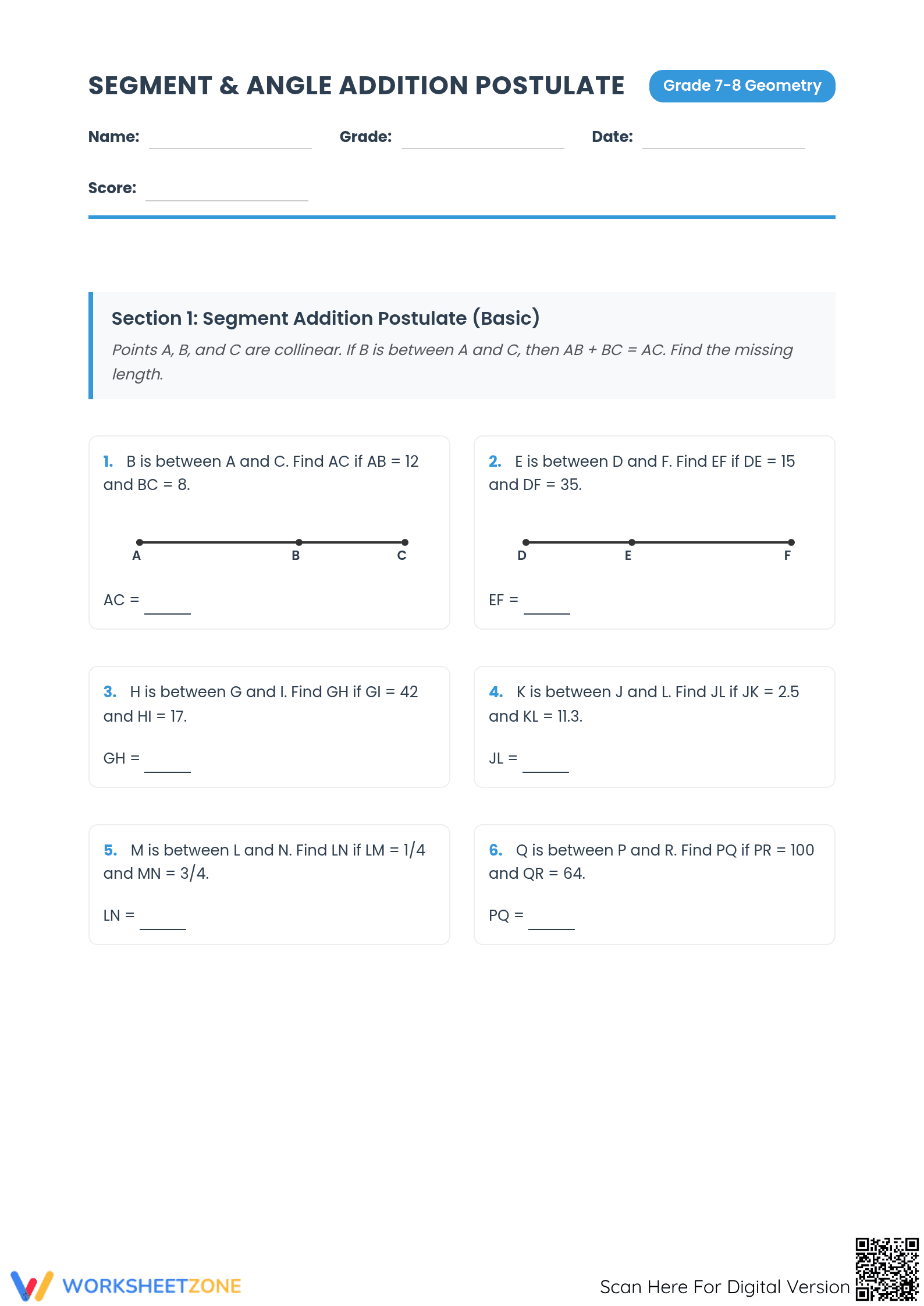
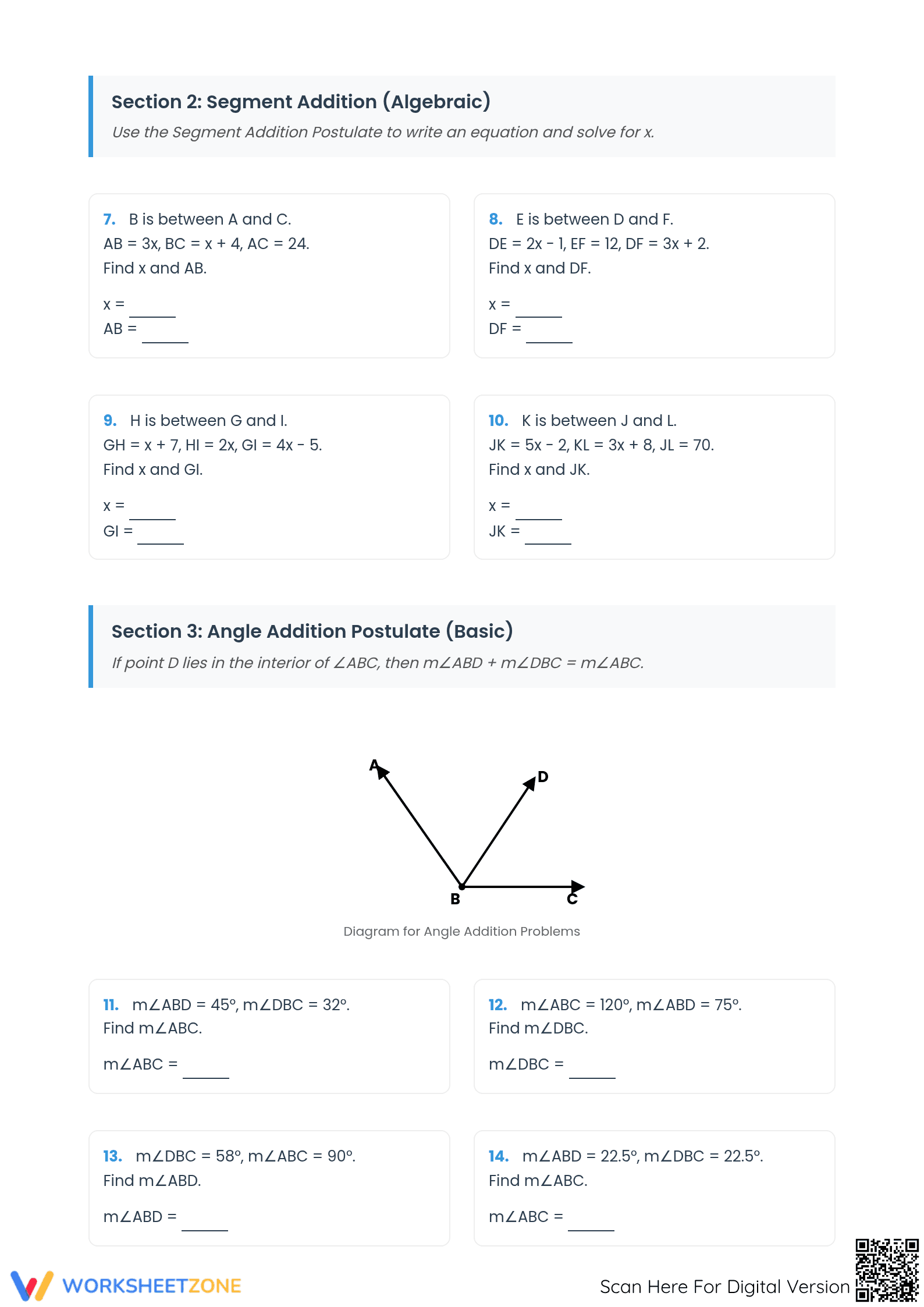
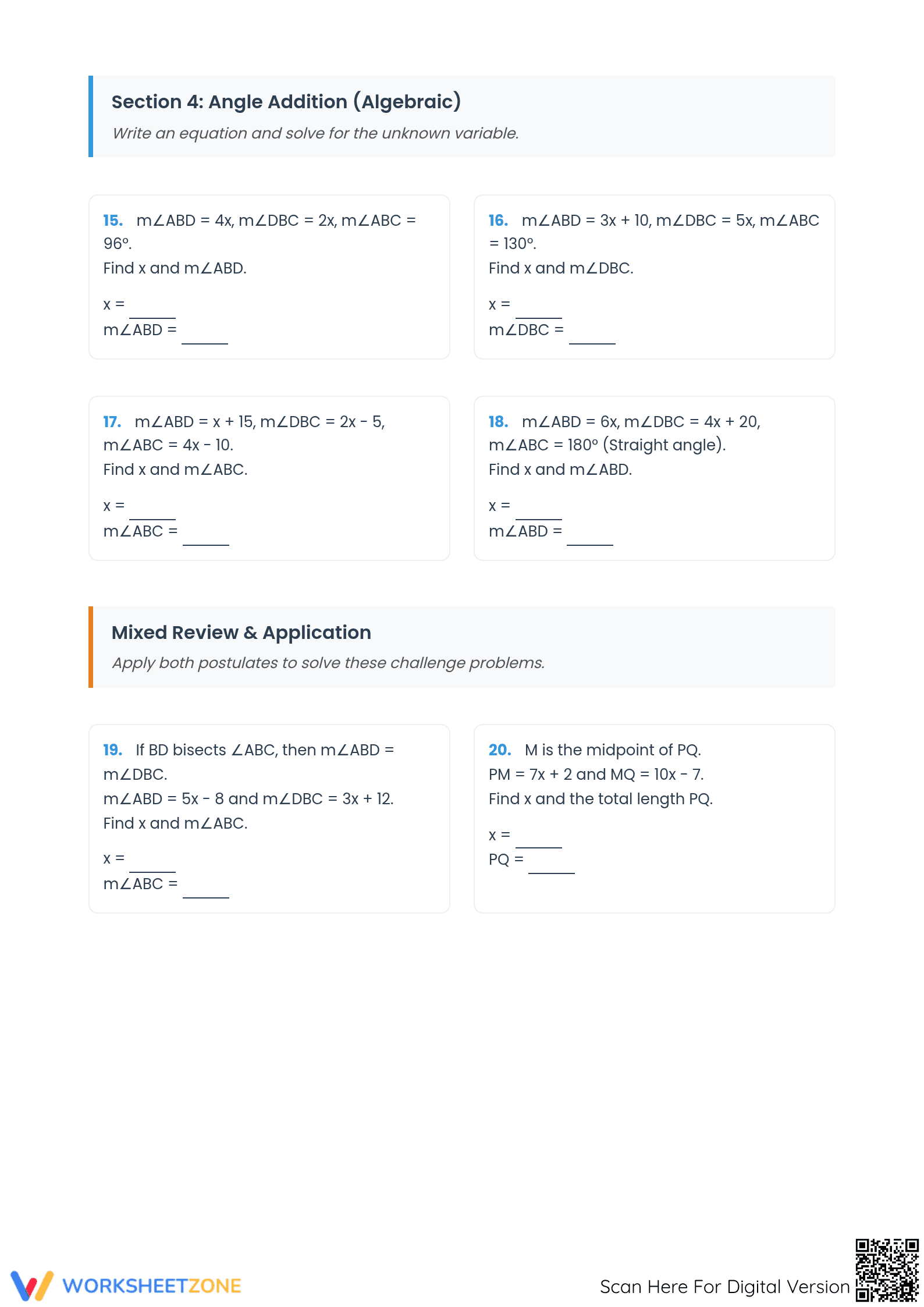
What's Inside: This three-page PDF offers 20 problems across four sections: basic segment and angle addition (with visuals), and algebraic segment and angle addition (including midpoints and bisections). Ample workspace and a full answer key are provided.
Skill Progression
- Guided Practice (Problems 1-6 & 11-14): These 10 problems focus on visual identification and basic arithmetic, reinforcing that the sum of parts equals the whole.
- Supported Practice (Problems 7-10 & 15-18): These 8 problems introduce algebraic variables. Students translate geometric relationships into linear equations (e.g., 3x + (x + 4) = 24) to solve for unknown measures.
- Independent Application (Problems 19-20): The final section presents mixed review challenges involving midpoints and angle bisectors, requiring students to synthesize definitions for complex equations.
The progression moves from direct computation to abstract problem-solving.
Standards Alignment
Primary Standard: `CCSS.MATH.CONTENT.7.G.B.5` — Focuses on using angle relationships and equations to solve for unknown values. This worksheet targets addition postulates, employing algebraic methods essential for mastering standard angle relationships. The code can be directly used in lesson plans or curriculum mapping.
How to Use It
Use the first page for in-class checks after introducing collinear points. Algebraic sections are great for connecting Geometry to Algebra I. For formative assessment, observe students in Section 2; if they struggle, prompt them to write postulates (e.g., AB + BC = AC) before substituting expressions. Expect 30-45 minutes for completion, depending on algebraic fluency.
Who It's For
Designed for Grade 7-8 Pre-Algebra or introductory Geometry students, this resource is effective for those needing segmented problems. Pair with an anchor chart or digital whiteboard for visual learning.
This resource reinforces the bedrock of Euclidean geometry, transitioning students from intuitive spatial reasoning to formal deductive logic. It aligns with gradual release of responsibility by progressing from concrete numeric examples to complex algebraic equations, ensuring learners internalize part-whole relationships per CCSS.MATH.CONTENT.7.G.B.5. Research shows integrating algebra in geometry improves mathematical fluency and proof-writing skills. The 20 targeted problems offer sufficient repetitions for procedural mastery, helping educators identify misconceptions in equation setup—a critical precursor to trigonometry. Inclusion of fractional and decimal values further enhances precision in calculations.


