


























Views
Downloads

Essential Seeds Worksheet | Grade 1 Science Printable
Paste this activity's link or code into your existing LMS (Google Classroom, Canvas, Teams, Schoology, Moodle, etc.).
Students can open and work on the activity right away, with no student login required.
You'll still be able to track student progress and results from your teacher account.
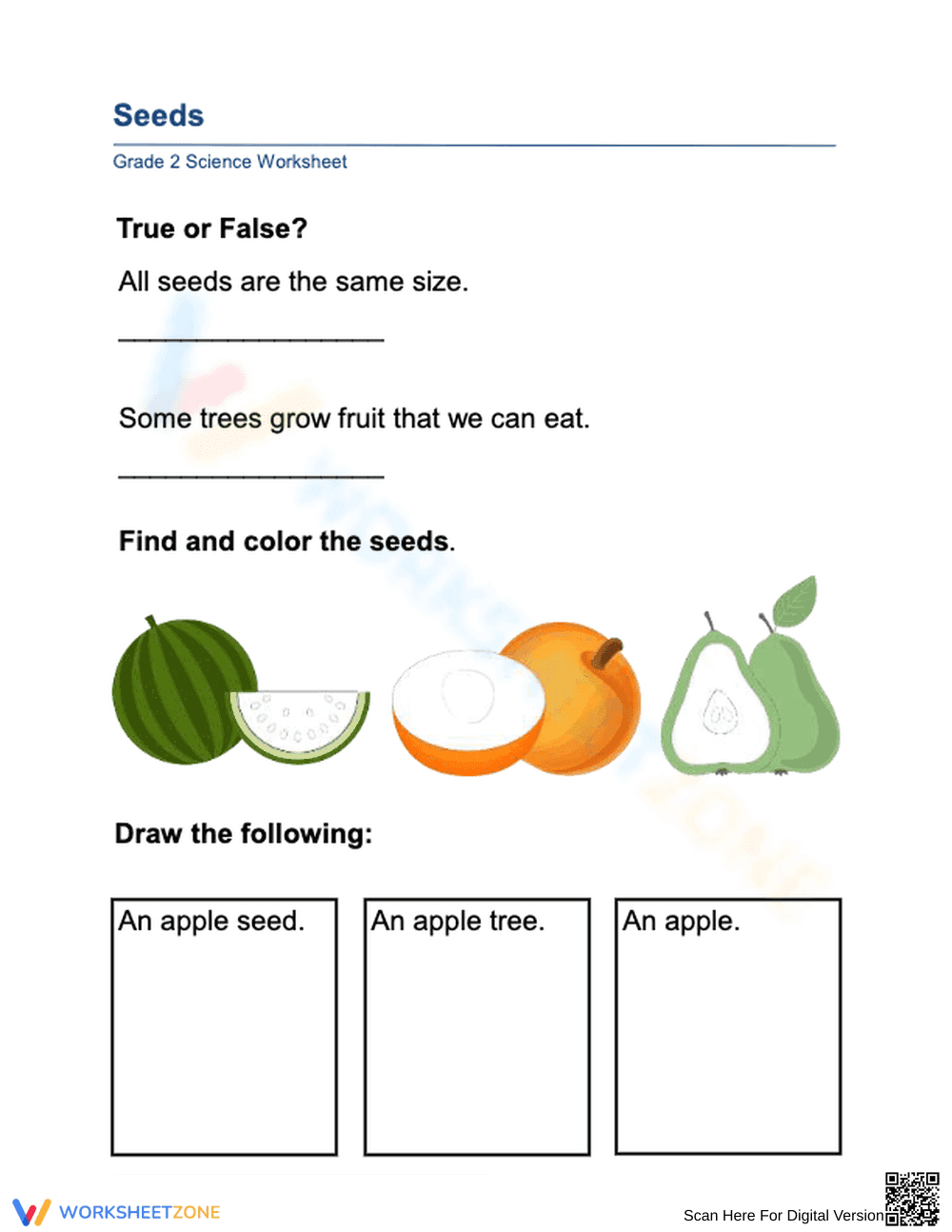
Help young learners identify the relationship between seeds and the food they eat with this focused science worksheet. Students practice observation skills by locating seeds within common fruits and illustrating the growth cycle from seed to apple. This resource provides a clear introduction to plant structures and life cycles for early elementary science.
At a Glance
- Grade: 1 · Subject: Science
- Standard:
1-LS1-1— Identify plant parts and how they help the plant grow and survive- Skill Focus: Seed identification and plant life cycles
- Format: 1 page · 6 problems · Answer key included · PDF
- Best For: Early elementary life science introductory lessons
- Time: 15–20 minutes
This single-page printable features three distinct task formats to engage different learning modalities. It begins with true-or-false conceptual checks, followed by a visual identification exercise where students locate seeds in cross-sections of watermelon, peaches, and pears. The final section requires students to illustrate an apple seed, tree, and fruit to demonstrate their understanding of biological sequences.
Zero-Prep Workflow:
1. Print: Select the worksheet page and the integrated answer key. Processing takes less than 30 seconds for a full class set.
2. Distribute: Hand out the sheets during your life science block or use as a quiet-time activity. No additional manipulatives are required.
3. Review: Use the provided answer key for immediate student feedback or peer grading. Total teacher preparation time is under 2 minutes, making this an ideal selection for emergency sub-plans or unexpected classroom transitions.
Primary alignment is to 1-LS1-1, focusing on how plants use their external parts (seeds and fruit) to grow and survive. The worksheet also touches upon organizational patterns in living things by connecting seeds to the mature plants they become. This standard code can be copied directly into lesson plans, IEP goals, or district curriculum mapping tools for easy documentation.
Assign this worksheet as an independent practice activity following a direct instruction lesson on plant parts. It also serves as an excellent formative assessment exit ticket to gauge student understanding of where seeds are located within a plant's structure. Teachers should observe whether students correctly identify the seed location within the fruit cross-sections. Completion typically ranges from 15 to 25 minutes depending on the level of drawing detail provided by the student.
This resource is designed for first-grade students but is appropriate for kindergarteners needing enrichment or second graders requiring a quick review of plant anatomy. It supports visual learners through its graphic tasks and can be easily paired with a reading passage about orchards or a hands-on fruit dissection activity in the classroom to provide a concrete learning experience.
According to the RAND AIRS 2024 report on elementary instructional materials, the use of high-quality, focused worksheets that combine visual identification with conceptual checking significantly improves retention of science vocabulary in Grade 1 students. By requiring students to draw the progression from seed to tree to fruit, this worksheet leverages dual coding theory, allowing learners to process information through both verbal and visual channels. This multi-modal approach aligns with the Next Generation Science Standards (NGSS) emphasis on making observations to understand patterns in the natural world. Research indicates that early exposure to plant biology fundamentals, such as seed placement and growth cycles, provides the necessary scaffolding for more complex ecological concepts in later grades. Educators can confidently integrate this printable into their curriculum knowing it meets rigorous standards for clarity and instructional alignment while providing a self-contained assessment of student mastery over basic botanical structures.


