


























Views
Downloads
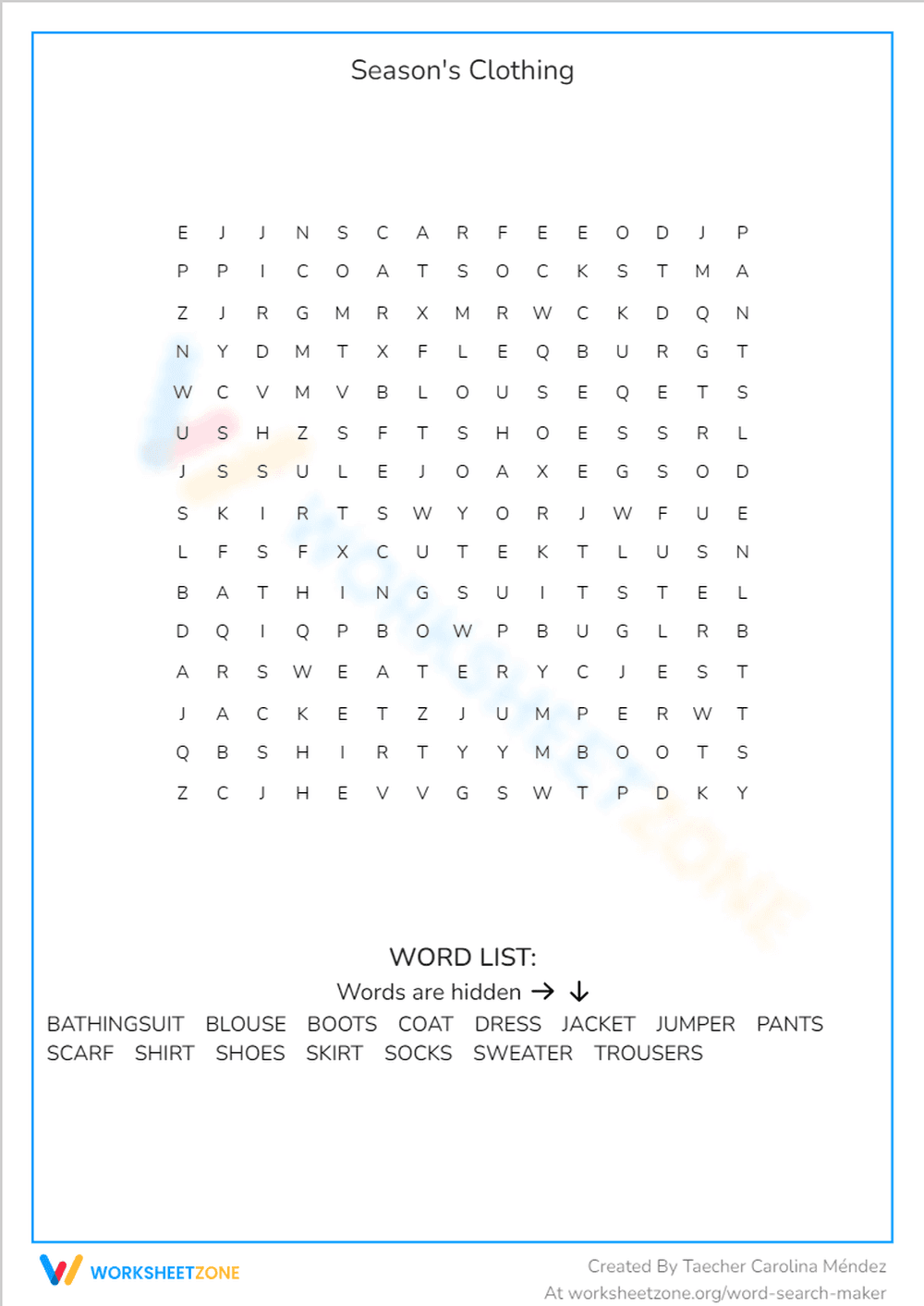

Season's Clothing Word Search | Grade 2-4 Essential
Paste this activity's link or code into your existing LMS (Google Classroom, Canvas, Teams, Schoology, Moodle, etc.).
Students can open and work on the activity right away, with no student login required.
You'll still be able to track student progress and results from your teacher account.
This Grade 2-4 seasonal clothing worksheet helps students master essential vocabulary through a focused word search activity. By identifying 16 specific terms related to weather and attire, learners strengthen their spelling and pattern recognition skills. This resource provides a clear, engaging way to reinforce language arts concepts during seasonal transitions or thematic units.
At a Glance
- Grade: 2-4 · Subject: ELA
- Standard:
CCSS.ELA-LITERACY.L.2.6— Use words and phrases acquired through conversations, reading and being read to- Skill Focus: Seasonal vocabulary and spelling
- Format: 1 page · 16 problems · Answer key included · PDF
- Best For: Morning work or early finishers
- Time: 15–20 minutes
The worksheet features a 15x15 grid containing 16 hidden words related to various seasons. The word list includes items like "bathingsuit," "sweater," and "trousers," covering a range of phonetic patterns and syllable counts. The layout is clean and professional, ensuring students can focus on the task without visual clutter. A comprehensive answer key is provided for quick grading and student self-correction.
This resource is designed for a zero-prep workflow. First, print the single-page PDF (30 seconds). Next, distribute the sheets to students as they enter the room or finish a primary task (1 minute). Finally, review the completed word searches or provide the answer key for self-correction (30 seconds). Total teacher preparation time is under 2 minutes, making it an ideal sub-plan component or emergency filler.
This activity aligns with `CCSS.ELA-LITERACY.L.2.6`, which requires students to use words and phrases acquired through reading and responding to texts. It also supports `CCSS.ELA-LITERACY.L.3.6` by focusing on grade-appropriate general academic and domain-specific words. Both standard codes can be copied directly into lesson plans, IEP goals, or district curriculum mapping tools to ensure instructional compliance.
Use this worksheet during the independent practice phase of a vocabulary lesson or as a formative assessment to check spelling accuracy. It works exceptionally well as a transition activity between subjects. Teachers can observe student persistence and scanning strategies, noting which learners struggle with longer words like "bathingsuit." Expected completion typically takes 15 to 20 minutes depending on the student's grade level.
This resource is perfect for general education students in grades 2 through 4, as well as English Language Learners (ELL) who need visual reinforcement of clothing terms. It pairs naturally with a seasonal weather chart or a direct instruction lesson on descriptive adjectives. The simple format supports students with executive functioning challenges by providing a clear, finite task with immediate feedback.
According to the RAND AIRS 2024 report, structured vocabulary practice that incorporates word recognition and spelling reinforcement is critical for developing reading fluency in the elementary years. This worksheet addresses these needs by requiring students to repeatedly scan and identify the orthographic patterns of 16 high-frequency clothing terms. Research from Fisher & Frey (2014) emphasizes that word-solving activities, such as word searches, help students build the cognitive stamina necessary for complex literacy tasks. By engaging with the standard CCSS.ELA-LITERACY.L.2.6, students move beyond simple memorization toward active word acquisition. This printable resource provides a low-stakes environment for students to practice spelling accuracy while building a robust mental lexicon of seasonal attire. It serves as a practical tool for teachers looking to integrate vocabulary development into a busy classroom schedule without increasing administrative burden or requiring extensive setup.


