


























Views
Plays

Project Selection & Management Quiz | College Ready
Paste this activity's link or code into your existing LMS (Google Classroom, Canvas, Teams, Schoology, Moodle, etc.).
Students can open and work on the activity right away, with no student login required.
You'll still be able to track student progress and results from your teacher account.
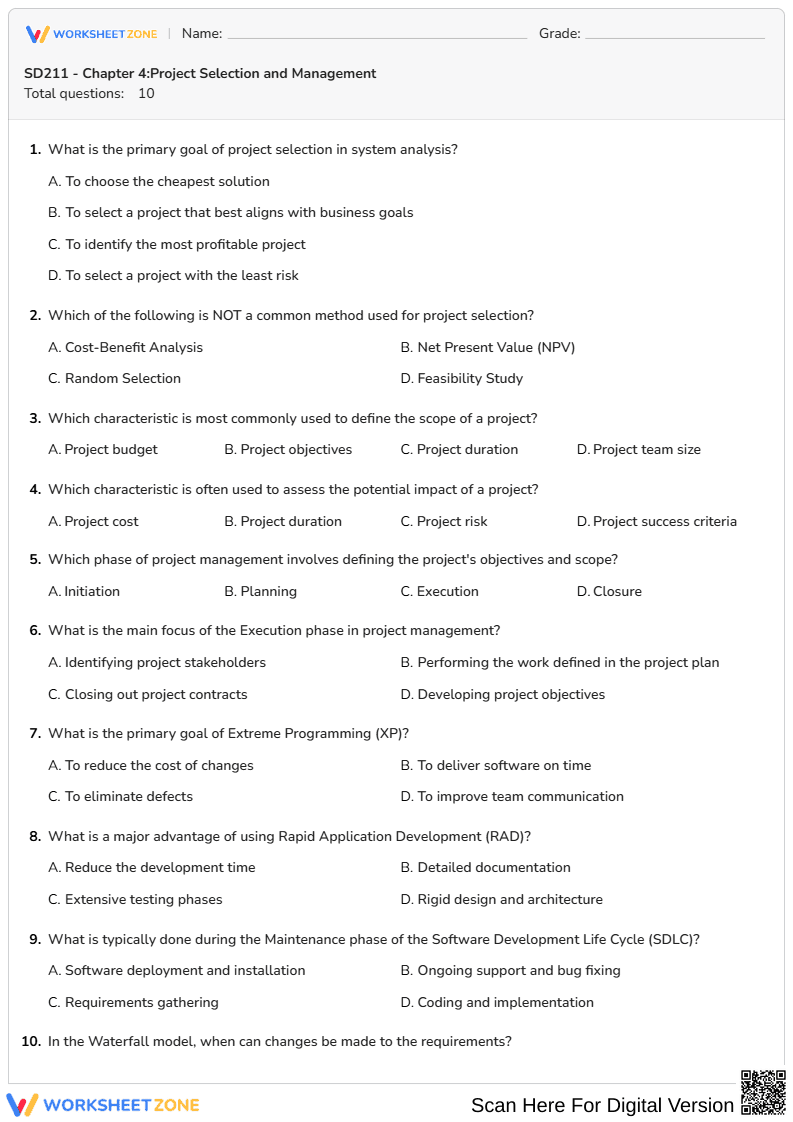
This College-level project management worksheet gives students targeted practice with system analysis and software development life cycles. By evaluating different methodologies like Agile, RAD, and Waterfall, learners will solidify their understanding of how to select and manage technical projects effectively in real-world scenarios.
At a Glance
- Grade: College · Subject: Computer Science
- Standard:
CSTA 3A-AP-22— Evaluate software development methodologies and project management strategies.- Skill Focus: Project Selection and SDLC
- Format: 2 pages · 10 problems · PDF
- Best For: Formative assessment or quiz
- Time: 15–20 minutes
Inside this resource, educators will find a streamlined, two-page multiple-choice quiz featuring 10 focused questions. The task types cover foundational concepts in system analysis, including cost-benefit analysis, project scope definition, and the specific phases of project management. Students will also encounter comparative questions that test their knowledge of Extreme Programming (XP), Rapid Application Development (RAD), and the traditional Waterfall model.
Zero-Prep Workflow
- Print (1 minute): Simply download the PDF and print a class set. The clean, black-and-white formatting ensures quick and economical copying.
- Distribute (1 minute): Hand out the two-page assessment at the beginning or end of your lecture on system analysis.
- Review (5 minutes): Use the straightforward multiple-choice format to quickly grade submissions or facilitate a full-class review discussion.
With a total teacher prep time of under two minutes, this resource is highly suitable for emergency sub plans or impromptu knowledge checks.
This assessment is aligned to CSTA 3A-AP-22, requiring students to design and develop computational artifacts while understanding the collaborative tools and methodologies used in project management. It also supports general career and technical education (CTE) competencies for business and information technology. Both standard codes can be copied directly into lesson plans, IEP goals, or district curriculum mapping tools.
This worksheet is highly versatile for higher education classrooms. Use it as a formative assessment immediately after direct instruction on the Software Development Life Cycle (SDLC). Alternatively, assign it as an independent reading check before a seminar discussion. As an observation tip, watch if students struggle distinguishing between Execution and Maintenance phases, indicating a need for review. Expected completion time is 15 to 20 minutes.
This resource is designed for college students or advanced high school seniors in computer science or business management courses. It serves as an excellent baseline assessment for mixed-ability classrooms. Pair this quiz with a detailed anchor chart on the Waterfall versus Agile methodologies to provide additional scaffolding for learners who need visual comparisons.
Effectively teaching project management requires frequent, low-stakes assessment to ensure foundational concepts are retained by learners. This worksheet aligns with CSTA 3A-AP-22, helping students evaluate software development methodologies and project management strategies. According to a recent ScienceDirect TpT Analysis, integrating structured multiple-choice formative assessments significantly improves long-term retention of technical vocabulary and procedural frameworks in higher education settings. By requiring students to differentiate between Rapid Application Development, Extreme Programming, and traditional Waterfall models, this resource reinforces critical thinking within system analysis. Regular knowledge checks like this 10-question quiz allow instructors to identify misconceptions early in the semester, ensuring that students are adequately prepared for more complex, collaborative capstone projects. Implementing these targeted evaluations bridges the gap between theoretical textbook knowledge and practical, industry-standard application in the modern workforce.


