


























Views
Plays

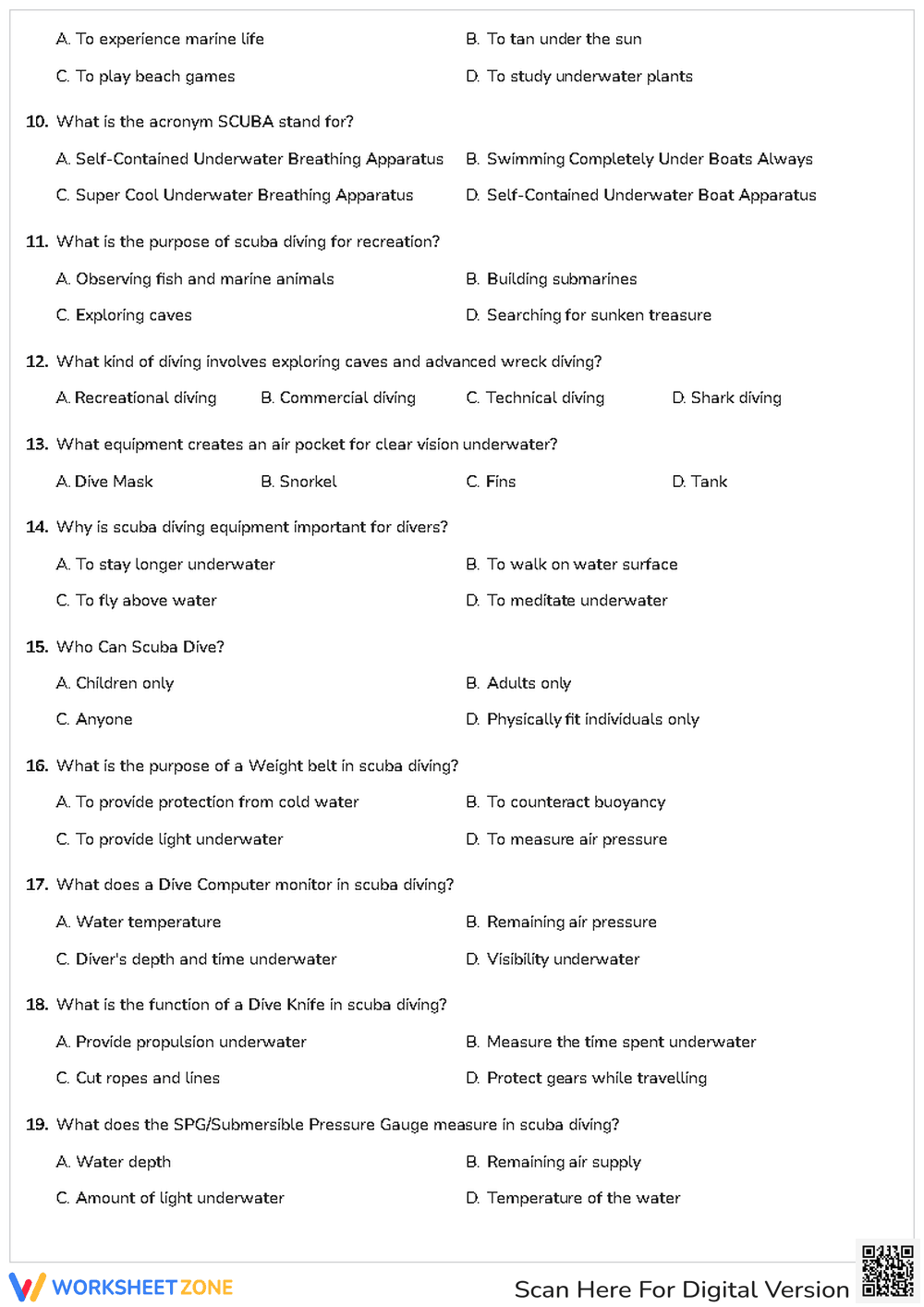


Scuba Diving for Fitness Quiz | Grade 11-12 Essential
Paste this activity's link or code into your existing LMS (Google Classroom, Canvas, Teams, Schoology, Moodle, etc.).
Students can open and work on the activity right away, with no student login required.
You'll still be able to track student progress and results from your teacher account.
Scuba diving requires significant physical preparation and a deep understanding of physiological markers to ensure safety and performance. This comprehensive worksheet assesses student knowledge of how moderate to vigorous physical activity (MVPA) impacts the body during aquatic exploration. Students will demonstrate their understanding of fitness metrics and technical diving equipment through a structured assessment format.
At a Glance
- Grade: 11-12 · Subject: Physical Education
- Standard:
HS.PE.2.1— Analyze physiological responses to exercise and identify fitness metrics for safety- Skill Focus: Fitness metrics and diving equipment
- Format: 6 pages · 54 problems · Answer key included · PDF
- Best For: End-of-unit assessment or emergency sub plans
- Time: 45–60 minutes
What's Inside: This extensive 6-page PDF contains 54 multiple-choice questions designed to test high school students on the intersection of fitness science and scuba diving. The assessment covers critical acronyms like MET (Metabolic Equivalents) and HRR (Heart Rate Reserve), alongside technical gear functions for BCDs, regulators, and dive computers. A complete answer key is provided for efficient grading.
Zero-Prep Workflow
- Print: Select the 6-page document and print enough copies for your class in under 60 seconds.
- Distribute: Hand out the assessment as a quiet, independent activity requiring zero teacher setup or additional materials.
- Review: Use the included answer key to grade the 54 questions or facilitate a peer-review session in less than 10 minutes.
This resource is specifically designed for high-school environments where teacher time is at a premium, making it an ideal choice for busy instructional days.
Standards Alignment
This resource aligns with HS.PE.2.1: "Analyze the physiological responses to exercise and identify the benefits of participating in moderate to vigorous physical activity." It specifically targets the student's ability to calculate target heart rate ranges and understand metabolic equivalents in specialized sports. Both standard codes can be copied directly into lesson plans, IEP goals, or district curriculum mapping tools.
How to Use It
This worksheet is best utilized as a summative assessment following a unit on aquatic fitness or specialized physical activities. Teachers can also use it as a formative diagnostic tool to gauge student familiarity with exercise physiology before starting a health unit. During the session, observe students as they navigate the technical equipment questions to identify which gear functions require further direct instruction. Expected completion time ranges from 45 to 60 minutes.
Who It's For
The primary audience is Grade 11 and Grade 12 students enrolled in Physical Education or Health Science courses. It is particularly effective for students interested in vocational diving or marine biology. This resource pairs naturally with an anchor chart on the FITT principle or a direct instruction lesson on cardiovascular health and target heart rate zones.
According to research by Fisher & Frey (2014), structured multiple-choice assessments serve as a vital component of checking for understanding, provided they target higher-order application of technical vocabulary. This 54-question quiz utilizes that principle by requiring students to apply the HS.PE.2.1 standard to the specific, high-stakes environment of scuba diving. By evaluating physiological indicators like MET and HRR, students move beyond simple recall into the analysis of how physical activity routines are constructed for safety and endurance. The inclusion of technical equipment questions ensures that students understand the mechanical supports necessary for human survival in aquatic environments. This assessment provides clear evidence of student mastery for gradebooks and progress monitoring, ensuring that learners can accurately identify the physiological demands of vigorous physical activity. This data-driven approach supports curriculum mapping and helps educators identify specific gaps in student knowledge regarding exercise science and aquatic safety protocols.


