


























Views
Plays
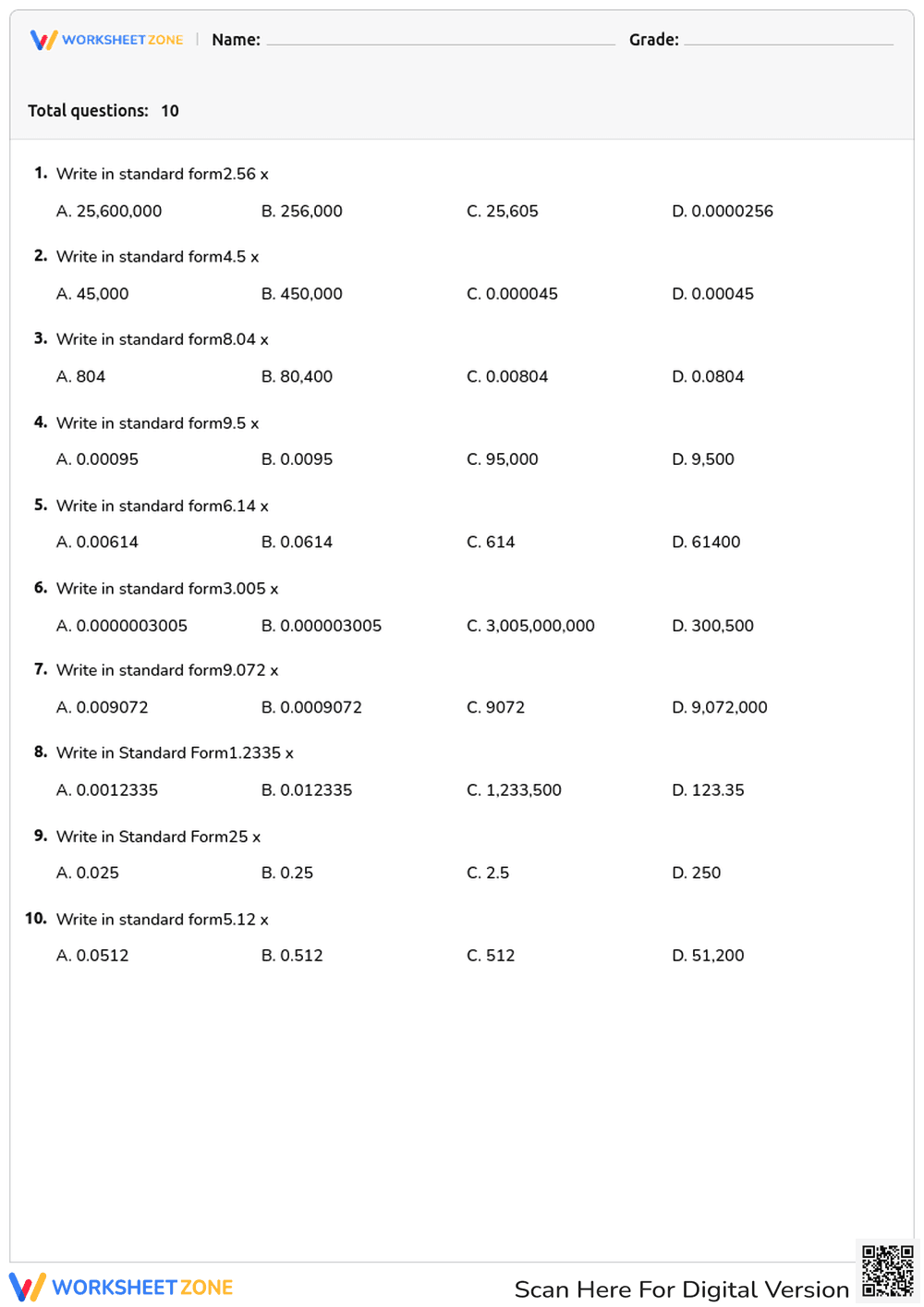

Grade 5 Scientific Notation — Printable No-Prep Worksheet
Paste this activity's link or code into your existing LMS (Google Classroom, Canvas, Teams, Schoology, Moodle, etc.).
Students can open and work on the activity right away, with no student login required.
You'll still be able to track student progress and results from your teacher account.
This Grade 5 math worksheet provides targeted practice for converting numbers from scientific notation into standard form. Students will apply their understanding of base-ten operations to correctly place decimal points. This resource ensures learners build fluency with powers of ten, a critical foundational skill for advanced mathematical reasoning.
At a Glance
- Grade: 5 · Subject: Math
- Standard:
CCSS.MATH.CONTENT.5.NBT.A.2— Multiply decimals by powers of ten- Skill Focus: Scientific Notation to Standard Form
- Format: 1 page · 10 problems · Answer key included · PDF
- Best For: Independent practice and review
- Time: 10–15 minutes
Inside this single-page resource, educators will find a streamlined, ten-question multiple-choice assessment. Each problem requires students to evaluate a number presented in scientific notation and select the correct standard form equivalent from four distinct options. The layout is clean and distraction-free, allowing students to focus entirely on the mathematical operations. A complete answer key is included to facilitate rapid grading and immediate feedback.
Enjoy a simple zero-prep workflow:
- Print (1 minute): Simply download the PDF and print the required number of copies. No special formatting or cutting is needed.
- Distribute (1 minute): Hand out the single-page assignment to students as a warm-up, exit ticket, or independent practice activity.
- Review (3 minutes): Use the provided answer key to quickly check student responses or conduct a whole-class review session.
With a total teacher preparation time of under two minutes, this resource is highly suitable for emergency sub plans or last-minute lesson additions.
This material is strictly aligned to CCSS.MATH.CONTENT.5.NBT.A.2: Explain patterns in the number of zeros of the product when multiplying a number by powers of 10, and explain patterns in the placement of the decimal point when a decimal is multiplied or divided by a power of 10. Both standard codes can be copied directly into lesson plans, IEP goals, or district curriculum mapping tools.
Teachers can deploy this worksheet during the independent practice phase of a lesson on powers of ten. After direct instruction, students can complete the ten problems to solidify their understanding of decimal movement. Alternatively, it serves as an effective formative assessment tool. While students work, teachers can observe whether learners are moving the decimal point in the correct direction and by the appropriate number of spaces. Expected completion time ranges from ten to fifteen minutes.
This resource is primarily designed for fifth-grade general education students mastering base-ten concepts. It also provides excellent remediation for middle school students who need to review foundational scientific notation skills before tackling more advanced physics or chemistry calculations. For optimal results, pair this worksheet with a visual anchor chart demonstrating how positive and negative exponents dictate decimal movement.
Developing fluency with base-ten concepts and scientific notation is a critical milestone in elementary and middle school mathematics. According to EdReports 2024, instructional materials that provide focused practice on specific procedural skills significantly improve long-term retention and mathematical confidence. This worksheet directly supports CCSS.MATH.CONTENT.5.NBT.A.2 by requiring students to multiply decimals by powers of ten and accurately convert values into standard form. By isolating this specific cognitive task within a multiple-choice format, learners can quickly identify misconceptions regarding decimal placement. Regular engagement with these types of structured problem sets ensures that students build the automaticity required for higher-level algebraic reasoning and complex scientific calculations in later grades. Educators can consistently rely on this targeted, standards-aligned practice to systematically build and assess essential numerical literacy.


