


























Views
Downloads
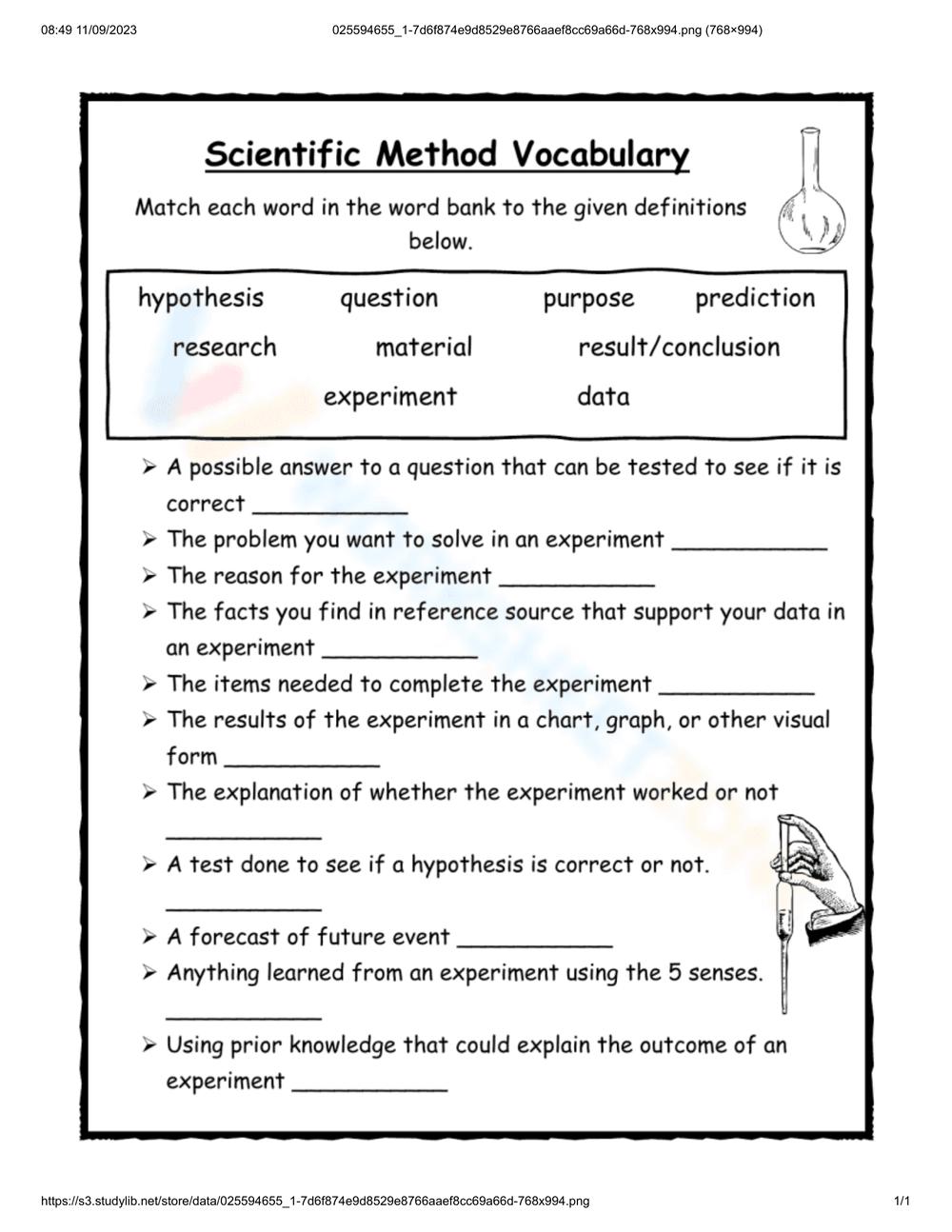

Scientific Method Vocabulary | Printable Grade 4 Worksheet
Paste this activity's link or code into your existing LMS (Google Classroom, Canvas, Teams, Schoology, Moodle, etc.).
Students can open and work on the activity right away, with no student login required.
You'll still be able to track student progress and results from your teacher account.
This scientific method vocabulary worksheet helps students master essential science terminology by matching key terms to their correct definitions. By completing this activity, learners build a strong foundation for conducting experiments and understanding scientific texts, ensuring they can accurately describe the investigative process.
At a Glance
- Grade: 4 · Subject: Science
- Standard:
CCSS.ELA-LITERACY.RI.4.4— Determine the meaning of domain-specific words- Skill Focus: Scientific Method Vocabulary
- Format: 1 page · 11 problems · Answer key included · PDF
- Best For: Independent practice
- Time: 10–15 minutes
This single-page resource features a clear, easy-to-read word bank containing nine foundational scientific terms, including hypothesis, experiment, data, and conclusion. Below the word bank, students will find eleven distinct definitions with blank lines provided for their answers. The straightforward layout minimizes distractions, allowing students to focus entirely on reading comprehension and vocabulary acquisition. A complete answer key is included to facilitate quick grading or peer review.
Designed for a zero-prep classroom workflow.
- Print (1 min): Download the PDF and print. The design ensures economical printing.
- Distribute (1 min): Hand out during a science block. Instructions are self-explanatory.
- Review (3 mins): Use the answer key to check responses or display for self-correction.
With teacher prep under two minutes, this is excellent for sub plans.
This activity is directly aligned to CCSS.ELA-LITERACY.RI.4.4: Determine the meaning of general academic and domain-specific words or phrases in a text relevant to a grade 4 topic or subject area. It also supports cross-curricular science standards by reinforcing the language needed to plan and carry out investigations. Both standard codes can be copied directly into lesson plans, IEP goals, or district curriculum mapping tools.
Teachers can utilize this worksheet in multiple instructional contexts. It serves as an effective pre-assessment before beginning a new science unit, allowing educators to gauge prior knowledge of the scientific method. Alternatively, it functions perfectly as an independent practice activity following direct instruction on experimental design. While students work, teachers can circulate and observe which terms cause the most confusion, using this formative assessment data to guide subsequent review sessions. Most students will complete the matching tasks within 10 to 15 minutes.
This resource is primarily designed for fourth-grade students, though it is highly adaptable for third and fifth graders reviewing foundational science concepts. The clear word bank provides built-in scaffolding, making it accessible for English Language Learners and students requiring vocabulary support. It pairs naturally with introductory science anchor charts, hands-on experiment demonstrations, or direct instruction lessons covering the steps of the scientific method.
Mastering domain-specific vocabulary is a critical component of science literacy and overall academic achievement. This worksheet directly targets CCSS.ELA-LITERACY.RI.4.4, requiring students to determine the meaning of domain-specific words related to the scientific method. According to an EdReports 2024 analysis, explicit vocabulary instruction in the content areas significantly improves reading comprehension and the ability to engage with complex informational texts. When students confidently understand terms like hypothesis, data, and conclusion, they are better equipped to participate in inquiry-based learning and articulate their scientific reasoning. By providing structured matching practice with a clear word bank, this resource helps bridge the gap between everyday language and academic science terminology. Consistent exposure to these foundational concepts ensures that learners can accurately document their investigations and communicate their findings, ultimately fostering a deeper understanding of the scientific process.


