


























Views
Downloads
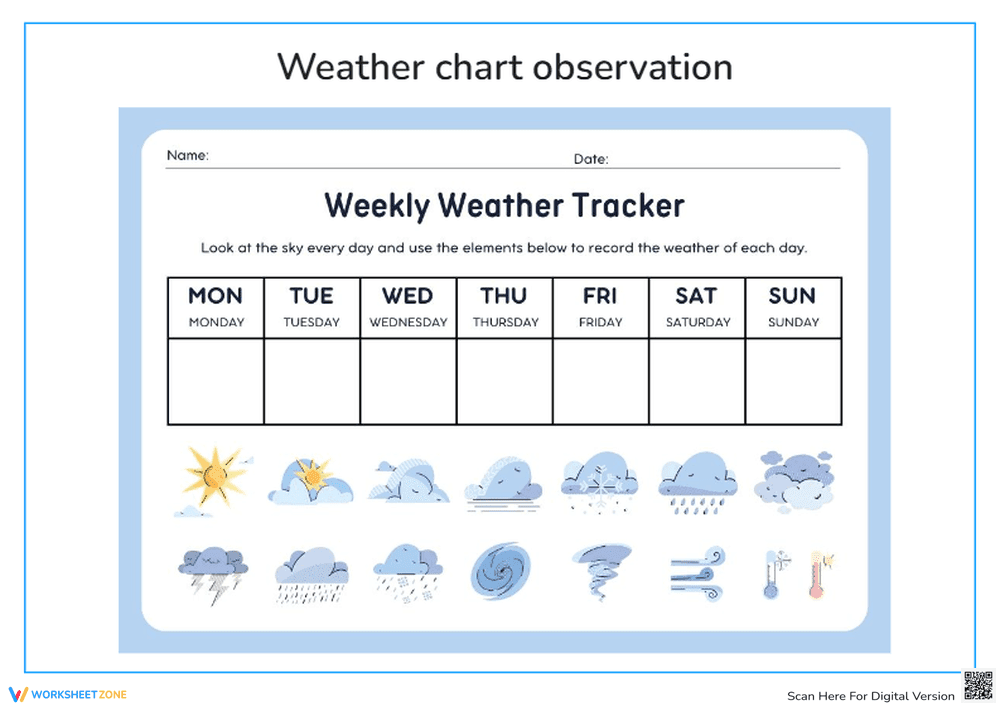

Grade 1 Weather Tracker — Printable No-Prep Worksheet
Paste this activity's link or code into your existing LMS (Google Classroom, Canvas, Teams, Schoology, Moodle, etc.).
Students can open and work on the activity right away, with no student login required.
You'll still be able to track student progress and results from your teacher account.
This Grade 1 weather tracker worksheet empowers students to observe and record daily atmospheric changes. By tracking the weather across a full week, young learners build foundational data collection skills, practice identifying days of the week, and begin recognizing natural patterns in their local environment.
At a Glance
- Grade: 1 · Subject: Science
- Standard:
K-ESS2-1— Observe and record local weather conditions to describe patterns- Skill Focus: Weather observation and data recording
- Format: 1 page · 7 problems · No answer key · PDF
- Best For: Morning work or daily science routines
- Time: 5–10 minutes daily
This single-page resource features a clear, structured weekly calendar spanning Monday through Sunday. Below the tracking grid, students will find a visual word bank of fourteen distinct weather icons, including sunny, partly cloudy, rainy, snowy, stormy, and windy conditions, alongside temperature indicators. The intuitive layout allows early readers to easily match their daily sky observations with the corresponding visual symbols.
This resource is designed for immediate classroom implementation:
- Print (1 minute): Generate enough copies for the entire class with a single click. The black-and-white friendly design ensures crisp printing.
- Distribute (1 minute): Hand out the trackers on Monday morning. The self-explanatory visual instructions require minimal teacher modeling.
- Review (2 minutes daily): Incorporate a brief check-in during morning meeting to discuss the day's observation.
Total teacher prep time is under two minutes, making this an excellent addition to emergency sub plans or established morning routines.
This worksheet aligns directly with K-ESS2-1: Use and share observations of local weather conditions to describe patterns over time. While technically a kindergarten standard, it serves as crucial review and foundational practice for Grade 1 students developing scientific inquiry skills. Both standard codes can be copied directly into lesson plans, IEP goals, or district curriculum mapping tools.
Integrate this tracker into your daily morning meeting. Before direct instruction begins, have students look out the window, select the appropriate weather icon, and draw it in the day's box. Alternatively, use it as a take-home science extension where students record weekend weather with their families. As a formative assessment observation tip, watch how students differentiate between similar conditions, such as cloudy versus partly cloudy, to gauge their attention to detail. Expected completion time is just a few minutes each day.
This worksheet is ideal for Grade 1 general education students, as well as kindergarteners and early learners needing visual supports. The icon-based recording system provides built-in differentiation for English Language Learners and pre-readers, allowing them to participate fully without writing complex vocabulary. Pair this tracker with a daily classroom weather graph or an anchor chart detailing seasonal changes to maximize its instructional impact.
Consistent daily observation routines significantly enhance early childhood scientific literacy. According to a 2024 report by EdReports, integrating structured data collection into daily classroom habits improves long-term retention of earth science concepts by providing repeated, low-stakes engagement. This resource directly supports K-ESS2-1 by requiring students to observe and record local weather conditions to describe patterns. By utilizing visual icons to represent complex atmospheric phenomena, the worksheet reduces cognitive load and allows young learners to focus entirely on accurate observation and consistent recording. Tracking weather over a continuous seven-day period helps students transition from isolated daily observations to recognizing broader environmental trends. This systematic approach to data collection builds the foundational inquiry skills necessary for more advanced scientific investigations in later elementary grades, ensuring students develop a robust understanding of their local climate.


