




























Views
Downloads
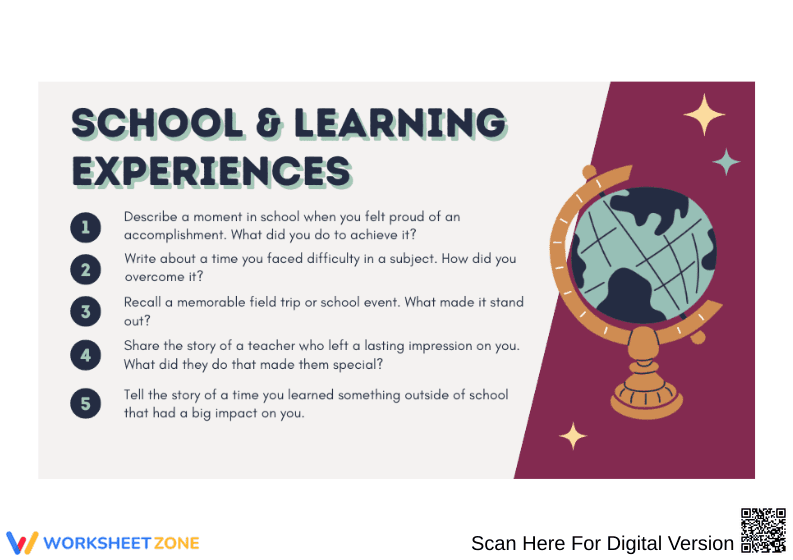

Printable School Experience Writing Prompts | Grade 6

Paste this activity's link or code into your existing LMS (Google Classroom, Canvas, Teams, Schoology, Moodle, etc.).
Students can open and work on the activity right away, with no student login required.
You'll still be able to track student progress and results from your teacher account.
This printable narrative writing worksheet provides middle school students with five engaging prompts focused on school and learning experiences. Students reflect on personal growth, challenges, and memorable moments to craft compelling personal narratives. This resource builds essential storytelling skills while encouraging meaningful self-reflection in the ELA classroom.
At a Glance
- Grade: 6 · Subject: ELA
- Standard:
CCSS.ELA-LITERACY.W.6.3— Write narratives about real experiences using descriptive details.- Skill Focus: Narrative Writing
- Format: 1 page · 5 problems · No answer key · PDF
- Best For: Independent practice
- Time: 30–45 minutes
Inside this single-page resource, educators will find five distinct narrative writing prompts centered around educational experiences. The prompts guide students to write about moments of pride, overcoming academic difficulties, memorable field trips, impactful teachers, and outside-of-school learning. The clean layout presents tasks clearly, making it easy for students to select a prompt and begin drafting immediately without requiring complex instructions.
This resource is designed for a seamless, zero-prep classroom experience. Print (1 minute): Simply download the PDF and print a class set, or display it digitally on a smartboard. Distribute (1 minute): Hand out the prompt list alongside lined paper or digital writing journals. Review (1 minute): Read through the five options together and let students choose their focus. Total teacher prep time is under two minutes, making this an ideal, stress-free activity for emergency sub plans, warm-ups, or dedicated writing workshop days.
This worksheet aligns directly with CCSS.ELA-LITERACY.W.6.3: Write narratives to develop real or imagined experiences or events using effective technique, relevant descriptive details, and well-structured event sequences. It also supports broader middle school writing goals by encouraging students to reflect on their personal growth and articulate their thoughts clearly. Both standard codes can be copied directly into lesson plans, IEP goals, or district curriculum mapping tools.
Integrate these prompts into your writing workshop as a foundational activity before diving into longer personal narrative units. Alternatively, use them as weekly journal entries during morning work or advisory periods. As students write, circulate the room to observe their ability to structure a clear beginning, middle, and end, providing formative feedback on their use of descriptive language. Expected completion time ranges from thirty to forty-five minutes depending on the required length of the response.
This resource is primarily designed for sixth, seventh, and eighth-grade ELA students developing their personal narrative skills. The open-ended nature of the prompts naturally differentiates for varying ability levels, allowing advanced writers to experiment with complex pacing while providing accessible entry points for struggling writers. Pair this worksheet with a mini-lesson on using sensory details or an anchor chart outlining the elements of a strong personal narrative.
Developing strong narrative writing skills requires consistent practice and meaningful topics that resonate with students' lived experiences. By aligning with CCSS.ELA-LITERACY.W.6.3, this resource ensures students actively write narratives about real experiences using descriptive details. According to an EdReports 2024 analysis of middle school literacy curricula, providing students with choice in writing prompts significantly increases engagement and the quality of written output. When students write about familiar subjects, such as their educational journeys, they focus more cognitive energy on structuring narratives and refining descriptive language rather than inventing complex fictional scenarios. This targeted practice solidifies foundational writing mechanics while fostering personal reflection.


