


























Views
Downloads



Essential SAT Vocab 1-2 Review Worksheet | Grades 9-12
Paste this activity's link or code into your existing LMS (Google Classroom, Canvas, Teams, Schoology, Moodle, etc.).
Students can open and work on the activity right away, with no student login required.
You'll still be able to track student progress and results from your teacher account.
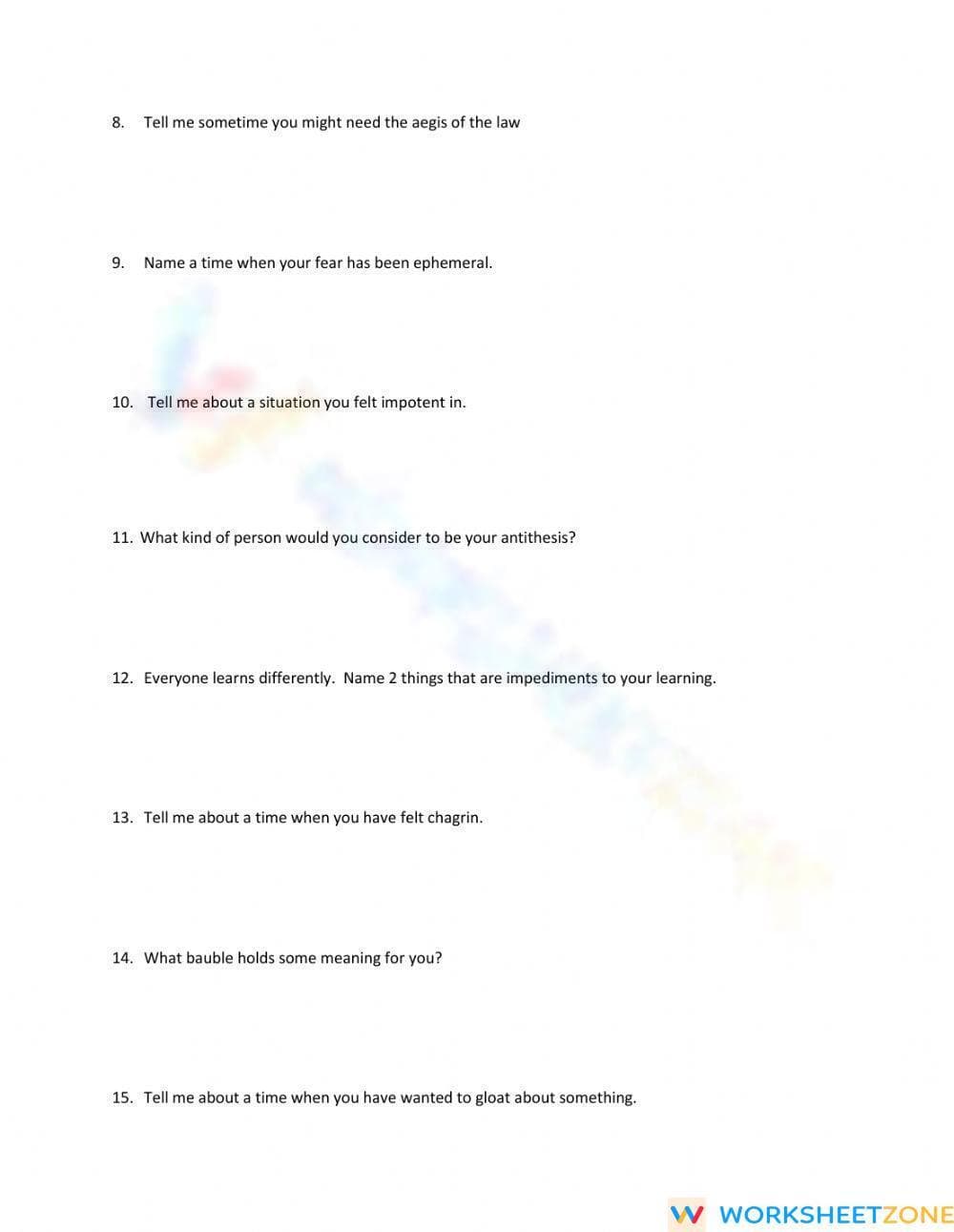
This SAT Vocabulary Lessons 1-2 Review worksheet empowers high school students to move beyond rote memorization by applying advanced lexicon in original sentences. Students demonstrate deep understanding of 15 essential terms by responding to thought-provoking prompts that require contextual accuracy. This resource ensures students can effectively use high-tier vocabulary in academic writing and standardized testing environments.
At a Glance
- Grade: 9–12 · Subject: English Language Arts
- Standard:
CCSS.ELA-LITERACY.L.11-12.4— Use context to determine or clarify the meaning of high-level academic words.- Skill Focus: Contextual Vocabulary Application
- Format: 2 pages · 15 problems · Answer key included · PDF
- Best For: SAT/ACT prep and advanced composition practice
- Time: 25–35 minutes
What's Inside
This two-page PDF resource features 15 open-ended prompts designed to elicit specific vocabulary usage. Each question requires a complete sentence response, ensuring students grapple with part of speech and semantic nuances. The worksheet covers a rigorous set of terms including perspicacity, enervates, and opulent, providing a comprehensive review of introductory SAT vocabulary. A full answer key is provided for efficient grading.
Skill Progression
- Guided Recall: Students engage in initial practice by interpreting prompts that define the situational context for terms like boor and rectify.
- Supported Application: Learners evaluate personal experiences or hypothetical scenarios to use words like chagrin or gloat in original sentences.
- Independent Mastery: Students demonstrate full command over sophisticated academic language and its appropriate stylistic register through complex sentence construction.
This gradual release approach ensures that students internalize word meanings through active production rather than passive recognition.
Standards Alignment
This resource is directly aligned to CCSS.ELA-LITERACY.L.11-12.4, which requires students to determine or clarify the meaning of unknown and multiple-meaning words and phrases. By forcing the active use of these terms in response to specific stimuli, the worksheet verifies that students have moved past simple recognition to functional literacy. This standard code can be copied directly into lesson plans, IEP goals, or district curriculum mapping tools.
How to Use It
Use this worksheet as a formative assessment following the direct instruction of SAT Vocabulary Lessons 1 and 2. It serves as an excellent bridge between initial word introduction and a summative quiz. Teachers should observe student responses for correct subject-verb agreement and logical consistency with the vocabulary word's definition, taking approximately 30 minutes for completion.
Who It's For
This resource is tailored for Grade 9-12 students preparing for college entrance exams or enrolled in Honors and AP English courses. It provides necessary scaffolding for students who struggle with abstract definitions by providing concrete scenarios. Pair this with a vocabulary anchor chart or a short informational passage for a complete 45-minute literacy block.
High-frequency vocabulary acquisition is a critical predictor of success on high-stakes assessments like the SAT. This worksheet aligns with CCSS.ELA-LITERACY.L.11-12.4 by facilitating the contextual application of academic language, a strategy emphasized by Fisher & Frey (2014) as essential for long-term retention. By completing 15 targeted sentence-construction tasks, students move from passive recognition to active production. This instructional shift is vital for mastering the plain-English skill of using context to clarify the meaning of sophisticated academic words. Research from EdReports 2024 indicates that consistent, focused practice with high-tier vocabulary significantly improves reading comprehension scores across disciplines. This self-contained review ensures that learners can reliably deploy these terms in their own writing and accurately interpret them during standardized testing. It bridges the gap between rote memorization and true academic fluency through rigorous application.


