


























Views
Downloads
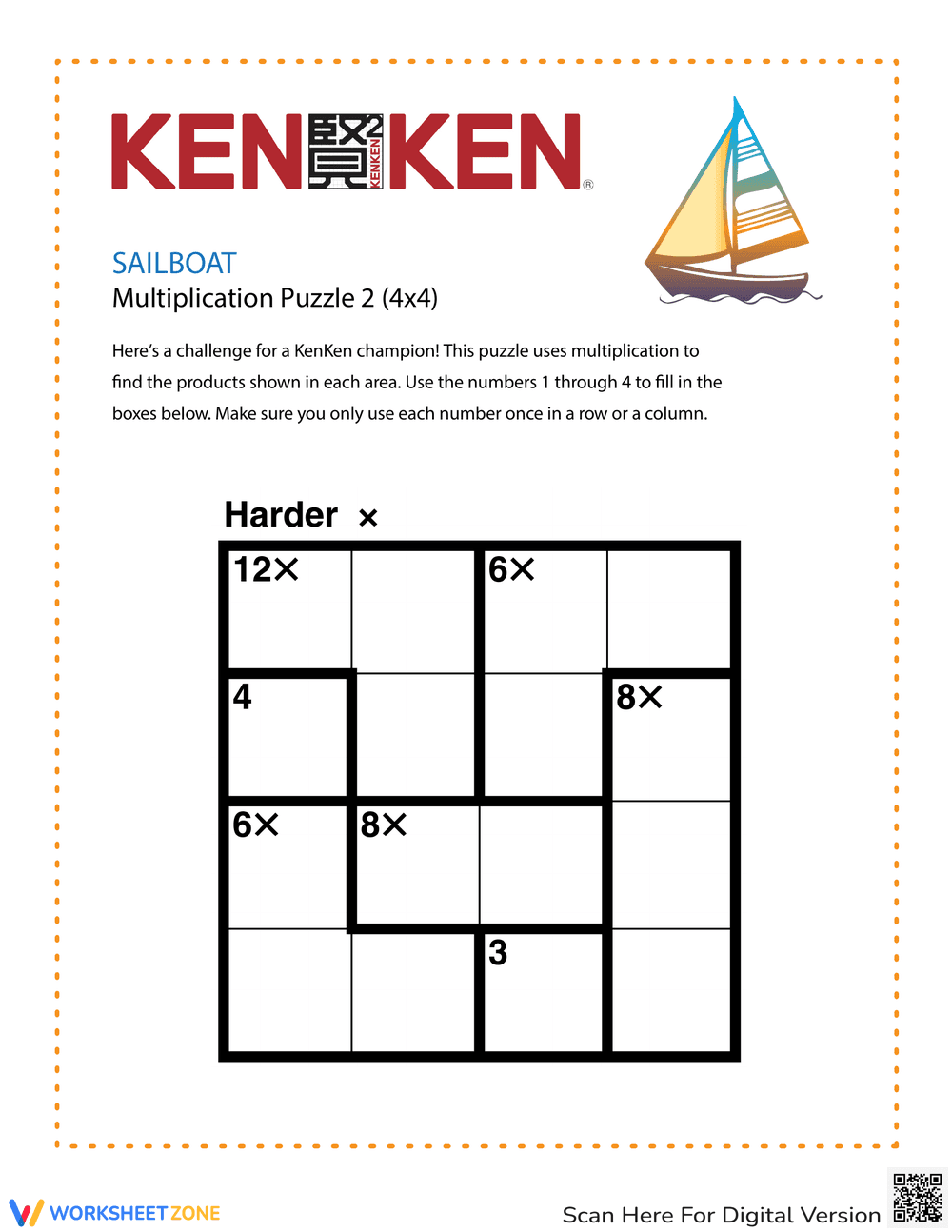

Sailboat KenKen® Puzzle | Essential Grade 3 Math
Paste this activity's link or code into your existing LMS (Google Classroom, Canvas, Teams, Schoology, Moodle, etc.).
Students can open and work on the activity right away, with no student login required.
You'll still be able to track student progress and results from your teacher account.
This Grade 3 multiplication puzzle provides a rigorous mental workout that strengthens basic fact fluency through logical deduction. Students must apply their knowledge of factors and products to solve the 4x4 grid, ensuring no numbers repeat while satisfying the mathematical constraints of each cage. It transforms routine arithmetic into an engaging challenge.
At a Glance
- Grade: 3 · Subject: Mathematics
- Standard:
CCSS.MATH.CONTENT.3.OA.C.7— Fluently multiply within 100 using strategies such as the relationship between multiplication and division- Skill Focus: Multiplication Fluency & Logic
- Format: 1 page · 16 cells · Answer key included · PDF
- Best For: Early finishers and math centers
- Time: 10–15 minutes
The worksheet features a single 4x4 KenKen® grid themed with a sailboat graphic. It includes clear instructions for students, specifying the use of digits 1 through 4. The "Harder" designation indicates a focus on multiplication operations within the outlined cages, requiring students to identify factor pairs for products like 12, 8, and 6.
Zero-Prep Workflow
The zero-prep workflow is designed for immediate classroom implementation. First, print the single-page PDF (30 seconds). Second, distribute the sheets to students as a warm-up or bell-ringer activity (1 minute). Third, review the completed grid using the provided answer key to provide instant feedback (1 minute). Total teacher preparation time is under two minutes, making it an ideal resource for sub plans.
Standards Alignment
This resource is aligned to `CCSS.MATH.CONTENT.3.OA.C.7`, which requires students to fluently multiply and divide within 100. By using a 4x4 grid restricted to digits 1-4, students practice specific factor combinations in a non-traditional format. This standard code can be copied directly into lesson plans, IEP goals, or district curriculum mapping tools.
How to Use It
Use this puzzle as a formative assessment tool during a unit on properties of multiplication. Observe how students approach the "12x" cage; those who immediately identify the 3 and 4 pair demonstrate strong number sense. It also serves as an excellent quiet activity for students who complete their primary assignments early, keeping them cognitively engaged without requiring additional direct instruction.
Who It's For
This worksheet is designed for third-grade students but is also appropriate for fourth-grade remediation or second-grade enrichment. It is particularly effective for learners who thrive on puzzles rather than repetitive drills. Pair this resource with a multiplication anchor chart or a set of physical manipulatives for students who need concrete support while visualizing factor combinations.
According to the RAND AIRS 2024 report, integrating gamified logic puzzles into elementary mathematics instruction significantly increases student engagement and persistence in problem-solving tasks. This Sailboat KenKen® puzzle addresses CCSS.MATH.CONTENT.3.OA.C.7 by requiring students to recall multiplication facts under logical constraints. Unlike standard worksheets, the grid format forces students to cross-reference multiple mathematical possibilities, which builds the executive function skills necessary for higher-level algebra. Research from Fisher & Frey (2014) supports this "productive struggle" as a key component of the gradual release of responsibility model. By providing a clear 4x4 structure, the worksheet scaffolds the complexity of the task while maintaining high cognitive demand. Educators can utilize this tool to bridge the gap between rote memorization and conceptual application, ensuring students develop a flexible understanding of how numbers interact within a system.


