


























Views
Downloads

Grade 1 Basic Needs — Printable No-Prep Worksheet
Paste this activity's link or code into your existing LMS (Google Classroom, Canvas, Teams, Schoology, Moodle, etc.).
Students can open and work on the activity right away, with no student login required.
You'll still be able to track student progress and results from your teacher account.
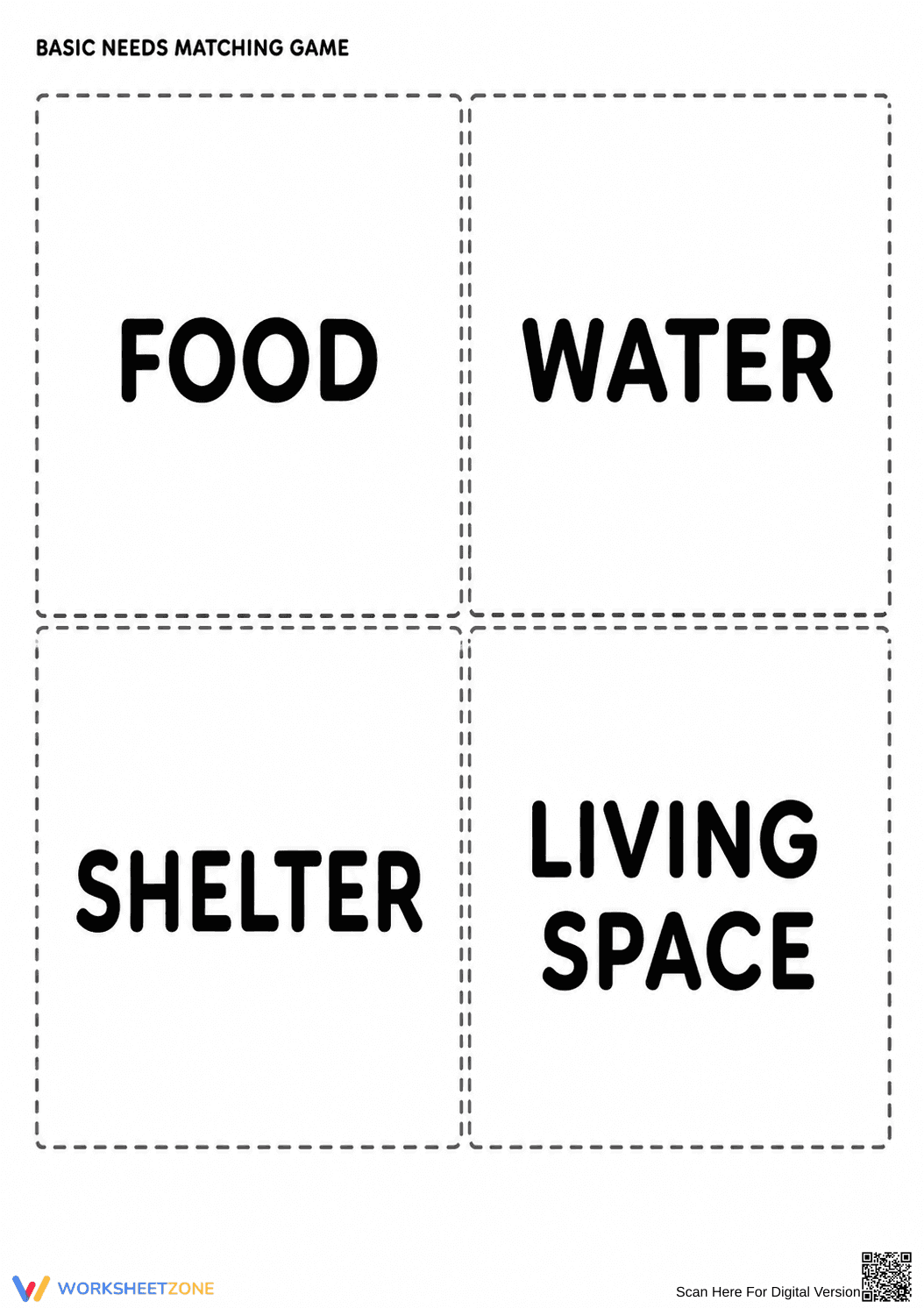
This Grade 1 science worksheet introduces young learners to the fundamental requirements for survival. By interacting with these printable cut-out cards, students will identify and categorize the four basic needs of living things: food, water, shelter, and living space, building a strong foundation for life science concepts.
At a Glance
- Grade: 1 · Subject: Science
- Standard:
K-LS1-1— Identify what animals and plants need to survive.- Skill Focus: Identifying basic survival needs
- Format: 1 page · 4 cards · No answer key needed · PDF
- Best For: Hands-on sorting and vocabulary building
- Time: 10–15 minutes
This single-page resource features four large, clearly labeled boxes containing the essential vocabulary words: FOOD, WATER, SHELTER, and LIVING SPACE. Each word is printed in a bold, easy-to-read font surrounded by dashed lines, indicating exactly where students should cut. The minimalist design ensures that early readers can focus entirely on the core vocabulary without visual distractions, making it an ideal tool for introductory science lessons.
- Print (1 minute): Simply print the single-page PDF. No special materials or color ink are required.
- Distribute (1 minute): Hand out the sheets along with child-safe scissors. The clear dashed lines make it easy for students to manage the cutting process independently.
- Review (3 minutes): Quickly go over the four terms as a class before students begin sorting or matching the cards to pictures of animals and habitats.
With under two minutes of total teacher prep time, this activity is highly effective for busy mornings or as a reliable component of a substitute teacher plan.
Aligned to primary standard K-LS1-1: Use observations to describe patterns of what plants and animals (including humans) need to survive. While technically a kindergarten standard, reviewing these four fundamental requirements is a critical first step in Grade 1 life science curricula before exploring more complex habitat interactions. Both standard codes can be copied directly into lesson plans, IEP goals, or district curriculum mapping tools.
Use these cards during direct instruction by having students hold up the corresponding card when you describe a specific scenario (e.g., "A bird building a nest represents which basic need?"). Alternatively, place the cut-outs in a science center where students can match them to magazine clippings or printed photos of animals fulfilling these needs. As a formative assessment observation tip, watch to see if students can accurately explain the difference between "shelter" and "living space" during small group discussions. Expect this activity to take 10 to 15 minutes.
This resource is designed for Grade 1 students, kindergarteners, and early childhood learners developing foundational science vocabulary. The large text and simple layout provide built-in differentiation for students with visual processing needs or those developing fine motor skills through cutting. It pairs perfectly with an introductory lesson on animal habitats or a read-aloud book about how different creatures survive in the wild.
Understanding foundational concepts like those outlined in K-LS1-1 is crucial for early cognitive development in the sciences. When students can identify what animals and plants need to survive, they build the necessary schema for more advanced ecological learning. According to a ScienceDirect TpT Analysis, hands-on sorting activities and manipulatives significantly increase vocabulary retention and conceptual understanding in early elementary science education. By physically interacting with these basic needs cards, young learners transition abstract survival concepts into concrete, manageable categories, fostering a deeper appreciation for the natural world and the requirements of living organisms.


