


























Views
Downloads



Living and Nonliving Sorting Cards | Essential Grade K
Paste this activity's link or code into your existing LMS (Google Classroom, Canvas, Teams, Schoology, Moodle, etc.).
Students can open and work on the activity right away, with no student login required.
You'll still be able to track student progress and results from your teacher account.
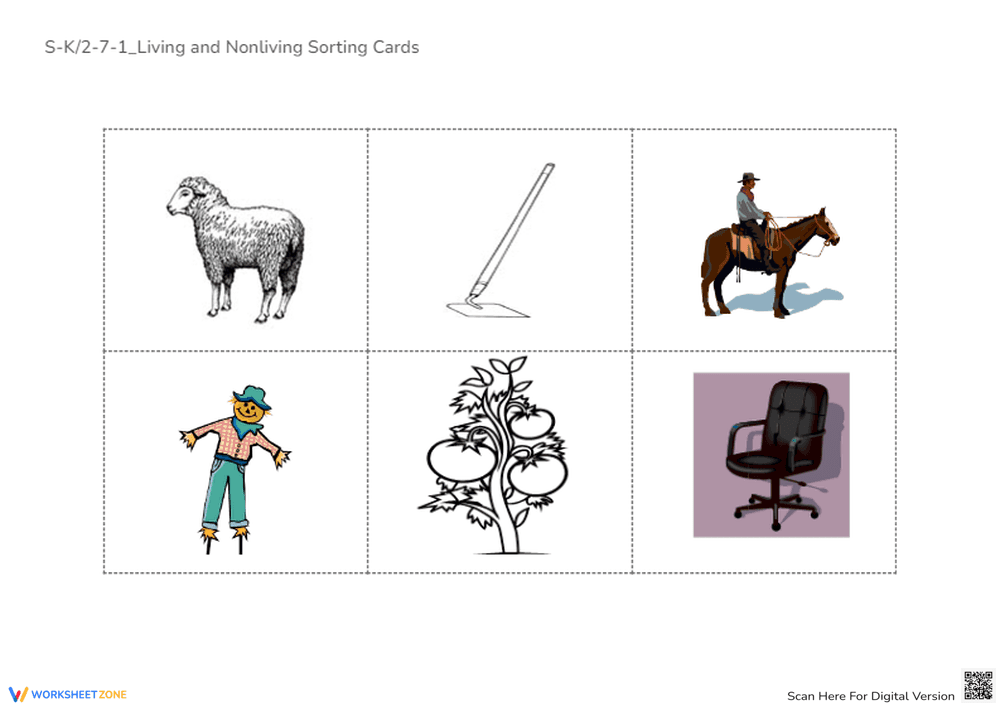
This Kindergarten science resource helps students distinguish between living and non-living things through tactile engagement. By categorizing 18 distinct images, learners develop foundational biological classification skills. Students will observe characteristics such as growth, movement, and the need for nutrients to determine the correct category for each card provided in this set.
At a Glance
- Grade: Kindergarten · Subject: Science
- Standard:
K-LS1-1— Use observations to describe patterns of what plants and animals need to survive- Skill Focus: Living vs. Non-living Classification
- Format: 3 pages · 18 cards · Answer key included · PDF
- Best For: Science centers and hands-on sorting
- Time: 15–20 minutes
What's Inside: The PDF contains three full pages of high-contrast, black-and-white illustrations designed for easy printing. There are 18 individual sorting cards featuring a mix of animals (chicks, cows, fish), plants (trees, tomato plants), people, and inanimate objects (hammers, chairs, drills). The clear borders make cutting simple for teachers or students practicing fine motor skills.
Zero-Prep Workflow: This resource is designed for immediate classroom implementation. First, print the three pages (1 minute). Second, cut the cards along the dashed lines or have a student helper assist (2 minutes). Third, distribute the cards to students for individual or partner sorting (1 minute). Total teacher preparation time is under five minutes, making it an ideal choice for emergency sub plans or last-minute science center rotations.
Standards Alignment: This worksheet aligns with K-LS1-1, which requires students to use observations to describe patterns of what plants and animals need to survive. By identifying living things, students begin to recognize the shared requirements of life. This standard code can be copied directly into lesson plans, IEP goals, or district curriculum mapping tools.
How to Use It: Use these cards during the "Explore" phase of a 5E lesson model. Before direct instruction, allow students to sort the cards based on their own criteria to see if they naturally group living things together. Alternatively, use it as a formative assessment after a lesson on the characteristics of life. Observe if students correctly place the "scarecrow" or "drill" in the non-living category to check for misconceptions about movement.
Who It's For: This activity is tailored for Kindergarten students but serves as an excellent intervention tool for first-grade students who need a refresher. The visual nature of the cards makes them highly accessible for English Language Learners (ELLs) and students with speech and language delays. Pair this with a "Living/Non-living" anchor chart for maximum instructional impact.
Research from the RAND AIRS 2024 report emphasizes that tactile sorting activities in early childhood science significantly improve long-term retention of classification concepts. By physically manipulating cards, students engage multiple neural pathways, moving beyond rote memorization to conceptual understanding. This specific resource focuses on the K-LS1-1 standard, providing 18 opportunities for students to practice the plain-English skill of identifying living and non-living entities based on observable traits. Fisher & Frey (2014) note that such scaffolded, visual tasks are essential for building the academic vocabulary necessary for later success in life sciences. This worksheet provides a structured environment where students can test their hypotheses about what constitutes life in a low-stakes, high-engagement format. It is a reliable tool for meeting state and national science frameworks while supporting the development of critical thinking and observational skills in the youngest learners.


