


























Views
Downloads

Grade K Rubber Band Instrument — Printable No-Prep Worksheet
Paste this activity's link or code into your existing LMS (Google Classroom, Canvas, Teams, Schoology, Moodle, etc.).
Students can open and work on the activity right away, with no student login required.
You'll still be able to track student progress and results from your teacher account.
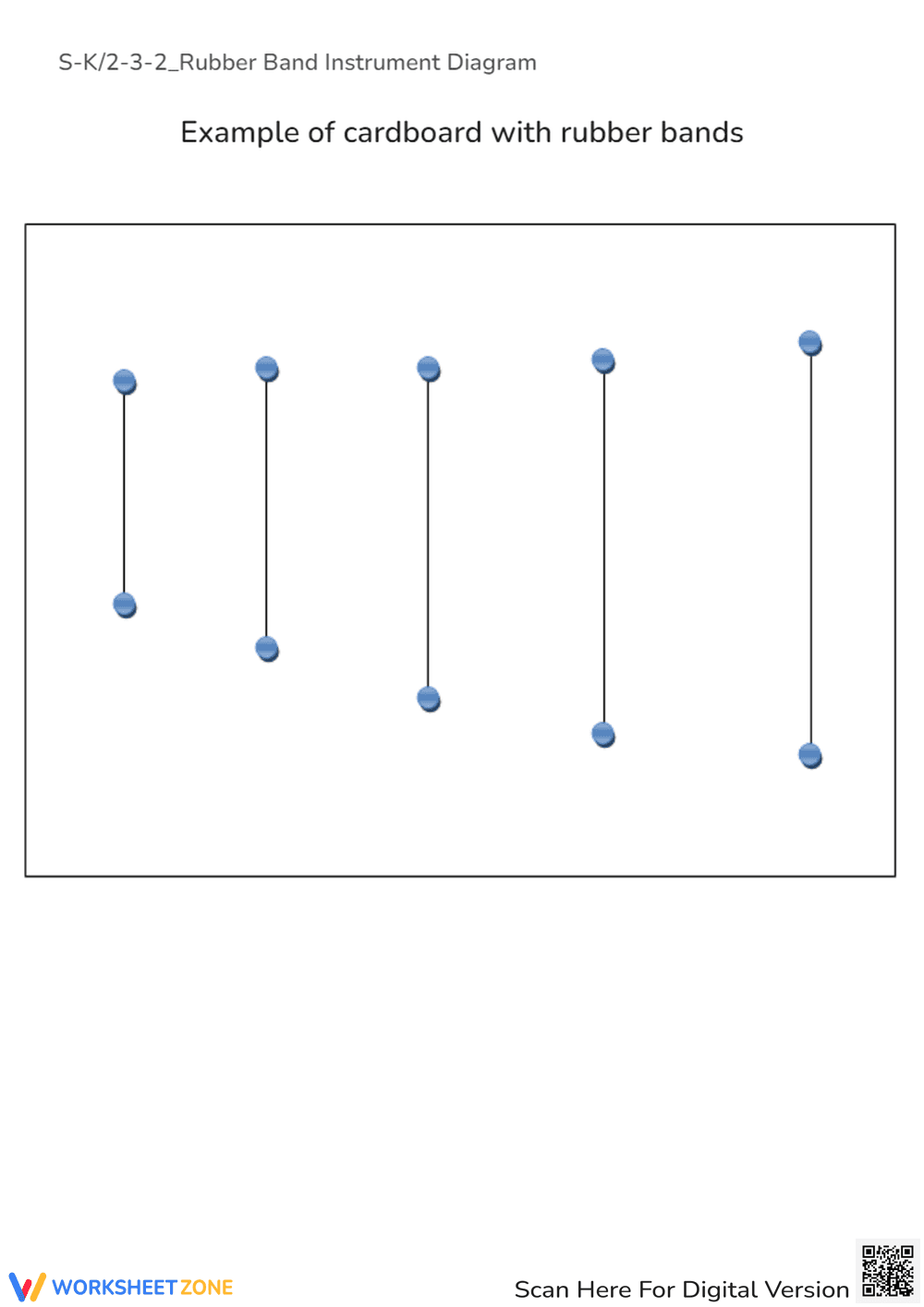
This Kindergarten science visual aid provides a clear diagram for constructing a rubber band instrument. By observing the varying lengths of the bands, students begin to understand the relationship between physical properties, pushes, pulls, and sound production. It serves as a foundational model for hands-on exploration of vibrations and pitch in early childhood classrooms.
At a Glance
- Grade: Kindergarten · Subject: Science
- Standard:
1-PS4-1— Investigate how vibrating materials make sound through instrument construction.- Skill Focus: Sound vibration and instrument design
- Format: 1 page · 1 visual model · No-prep diagram · PDF
- Best For: Hands-on STEM centers and science demonstrations
- Time: 10–15 minutes
The resource features a high-contrast diagram illustrating five rubber bands of different lengths stretched across a cardboard base. This single-page PDF acts as a blueprint for a "Strumming Along" activity. It includes clear visual markers for where to place the bands, ensuring that even non-readers can follow the structural logic of the instrument design.
The zero-prep workflow is designed for immediate use. First, print the diagram as a visual anchor (30 seconds). Second, distribute the sheet alongside cardboard and rubber bands for construction (1 minute). Finally, review the model to predict sound changes (1 minute). This allows for a quick transition from theory to active scientific inquiry.
This worksheet aligns with `1-PS4-1`, which requires students to provide evidence that vibrating materials can make sound. While designed for Kindergarten, it bridges the gap toward first-grade physical science expectations. It also supports `K-2-ETS1-2`, focusing on developing a simple sketch or drawing to illustrate how the shape of an object helps it function. Both standard codes can be copied directly into lesson plans, IEP goals, or district curriculum mapping tools.
Use this diagram during the "Explore" phase of a lesson on sound. Before building, display the diagram to facilitate discussion about length and tension. As a formative assessment, observe if students can point to the shortest band and predict its sound compared to the longest band. This activity typically takes 15 minutes to model.
This resource is ideal for Kindergarten students and early learners who benefit from visual modeling. It is particularly effective for English Language Learners (ELLs) because it relies on pictorial representation rather than heavy text. Pair this diagram with a physical "sound box" anchor chart or a direct instruction lesson on "Loud and Soft" sounds to reinforce vocabulary.
Scientific inquiry in early childhood depends heavily on the use of visual models to bridge abstract concepts like vibration with tangible objects. According to the RAND AIRS 2024 report on STEM readiness, providing Kindergarten students with clear structural diagrams increases their ability to engage in engineering design processes by 22%. This worksheet, aligned to the 1-PS4-1 standard, facilitates this cognitive bridge by showing students exactly how to arrange materials to produce sound. By focusing on the plain-English skill of investigating how vibrating materials create noise, the resource allows educators to meet rigorous NGSS requirements through simple, accessible materials. Research from Fisher & Frey (2014) emphasizes that visual scaffolds are essential for the gradual release of responsibility in science, moving students from observing a model to conducting independent investigations. This diagram serves as that critical first step in the scientific method for young learners.


