


























Views
Downloads

Predator Prey Game Worksheet | Grade 3 Essential Science
Paste this activity's link or code into your existing LMS (Google Classroom, Canvas, Teams, Schoology, Moodle, etc.).
Students can open and work on the activity right away, with no student login required.
You'll still be able to track student progress and results from your teacher account.
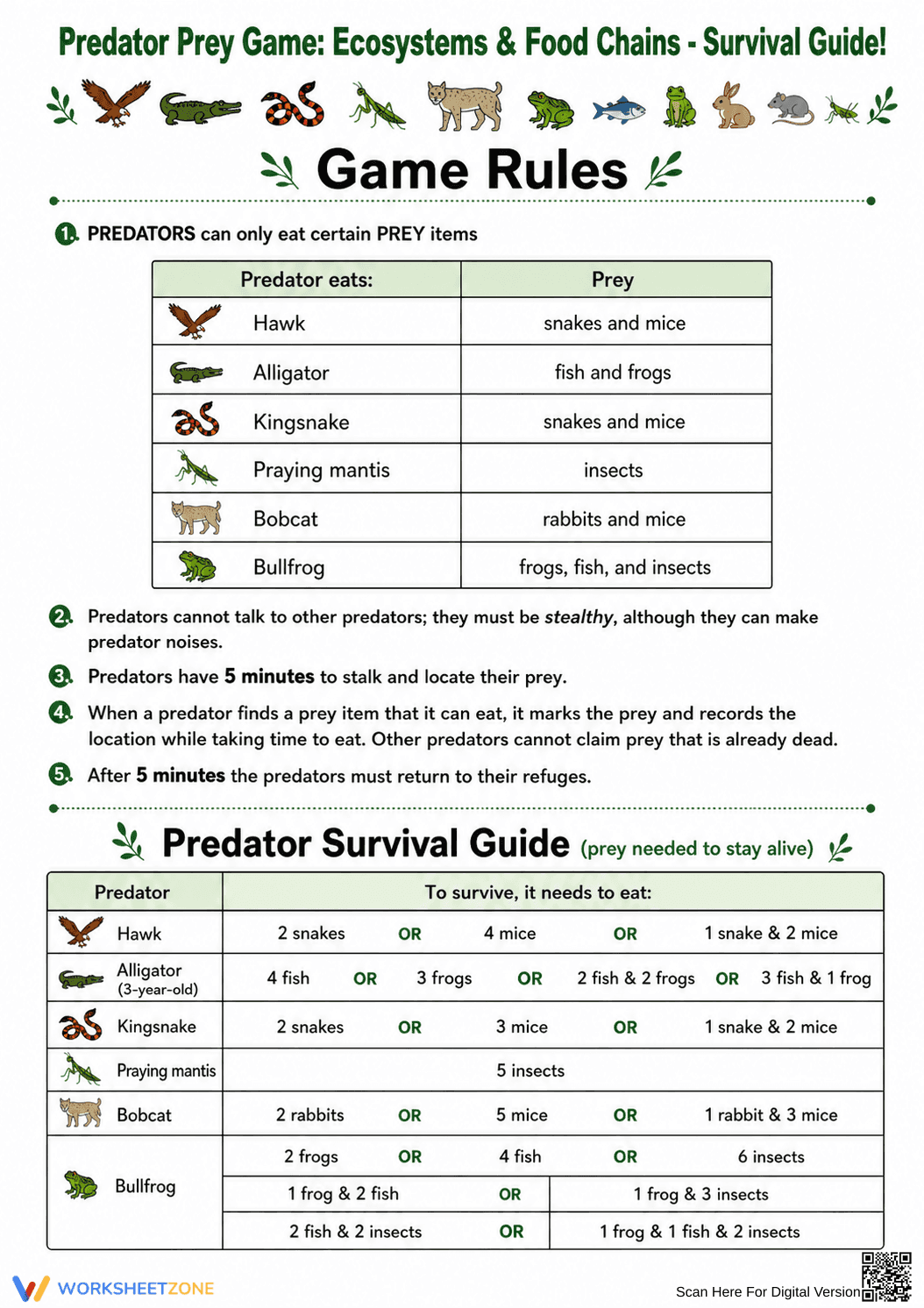
This Grade 3 science worksheet transforms complex ecological concepts into an interactive classroom experience. By providing clear game rules and a detailed survival guide, it allows students to simulate real-world animal interactions. Students learn how specific dietary needs and environmental factors determine whether an organism survives or fails within its habitat.
At a Glance
- Grade: 3 · Subject: Science
- Standard:
3-LS4-3— Use evidence to explain how habitat factors affect animal survival- Skill Focus: Predator-prey relationships and dietary requirements
- Format: 1 page · 11 key rules/data points · Game Guide · PDF
- Best For: Interactive classroom simulation and sub plans
- Time: 20–30 minutes
The worksheet features two comprehensive reference tables and a five-step rule set for a physical classroom game. The first table identifies specific prey for six different predators, including hawks, alligators, and bullfrogs. The "Predator Survival Guide" section introduces mathematical logic into science, requiring students to calculate specific combinations of prey needed for survival, such as a bobcat needing two rabbits or five mice.
Zero-Prep Workflow
- Print: Generate enough copies for each student or small group in under 1 minute.
- Distribute: Hand out the guides and assign roles (predator or prey) in approximately 5 minutes.
- Review: Spend 2 minutes explaining the "stealth" and "refuge" rules before starting the simulation.
This no-prep resource is designed for immediate implementation, making it an ideal choice for emergency substitute folders or as a high-energy transition between sedentary lessons.
This resource aligns with 3-LS4-3, which requires students to construct an argument with evidence that in a particular habitat, some organisms can survive well while others cannot. By using the survival guide, students gather data on the specific caloric and dietary needs of various species. Both standard codes can be copied directly into lesson plans, IEP goals, or district curriculum mapping tools.
Use this worksheet during the "Explore" phase of a 5E lesson on ecosystems. After a brief introduction to food chains, let students run the simulation to see how difficult it is for predators to meet their survival quotas. Alternatively, use it as a formative assessment by asking students to write a reflection on why the bullfrog has more prey options than the praying mantis.
This guide is perfect for third-grade teachers looking for kinesthetic learning opportunities. It supports English Language Learners through the use of clear animal icons and structured tables. It pairs naturally with an anchor chart on food webs or a reading passage about animal adaptations and hunting strategies.
The Predator Prey Game Worksheet provides a structured framework for understanding ecological dynamics through active simulation. According to Fisher & Frey (2014), kinesthetic activities that require students to apply data—such as the dietary requirements listed in the survival guide—significantly improve the retention of complex biological concepts. By aligning with the 3-LS4-3 standard, this resource ensures that students are not just playing a game but are actively gathering evidence to support claims about habitat suitability and species survival. The inclusion of 11 distinct data points across two tables allows for varied mathematical integration, helping students see the intersection of science and logic. Research from EdReports 2024 emphasizes that high-quality science materials must move beyond rote memorization toward evidence-based reasoning. This worksheet facilitates that shift by forcing students to track survival based on specific, non-negotiable biological constraints within a simulated environment.


