




























Views
Downloads
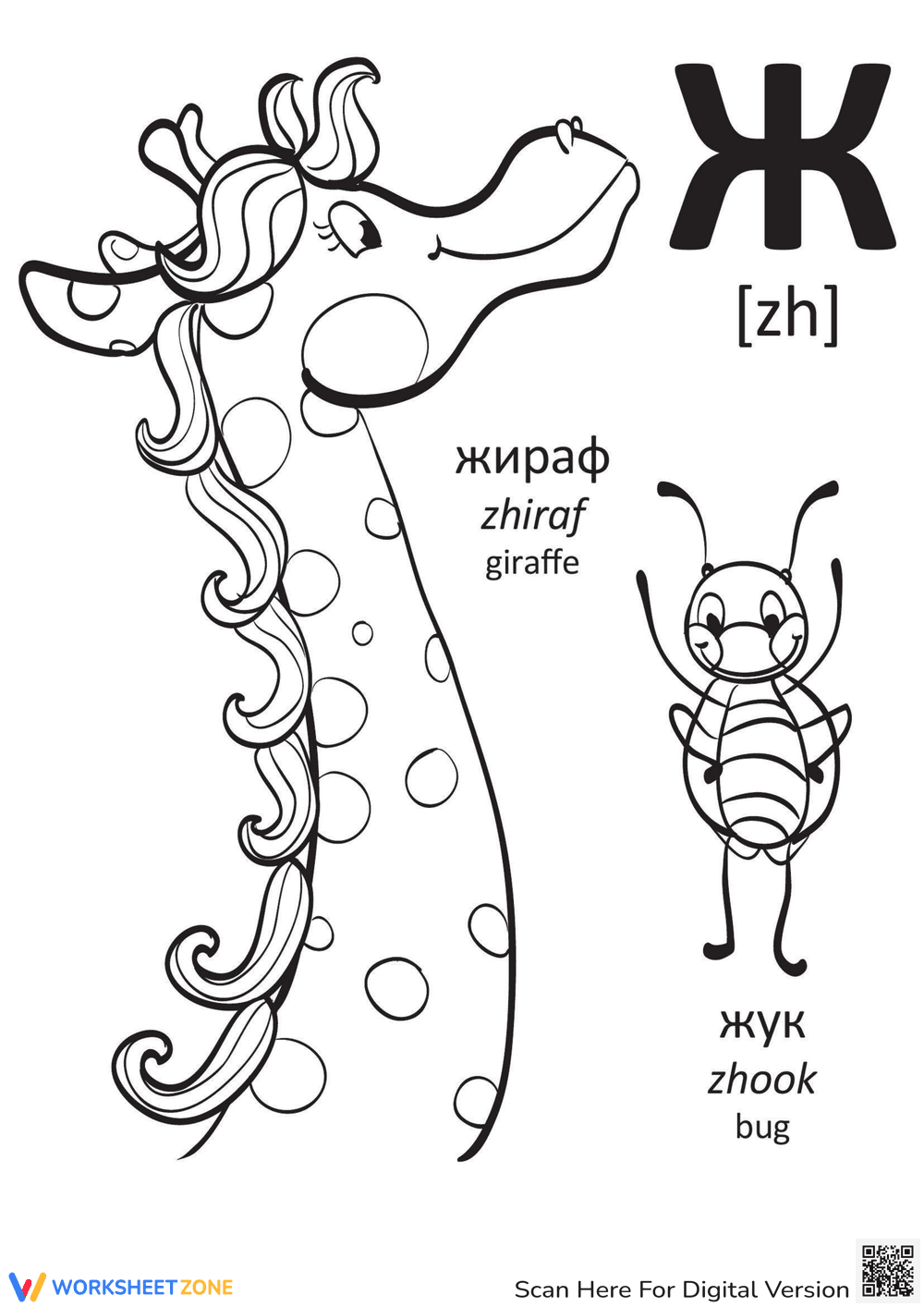

Printable Russian Alphabet Zh Worksheet | Grade K

Paste this activity's link or code into your existing LMS (Google Classroom, Canvas, Teams, Schoology, Moodle, etc.).
Students can open and work on the activity right away, with no student login required.
You'll still be able to track student progress and results from your teacher account.
Introduce young learners to global languages with this engaging Russian alphabet worksheet focusing on the letter Zh. This resource helps Kindergarten students build foundational phonics skills and letter recognition by connecting new sounds to familiar animals through a fun, hands-on coloring activity.
At a Glance
- Grade: K · Subject: Early Literacy
- Standard:
CCSS.ELA-LITERACY.RF.K.3.A— Demonstrate basic knowledge of letter-sound correspondences- Skill Focus: Letter recognition and phonics
- Format: 1 page · 1 task · No answer key · PDF
- Best For: Independent practice and cultural exposure
- Time: 10–15 minutes
This single-page printable features a large, clear depiction of the Russian letter Zh alongside its phonetic English pronunciation. Students will find two engaging coloring illustrations: a giraffe (zhiraf) and a bug (zhook), complete with their Russian, phonetic, and English names. The clean layout provides ample space for coloring, making it an accessible and visually appealing tool for early childhood language exploration without overwhelming young readers.
Designed for immediate classroom implementation, this resource requires zero teacher preparation:
- Print (1 minute): Generate the single-page PDF for the entire class.
- Distribute (1 minute): Hand out the coloring pages along with crayons or markers.
- Review (3 minutes): Pronounce the letter "Zh" and the animal names together as a class before students begin coloring.
With a total prep time of under two minutes, this worksheet is an excellent addition to emergency sub plans, morning work routines, or early finisher folders.
This activity aligns with CCSS.ELA-LITERACY.RF.K.3.A: Demonstrate basic knowledge of one-to-one letter-sound correspondences by producing the primary sound or many of the most frequent sounds for each consonant. While focusing on a non-English alphabet, it reinforces the universal concept that specific symbols represent specific sounds. Both standard codes can be copied directly into lesson plans, IEP goals, or district curriculum mapping tools.
Integrate this worksheet into your morning centers or cultural awareness units. Before direct instruction, use it as a hook to discuss how different languages use different symbols for sounds. During independent work time, observe students as they color to formatively assess their fine motor control and ability to repeat the "Zh" sound when prompted. Expect students to complete the coloring and pronunciation practice within 10 to 15 minutes.
This resource is ideal for Kindergarten students developing early phonemic awareness and fine motor skills. It serves as a gentle introduction for English language learners or native speakers exploring world languages. For differentiation, encourage advanced learners to trace the Russian words or attempt to draw another item that makes the "Zh" sound. Pair this worksheet with a read-aloud book about global cultures or a direct instruction lesson on animal habitats.
Integrating diverse linguistic exposure in early childhood education significantly enhances overall phonological awareness. According to a recent RAND AIRS 2024 report on early literacy interventions, students who engage with cross-linguistic phonetic activities demonstrate a higher capacity for decoding novel words in their primary language. This worksheet directly supports CCSS.ELA-LITERACY.RF.K.3.A by having students demonstrate basic knowledge of letter-sound correspondences through the exploration of the Russian letter Zh. By connecting the visual symbol to the auditory sound and reinforcing it with familiar vocabulary like giraffe and bug, educators can build stronger neural pathways for reading readiness. The combination of visual arts and phonetic practice ensures that young learners remain engaged while developing critical foundational skills necessary for long-term academic success in reading and language arts.


