


























Views
Downloads
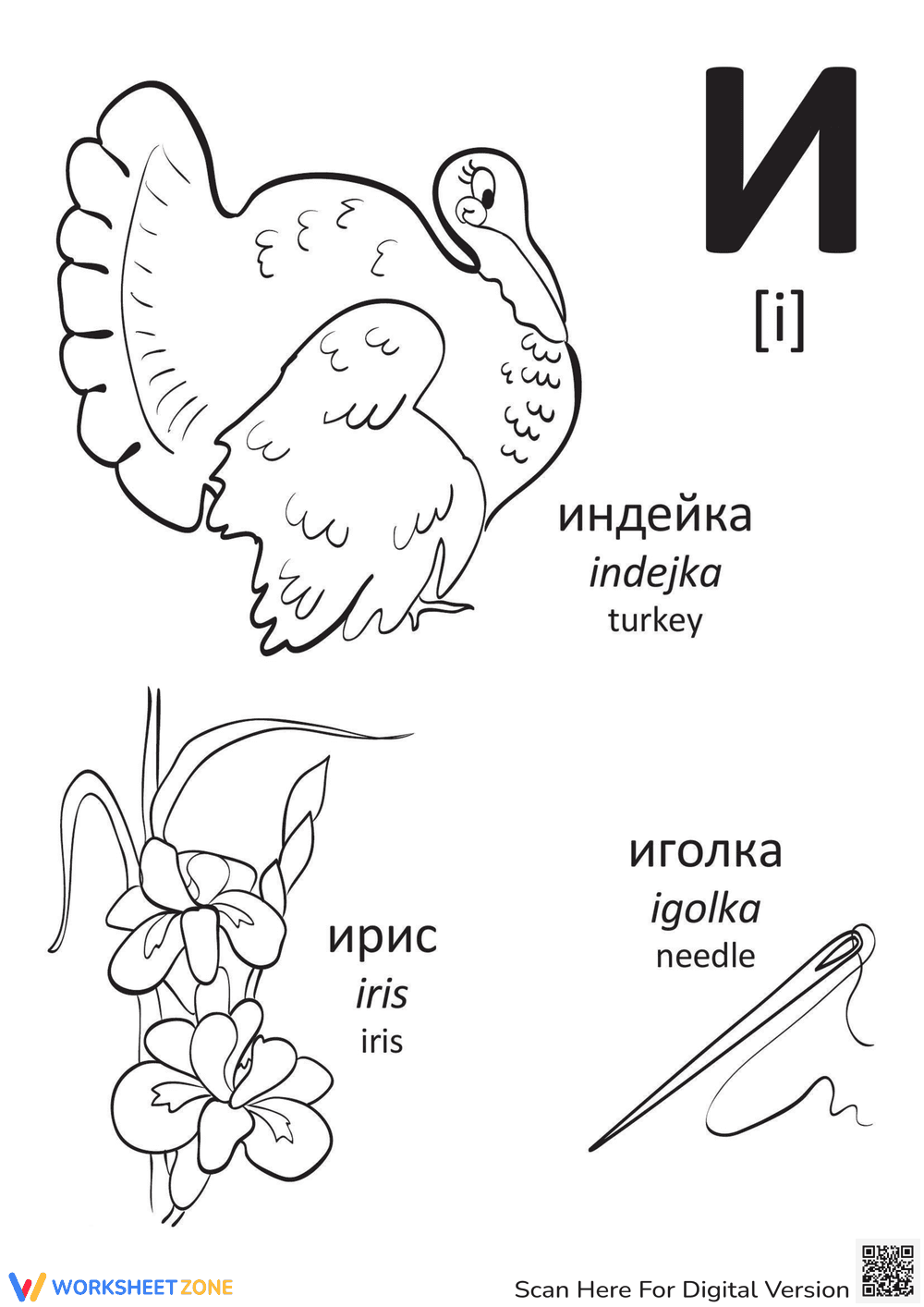

Printable Russian Alphabet Letter I Worksheet
Paste this activity's link or code into your existing LMS (Google Classroom, Canvas, Teams, Schoology, Moodle, etc.).
Students can open and work on the activity right away, with no student login required.
You'll still be able to track student progress and results from your teacher account.
This printable Kindergarten worksheet introduces students to the Russian letter И through engaging coloring activities and vocabulary association. Students identify the letter shape, connect it to three Russian words (turkey, iris, needle), and color the corresponding illustrations. This activity builds early phonics, letter recognition, and multicultural language awareness.
At a Glance
- Grade: Kindergarten · Subject: Early Literacy
- Standard:
CCSS.ELA-LITERACY.RF.K.1.D— Recognize and name uppercase and lowercase letters- Skill Focus: Russian letter И recognition and vocabulary
- Format: 1 page · 3 tasks · No answer key · PDF
- Best For: Independent morning work or language enrichment
- Time: 15–20 minutes
This single-page PDF features the uppercase Russian letter И along with its phonetic pronunciation [i]. It includes three distinct vocabulary illustrations for coloring: a turkey (индейка), an iris flower (ирис), and a needle (иголка). Each illustration is clearly labeled with its Cyrillic spelling, transliteration, and English translation, providing a clear visual and linguistic guide for young learners.
The zero-prep workflow for this worksheet is designed for maximum classroom efficiency. First, print the single-page PDF (takes less than 1 minute). Next, distribute the sheets to students along with coloring crayons (takes 1 minute). Finally, review the letter sound and three vocabulary words as a whole group (takes 5 minutes). Total teacher preparation time is under 2 minutes, making this resource highly suitable for emergency sub plans or quick transition activities.
This resource aligns with CCSS.ELA-LITERACY.RF.K.1.D by encouraging students to recognize letter symbols and associate them with specific sounds and words. While focused on the Cyrillic alphabet, it supports foundational print concepts and phonological awareness by comparing letter-sound relationships across languages. Both standard codes can be copied directly into lesson plans, IEP goals, or district curriculum mapping tools.
Use this worksheet during direct instruction as an introduction to world languages, prompting students to trace the letter И with their fingers before coloring. Alternatively, assign it as a quiet, independent center activity after introducing the letter sound. Teachers can observe student fine-motor coloring skills and verbal pronunciation of the target words during the 15-minute activity.
This worksheet is designed for Kindergarten students, early language learners, and homeschoolers exploring introductory Russian. It serves as an excellent enrichment tool for bilingual classrooms or general education classrooms introducing multicultural units. Pair this worksheet with a read-aloud book about world alphabets or a basic Cyrillic pronunciation audio guide to enhance student engagement.
Early childhood literacy research emphasizes that introducing diverse writing systems supports metalinguistic awareness and phonological development. According to the RAND AIRS 2024 framework, exposing young learners to non-Latin scripts like Cyrillic enhances visual discrimination skills, which directly benefits native language reading acquisition. This worksheet targets the standard CCSS.ELA-LITERACY.RF.K.1.D by focusing on letter-sound association and symbol recognition through 3 structured coloring tasks. By connecting the Russian letter И to familiar concepts like a turkey or needle, the resource scaffolds vocabulary acquisition and fine motor control. Educators can integrate this 1-page activity into early literacy rotations to foster cultural appreciation and cognitive flexibility. The structured layout ensures that students independently practice letter recognition while building foundational print concepts, making it a valuable addition to any early childhood curriculum.


