


























Views
Downloads
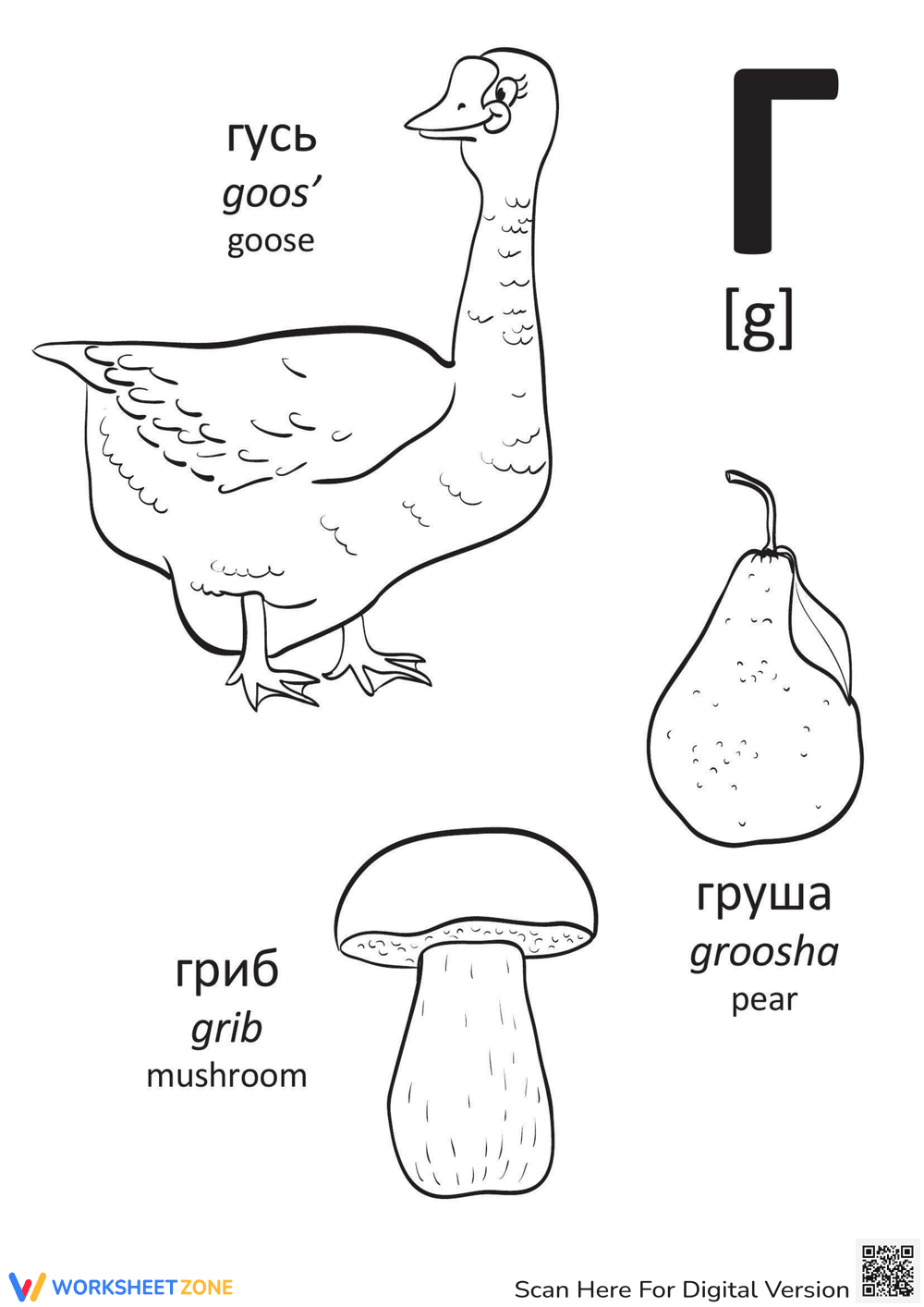

Russian Alphabet G — Printable Kindergarten Sheet
Paste this activity's link or code into your existing LMS (Google Classroom, Canvas, Teams, Schoology, Moodle, etc.).
Students can open and work on the activity right away, with no student login required.
You'll still be able to track student progress and results from your teacher account.
This Kindergarten Russian alphabet worksheet targets letter "G" recognition, tracing, and basic sight word exposure in Russian, giving early learners a structured, single-letter entry point into a new writing system while reinforcing core phonics habits already practiced in English.
At a Glance
- Grade: Kindergarten · Subject: English Language Arts / Early Literacy
- Standard:
CCSS.ELA-LITERACY.RF.K.1— Demonstrate understanding of organization and basic features of print- Skill Focus: Russian letter "G" recognition, tracing, and sight word identification
- Format: 1 page · 6 problems · Coloring activity included · PDF
- Best For: Enrichment, early literacy centers, multicultural exploration
- Time: 10–20 minutes
Inside this single-page PDF: letter tracing lines for uppercase and lowercase Russian "G," a coloring illustration tied to a Russian sight word, and short recognition tasks that connect the letter's shape to its sound. No word bank or sentence frames are included — the sheet is intentionally lean so young learners stay focused on one letter at a time. Part of a 33-letter Russian Alphabet series, each sheet follows the same clean layout.
Skill Progression
- Guided practice: 2 tracing tasks model the stroke sequence for Russian "G" with directional arrows, reducing motor uncertainty before independent writing.
- Supported practice: 2 recognition tasks ask students to identify the target letter among similar Cyrillic characters, building visual discrimination with a constrained choice set.
- Independent practice: 2 sight-word and coloring tasks let students apply letter knowledge without scaffolding, consolidating the I Do, We Do, You Do gradual-release cycle in a single page.
Standards Alignment
Primary standard: CCSS.ELA-LITERACY.RF.K.1 — Students demonstrate understanding of the organization and basic features of print, including recognizing that letters represent sounds and that print carries meaning. This worksheet extends that concept cross-linguistically, reinforcing print awareness in a novel alphabet context. Supporting connection: CCSS.ELA-LITERACY.L.K.1 addresses foundational conventions of standard English, which pairs naturally with comparative alphabet study. Both standard codes can be copied directly into lesson plans, IEP goals, or district curriculum mapping tools.
How to Use It
Use after a brief teacher-led introduction to the Cyrillic alphabet or as a literacy center activity during independent work time. Assign as enrichment for students who have mastered English letter recognition and are ready for cross-linguistic challenge. Formative tip: observe whether students self-correct stroke direction during tracing — reversal patterns here mirror common English letter-reversal issues worth noting. Expected completion time: 10–20 minutes depending on coloring detail chosen by the student.
Who It's For
Best suited for Kindergarten students in enrichment tracks, dual-language programs, or classrooms with Russian-speaking families seeking home-school connection. Pairs naturally with an anchor chart showing the full 33-letter Cyrillic alphabet posted at the literacy center. Teachers can sequence all 33 sheets across the year as a recurring enrichment rotation without additional prep.
This worksheet supports CCSS.ELA-LITERACY.RF.K.1 print-awareness development by extending letter-recognition practice into the Cyrillic writing system. Research from Fisher & Frey (2014) on gradual-release frameworks confirms that brief, focused single-skill practice — under 20 minutes — produces stronger retention in early readers than extended mixed-skill sessions. The sheet's tracing-to-recognition-to-application sequence mirrors that model. Six discrete tasks keep cognitive load low while giving teachers an observable, task-by-task window into each student's fine-motor control and visual discrimination. Suitable for literacy centers, enrichment folders, or multicultural family engagement packets, this one-page PDF requires no teacher setup and fits any Kindergarten ELA block focused on foundational print concepts.


