


























Views
Downloads


Runny Materials Science Worksheet | Grade 3 Printable
Paste this activity's link or code into your existing LMS (Google Classroom, Canvas, Teams, Schoology, Moodle, etc.).
Students can open and work on the activity right away, with no student login required.
You'll still be able to track student progress and results from your teacher account.
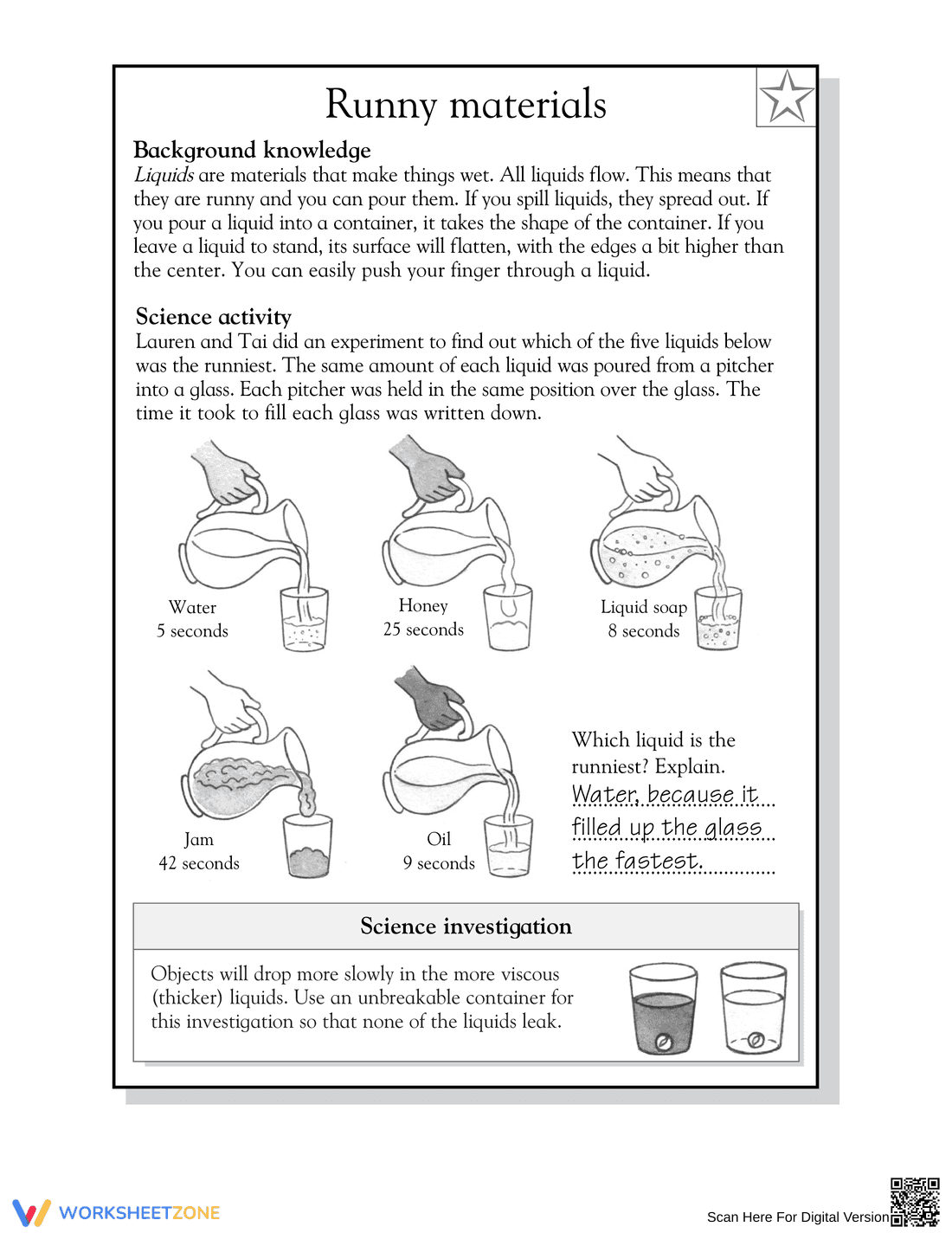
Students explore the physical properties of liquids by analyzing flow rates and viscosity in this engaging science worksheet. By interpreting experimental data from five different substances, learners identify which materials are the "runniest" and explain their reasoning using evidence. This resource bridges the gap between observation and data-driven scientific conclusions for elementary learners.
At a Glance
- Grade: 3 · Subject: Science
- Standard:
2-PS1-1— Plan and conduct an investigation to describe and classify different kinds of materials- Skill Focus: Properties of liquids and viscosity
- Format: 1 page · 2 problems · Answer key included · PDF
- Best For: Science centers or quick formative assessments
- Time: 15–20 minutes
What's Inside
This single-page PDF features a concise "Background Knowledge" section that defines liquid behavior and flow. The core "Science Activity" presents a controlled experiment involving water, honey, liquid soap, jam, and oil, complete with timed results. Students must interpret this data to answer a critical thinking prompt. The page concludes with a "Science Investigation" design block for hands-on extension.
Zero-Prep Workflow
This resource is designed for immediate classroom implementation with a total teacher prep time of under 2 minutes. Simply Print the single-page PDF for your class (30 seconds), Distribute to students as a bell-ringer or center activity (30 seconds), and Review the results using the included answer key for instant feedback (1 minute). It is an ideal emergency sub plan or quick check for understanding.
Standards Alignment
This resource aligns to 2-PS1-1, focusing on investigations to describe materials by observable properties. While used for Grade 3, it supports progression toward 5-PS1-3 by introducing measurements as evidence for identification. Both standard codes can be copied directly into lesson plans, IEP goals, or district curriculum mapping tools to ensure all scientific observations are tracked against national benchmarks.
How to Use It
Assign this worksheet during a unit on states of matter after a direct instruction lesson on liquids. It works best as a "During" instruction activity to reinforce the concept of flow and viscosity. For a formative assessment, observe students during the final "Science Investigation" prompt to see if they can identify that objects fall faster through less viscous liquids. Expect completion within 20 minutes.
Who It's For
This worksheet is tailored for third-grade students exploring physical science and the scientific method. It is particularly effective for visual learners who benefit from the clear illustrations of the pouring experiment. This resource pairs naturally with a hands-on "States of Matter" anchor chart or a reading passage on physical properties of common household substances.
Scientific literacy in the elementary years depends on the ability to translate observable physical phenomena into data-driven conclusions. According to Fisher & Frey (2014), the gradual release of responsibility—moving from teacher-led background knowledge to student-led investigations—is essential for deepening comprehension. This worksheet leverages the 2-PS1-1 framework, where students first observe liquid properties like flow rate and then apply those observations to a self-designed experiment. By measuring the viscosity of various materials, students build the foundational analytical skills required for higher-level science. This approach ensures that learners do not just memorize definitions but actively engage in the scientific method. Research indicates that hands-on inquiry, combined with structured data analysis, significantly improves retention of physical property concepts across student populations in the third through fifth-grade range. This 1-page resource provides the necessary scaffolding for students to master these complex physical science concepts efficiently.


