




























Views
Downloads

RL.7.1 Worksheet: The Sound We Kept — Grade 7 Aligned

Paste this activity's link or code into your existing LMS (Google Classroom, Canvas, Teams, Schoology, Moodle, etc.).
Students can open and work on the activity right away, with no student login required.
You'll still be able to track student progress and results from your teacher account.
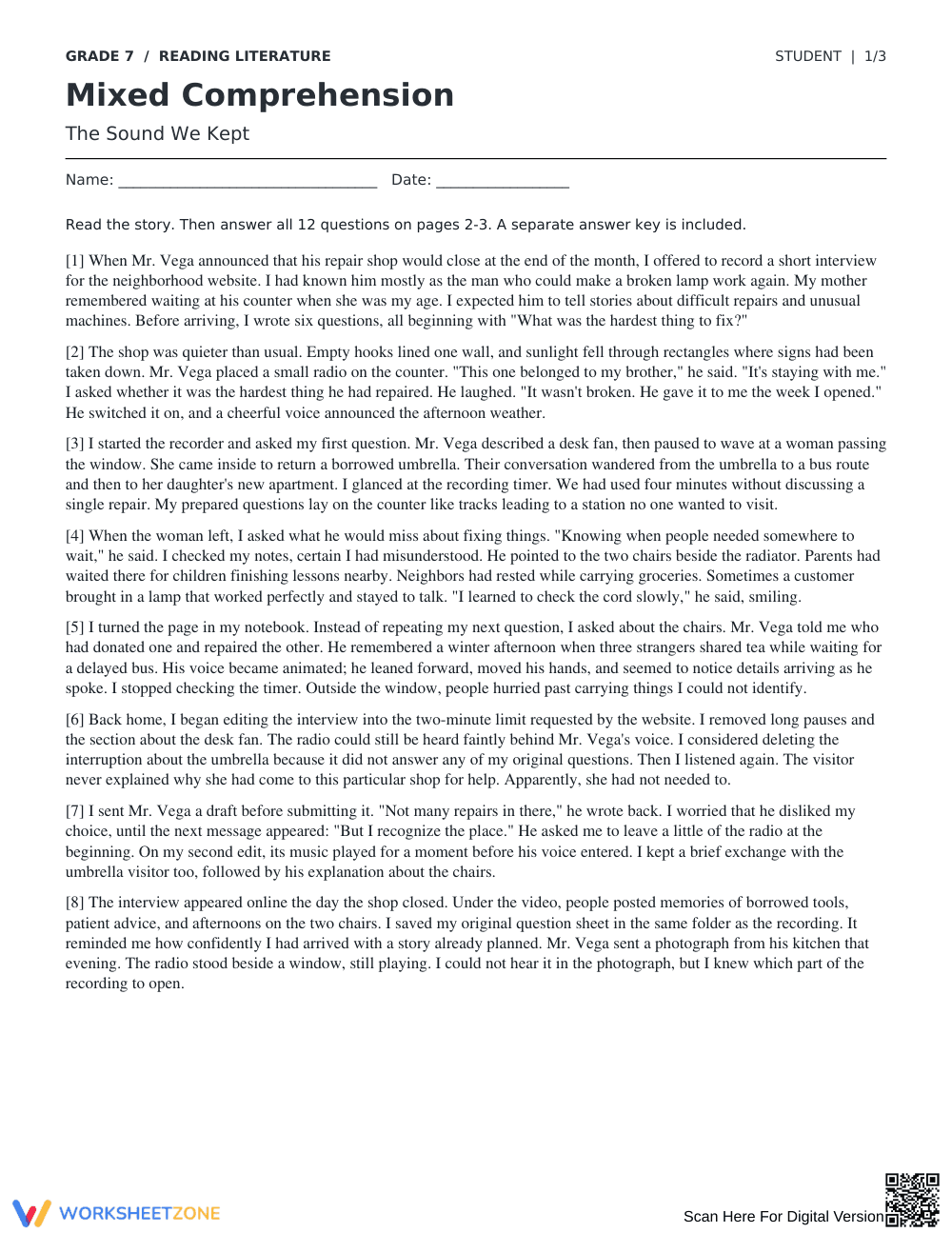
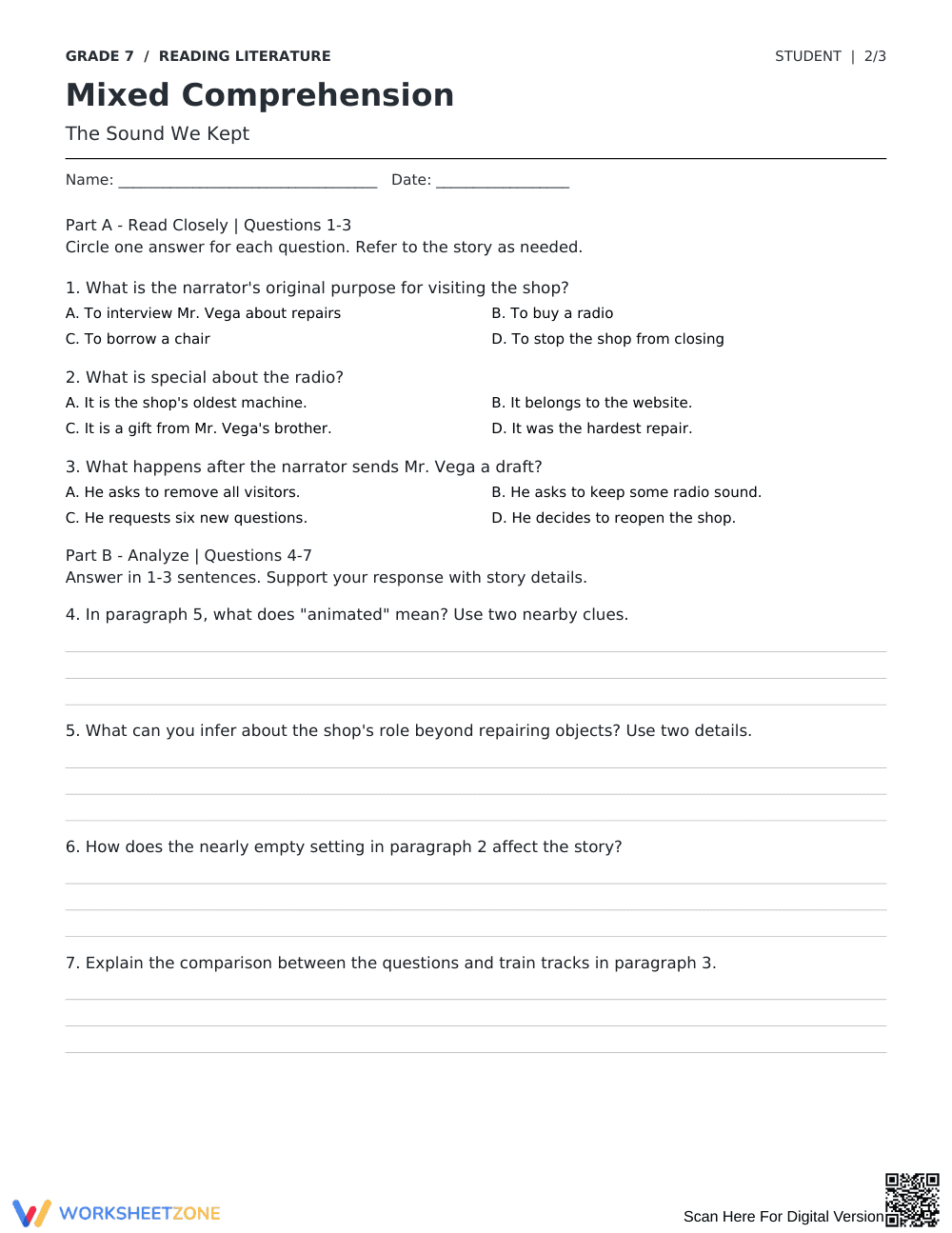
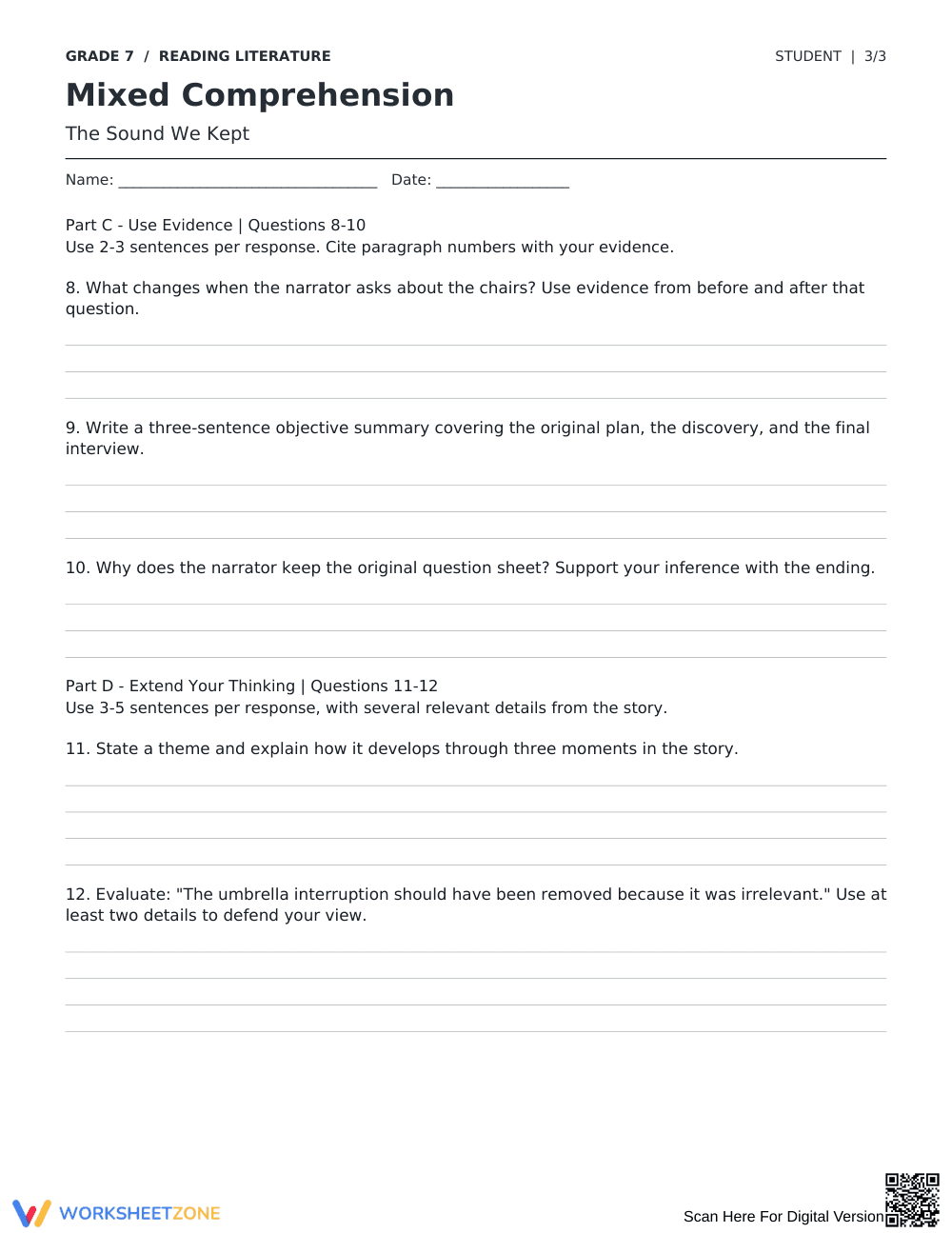
This Grade 7 reading literature worksheet evaluates students' ability to analyze text, determine theme, and cite explicit textual evidence using an original realistic fiction passage, 'The Sound We Kept.' Learners engage with 12 scaffolded questions that bridge literal comprehension and deep critical evaluation, demonstrating mastery of key middle school reading standards.
At a Glance
- Grade: 7 · Subject: English Language Arts
- Standard:
CCSS.ELA-LITERACY.RL.7.1— Cite several pieces of textual evidence to support analysis of what text says- Skill Focus: Literature Comprehension & Text Evidence
- Format: 3 pages · 12 problems · Answer key included · PDF
- Best For: Standards-based literary reading comprehension assessment
- Time: 35–45 minutes
What's Inside
The 3-page printable features an 8-paragraph narrative, 'The Sound We Kept,' followed by 12 varied items across 4 sections: multiple-choice recall, short-response analysis, evidence-based responses citing paragraph numbers, and extended evaluation. A 2-page answer key provides complete model responses and a 36-point rubric.
Mastery Evidence
A 36-point scoring rubric categorizes student proficiency across three distinct tiers. Scores under 25 indicate Approaching mastery, highlighting difficulties with evidence citation or inference. Scores from 26 to 31 represent Meeting proficiency, confirming accurate textual inferences, objective summary writing, and vocabulary analysis. Scores of 32 to 36 reflect Exceeding standards through sophisticated theme analysis and argument evaluation. Scores transfer directly into gradebooks or IEP progress notes.
Standards Alignment
Primary alignment targets `CCSS.ELA-LITERACY.RL.7.1`: Cite several pieces of textual evidence to support analysis of what the text says explicitly as well as inferences drawn from the text. Secondary reinforcement targets `CCSS.ELA-LITERACY.RL.7.2` through theme identification and objective summary writing. Both standard codes can be copied directly into lesson plans, IEP goals, or district curriculum mapping tools.
How to Use It
Administer this assessment after direct instruction on citing textual evidence, budgeting 35 to 45 minutes for independent student completion. During testing, check Part B formatively to verify students look back at paragraphs 3 and 5 rather than guessing. Alternatively, assign the passage during mid-unit review to identify students needing targeted reteaching before quarterly exams.
Who It's For
This printable is designed for Grade 7 English language arts classrooms, intervention blocks, and tutoring settings. Differentiate for emerging readers by providing chunked reading or paired read-alouds, while advanced learners complete Part D independently. Pair this assessment directly with an anchor chart outlining summary writing rules.
Grade 7 reading comprehension standards require middle school students to cite specific textual evidence to support both literal statements and complex thematic inferences. According to Fisher & Frey (2014), purposeful close reading sequences that progress from literal recall to text-dependent analysis and extended evaluative synthesis foster lasting literacy gains. This instructional worksheet targets CCSS.ELA-LITERACY.RL.7.1 by pairing an engaging eight-paragraph realistic narrative with twelve rigorous, multi-tiered comprehension questions. Across three structured pages, students analyze character motives, interpret figurative comparisons, draft objective summaries, and defend literary evaluations using precise paragraph citations. A complete two-page teacher answer key provides explicit model responses alongside an objective thirty-six-point scoring rubric that distinguishes approaching, meeting, and exceeding proficiency tiers. Educators can reliably implement this standards-aligned resource for summative benchmarks, sub plans, or progress monitoring to ensure seventh-grade readers develop verifiable evidence-based analytical skills.


