


























1 / 3
0
Views
0
Downloads


10.0
0
Save
0 Likes
Share
Crack Riddles and Codes with this Fun Worksheet
0 Views
0 Downloads
Paste this activity's link or code into your existing LMS (Google Classroom, Canvas, Teams, Schoology, Moodle, etc.).
Students can open and work on the activity right away, with no student login required.
You'll still be able to track student progress and results from your teacher account.
Information
Description
What It Is:
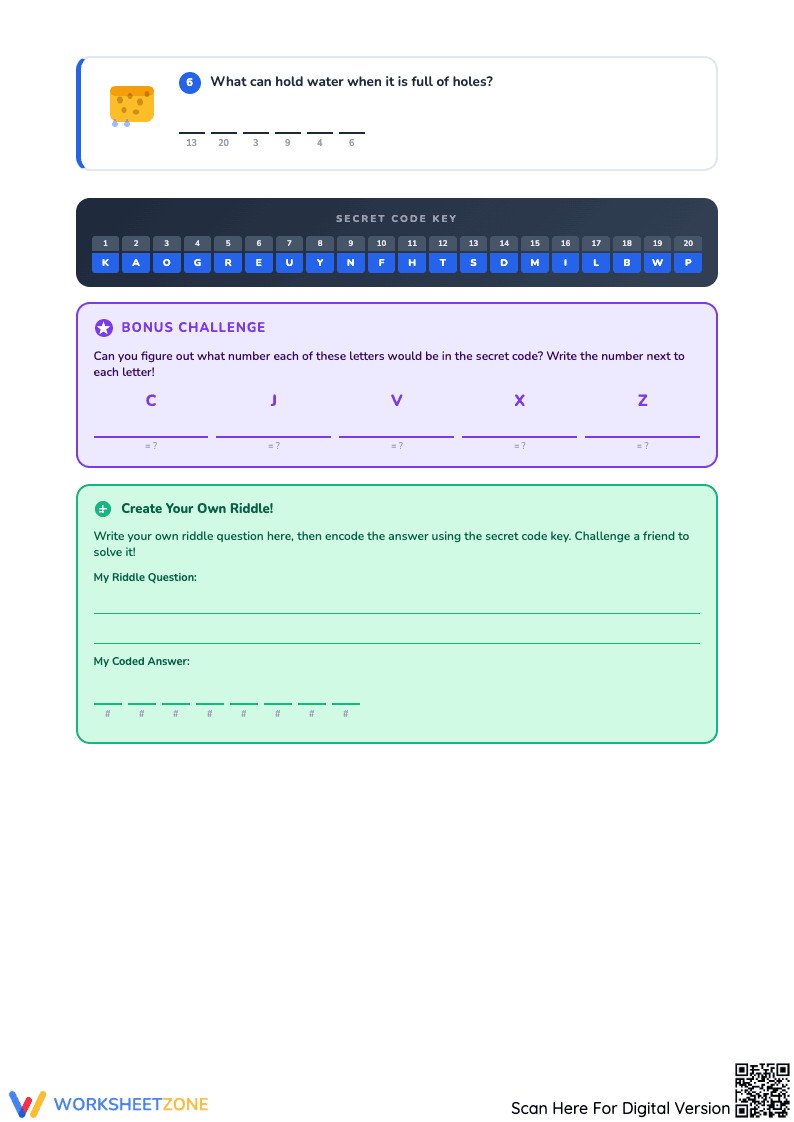
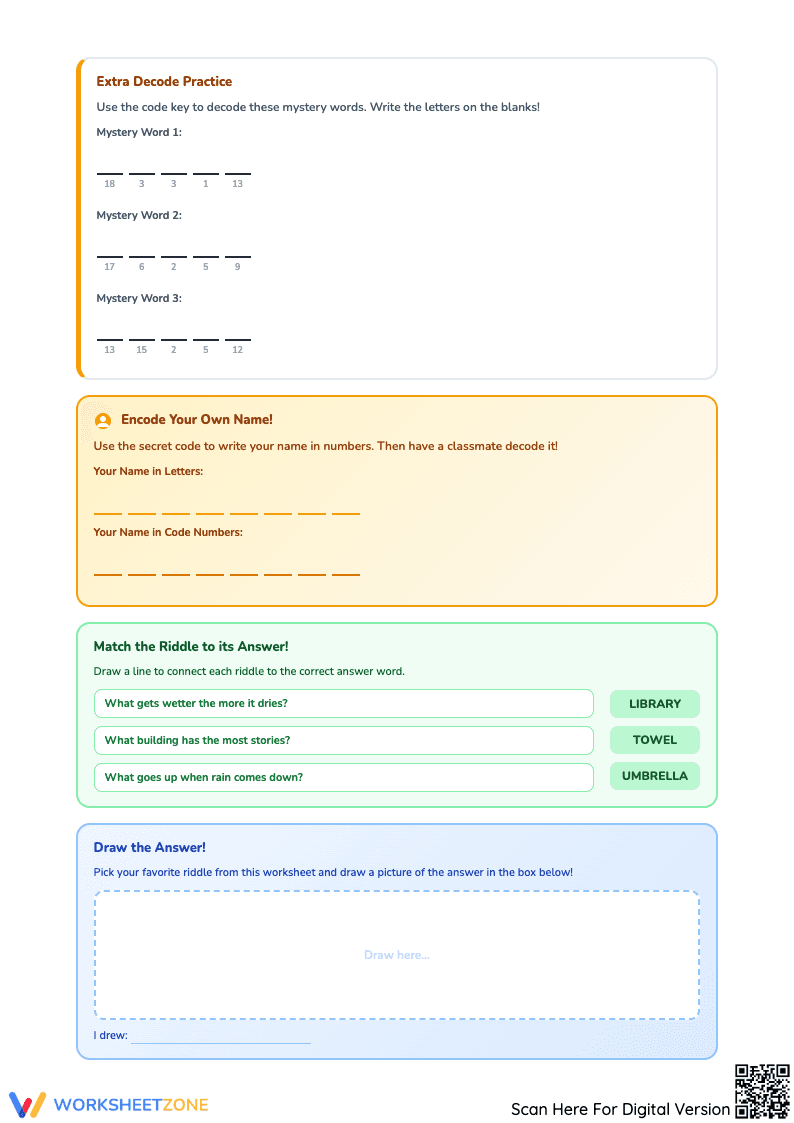
This is a worksheet titled 'Riddles and Codes.' It presents a series of riddles, each accompanied by a sequence of numbers. A code key is provided at the bottom, linking each number to a specific letter of the alphabet. The student must use the code to decipher the answer to each riddle and write the letters in the spaces provided. The worksheet also includes simple illustrations related to some of the riddles, such as a cap, rain clouds, a city skyline, and a bucket.
Grade Level Suitability:
This worksheet is suitable for grades 2-4. The riddles are relatively simple and age-appropriate, while the code-breaking aspect adds an element of challenge and reinforces letter recognition and number association.
Why Use It:
This worksheet encourages critical thinking, problem-solving skills, and letter recognition. It combines the fun of riddles with the challenge of code-breaking, making learning engaging and interactive. It also helps reinforce the alphabet and number associations.
How to Use It:
First, read the riddle carefully. Then, for each number provided below the riddle, find the corresponding letter in the code key at the bottom of the page. Write that letter in the blank space above the number. Once all the numbers have been decoded, the letters will spell out the answer to the riddle.
Target Users:
This worksheet is ideal for elementary school students in grades 2-4 who enjoy riddles and puzzles. It can be used in the classroom as a supplemental activity or at home for extra practice and fun. It's also beneficial for students who need to strengthen their letter recognition and problem-solving skills.
This is a worksheet titled 'Riddles and Codes.' It presents a series of riddles, each accompanied by a sequence of numbers. A code key is provided at the bottom, linking each number to a specific letter of the alphabet. The student must use the code to decipher the answer to each riddle and write the letters in the spaces provided. The worksheet also includes simple illustrations related to some of the riddles, such as a cap, rain clouds, a city skyline, and a bucket.
Grade Level Suitability:
This worksheet is suitable for grades 2-4. The riddles are relatively simple and age-appropriate, while the code-breaking aspect adds an element of challenge and reinforces letter recognition and number association.
Why Use It:
This worksheet encourages critical thinking, problem-solving skills, and letter recognition. It combines the fun of riddles with the challenge of code-breaking, making learning engaging and interactive. It also helps reinforce the alphabet and number associations.
How to Use It:
First, read the riddle carefully. Then, for each number provided below the riddle, find the corresponding letter in the code key at the bottom of the page. Write that letter in the blank space above the number. Once all the numbers have been decoded, the letters will spell out the answer to the riddle.
Target Users:
This worksheet is ideal for elementary school students in grades 2-4 who enjoy riddles and puzzles. It can be used in the classroom as a supplemental activity or at home for extra practice and fun. It's also beneficial for students who need to strengthen their letter recognition and problem-solving skills.


