


























Views
Downloads
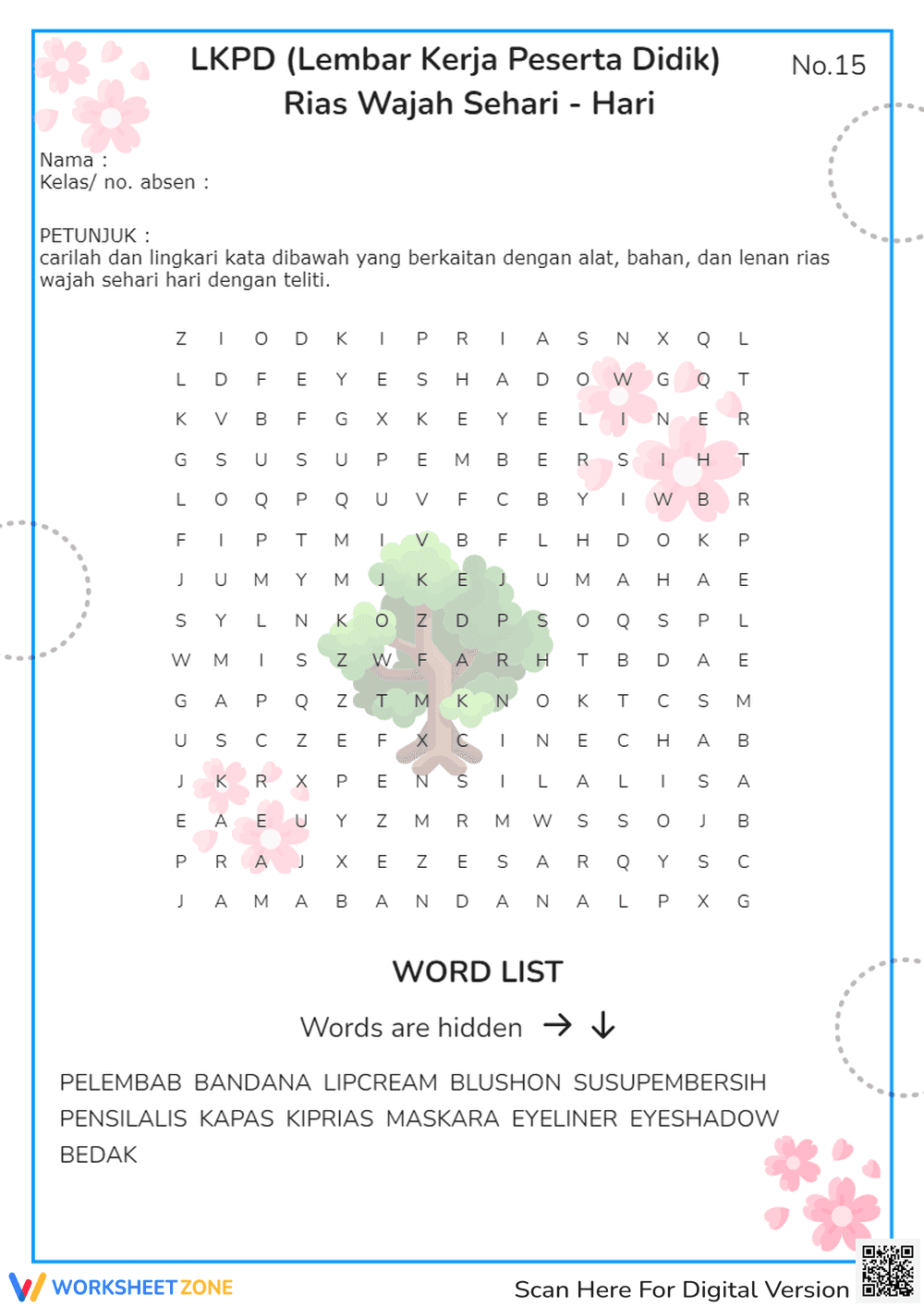

Printable Makeup Vocabulary Word Search | Grade 2
Paste this activity's link or code into your existing LMS (Google Classroom, Canvas, Teams, Schoology, Moodle, etc.).
Students can open and work on the activity right away, with no student login required.
You'll still be able to track student progress and results from your teacher account.
This engaging vocabulary word search helps students build word recognition and spelling skills through a fun, themed activity. By searching for twelve specific daily makeup and cosmetic terms, learners reinforce their visual scanning abilities and letter-pattern awareness. The straightforward format ensures students can immediately begin practicing their vocabulary acquisition independently.
At a Glance
- Grade: 2 · Subject: Vocabulary
- Standard:
CCSS.ELA-LITERACY.L.2.6— Use acquired words and phrases- Skill Focus: Word recognition and spelling
- Format: 1 page · 12 problems · No answer key · PDF
- Best For: Independent practice and morning work
- Time: 10–15 minutes
Inside this single-page resource, educators will find a clearly formatted word search puzzle featuring twelve distinct vocabulary words related to daily cosmetics. The worksheet includes a dedicated word bank at the bottom, displaying terms like eyeliner and mascara to guide students. The grid is designed with clear text, making it accessible for early elementary readers to scan horizontally and vertically.
This resource is designed for immediate classroom implementation with a highly efficient zero-prep workflow.
- Print (1 minute): Simply download the PDF and print the required number of copies.
- Distribute (1 minute): Hand out the single-page puzzle to students. The clear instructions and visible word bank mean no additional teacher setup is required.
- Review (3 minutes): Quickly check student progress by scanning their circled words against the provided list.
With a total teacher preparation time of under two minutes, this worksheet serves as an excellent emergency sub plan or a rapid transition activity.
This activity is aligned to CCSS.ELA-LITERACY.L.2.6: Use words and phrases acquired through conversations, reading and being read to, and responding to texts, including using adjectives and adverbs to describe. It also supports foundational reading skills by encouraging students to decode and recognize complex letter sequences. Both standard codes can be copied directly into lesson plans, IEP goals, or district curriculum mapping tools.
Teachers can utilize this word search as a calming morning work assignment to help students settle into the school day while activating their cognitive skills. Alternatively, it functions perfectly as an early finisher activity during literacy blocks, keeping fast-working students engaged without disrupting peers. For a formative assessment observation tip, note if students scan systematically by first letters, indicating strong phonemic awareness. Expect most second-grade students to complete this puzzle within a ten to fifteen-minute timeframe.
This worksheet is primarily designed for second-grade students developing their visual tracking and spelling capabilities. It serves as a helpful tool for English Language Learners or students studying Indonesian vocabulary, as the thematic word list provides focused exposure to specific terminology. To differentiate for students needing extra support, teachers can highlight the first letter of each hidden word in the grid. This activity pairs naturally with a direct instruction lesson on personal care routines or a thematic vocabulary anchor chart.
Effective vocabulary instruction requires multiple exposures to target words in varied contexts. This activity supports CCSS.ELA-LITERACY.L.2.6 by requiring students to use acquired words and phrases through active visual engagement. When learners search for specific letter sequences, they reinforce orthographic mapping skills, critical for fluent reading. According to Fisher & Frey (2014), providing structured, independent practice significantly improves vocabulary retention and spelling pattern recognition. Word searches offer a low-stakes environment where students interact with new terminology, reducing cognitive load while building word recognition automaticity. By integrating this targeted practice into routines, educators foster stronger foundational literacy skills, ensuring students internalize the structural components of the words.


