


























Views
Downloads
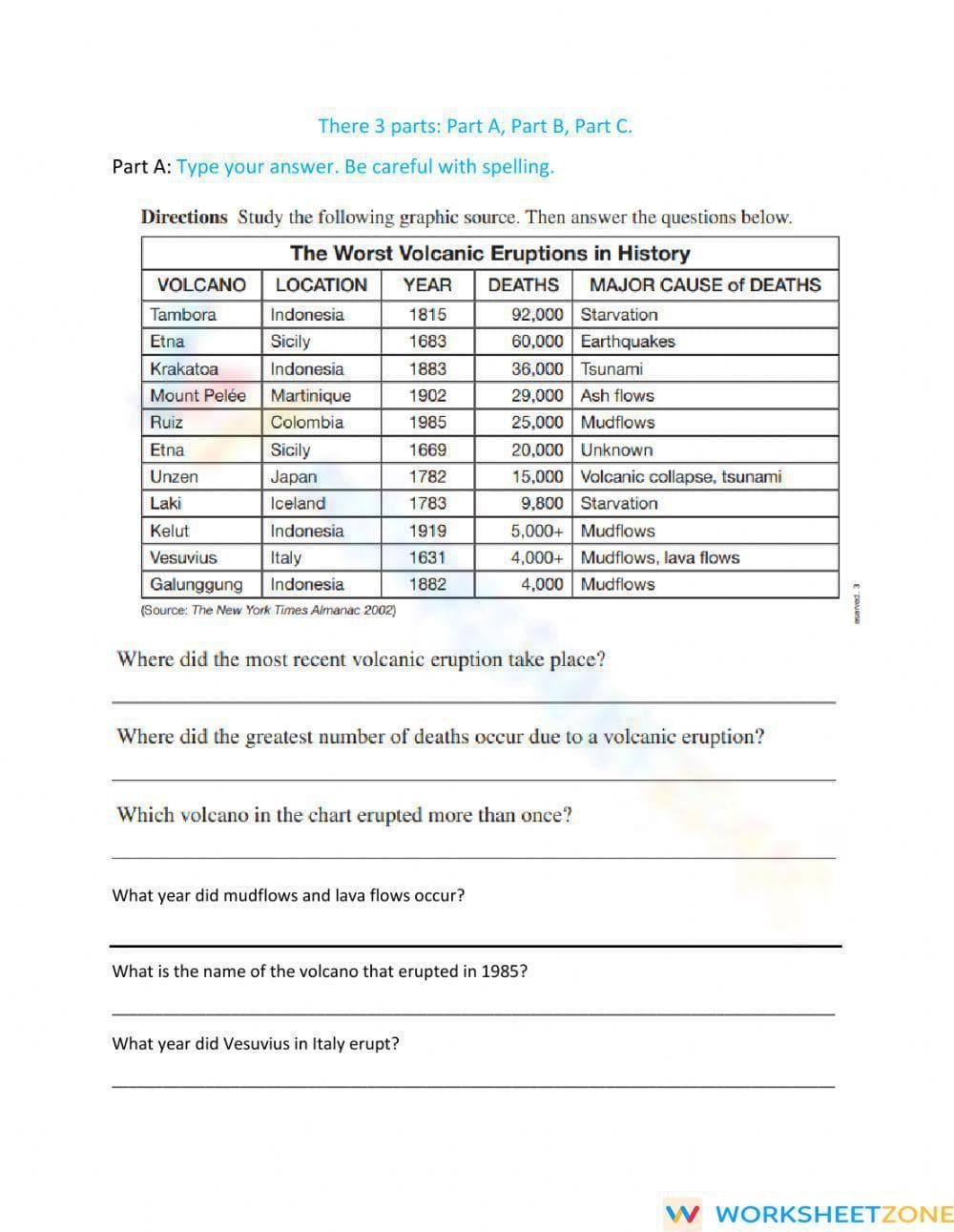


Printable ELA Review Worksheet: Grade 4 Volcanic Data
Paste this activity's link or code into your existing LMS (Google Classroom, Canvas, Teams, Schoology, Moodle, etc.).
Students can open and work on the activity right away, with no student login required.
You'll still be able to track student progress and results from your teacher account.
This Grade 4 ELA review worksheet helps students extract information from graphic sources, define geography vocabulary, and identify phonics patterns. By analyzing volcano data and mastering the /er/ sound, learners develop essential skills for interpreting complex non-fiction texts and improving spelling accuracy.
At a Glance
- Grade: 4 · Subject: ELA
- Standard:
CCSS.ELA-LITERACY.RI.4.7— Interpret information presented visually in charts and graphs to build deep text understanding- Skill Focus: Data Interpretation, Vocab, and Phonics
- Format: 2 pages · 30 problems · Answer key included · PDF
- Best For: End-of-unit review or assessment preparation
- Time: 25–35 minutes
What's Inside
This resource contains 30 tasks across two pages. Part A features a "Worst Volcanic Eruptions" table with six comprehension questions. Part B includes an eight-word matching activity for geography terms like "erupted" and "tides." Part C provides a phonics grid where students identify sixteen words containing the /er/ sound pattern.
Zero-Prep Workflow
This resource is designed for immediate use. First, print the two-page PDF (30 seconds). Second, distribute to students for independent practice (1 minute). Third, use the included answer key for rapid grading (5 minutes). Total preparation time is under two minutes, making it perfect for sub plans or bell-ringers.
Standards Alignment
The primary focus is CCSS.ELA-LITERACY.RI.4.7, interpreting information in charts. It also supports CCSS.ELA-LITERACY.RF.4.3 through vowel-r phonics identification. Both standard codes can be copied directly into lesson plans, IEP goals, or district curriculum mapping tools to track student progress toward mastery.
How to Use It
Assign this worksheet as a summative review after studying informational text or Earth science. It bridges science and literacy, allowing teachers to observe data retrieval skills. Students should complete the thirty tasks in about thirty minutes, providing a clear snapshot of their current proficiency in data analysis and phonemic awareness.
Who It's For
This resource is ideal for Grade 4-5 students, offering helpful scaffolding for advanced Grade 3 learners. It is particularly effective for English Language Learners due to the visual data and clear definitions. Pair it with a short passage about geological disasters or a phonics anchor chart for maximum instructional impact.
According to the RAND AIRS 2024 research, integrating quantitative data analysis into elementary ELA instruction improves a student's ability to synthesize information from diverse formats. This worksheet addresses this by requiring students to navigate a complex data table to answer factual questions, a core requirement of CCSS.ELA-LITERACY.RI.4.7. By practicing the identification of the /er/ sound, students strengthen orthographic processing skills, a key predictor of reading fluency. The vocabulary matching component ensures that technical geography terms are reinforced. This balanced approach—combining phonics, vocabulary, and informational text analysis—aligns with evidence-based practices for comprehensive instruction. Educators can use this 30-task tool to provide the structured repetition necessary to master essential reading standards while building background knowledge. This self-contained resource serves as a valid assessment of a student's readiness to interact with more complex informational texts in higher grades.


