


























Views
Downloads
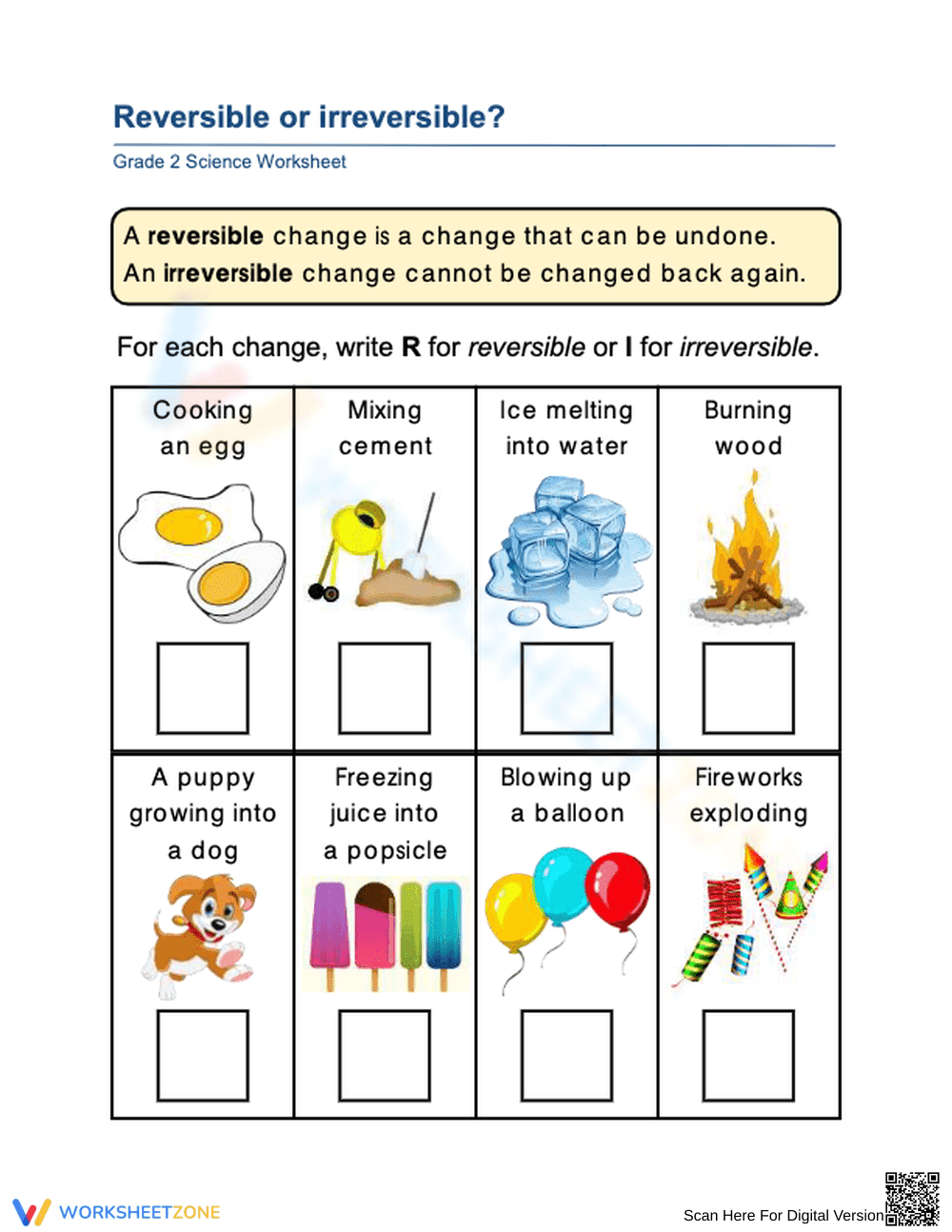

Grade 2 Reversible Changes — Printable No-Prep Worksheet
Paste this activity's link or code into your existing LMS (Google Classroom, Canvas, Teams, Schoology, Moodle, etc.).
Students can open and work on the activity right away, with no student login required.
You'll still be able to track student progress and results from your teacher account.
This Grade 2 science worksheet helps students identify whether physical changes to materials are reversible or irreversible. By analyzing everyday examples like melting ice and cooking an egg, young learners build foundational knowledge of material properties and how heating, cooling, or mixing affects different substances.
At a Glance
- Grade: 2 · Subject: Science
- Standard:
2-PS1-4— Identify changes to materials that can and cannot be reversed.- Skill Focus: Reversible and Irreversible Changes
- Format: 2 pages · 8 problems · Answer key included · PDF
- Best For: Independent practice or review
- Time: 10–15 minutes
What's Inside
This resource includes a single-page student worksheet featuring eight visual classification tasks. Students examine colorful illustrations of various physical and chemical changes—such as a puppy growing, fireworks exploding, and freezing juice into a popsicle—and write "R" for reversible or "I" for irreversible. A complete, identical answer key is provided on the second page for quick grading or self-checking.
Zero-Prep Workflow
Designed for immediate classroom use, this activity requires minimal teacher setup:
- Print (1 minute): Generate copies of the single-page student handout.
- Distribute (1 minute): Hand out the worksheets along with pencils.
- Review (3 minutes): Use the included answer key to quickly check student responses or project it for whole-class review.
With under two minutes of total teacher prep time, this worksheet is an excellent addition to any emergency sub plan or quick science center.
Standards Alignment
This activity is aligned to the Next Generation Science Standard 2-PS1-4: Construct an argument with evidence that some changes caused by heating or cooling can be reversed and some cannot. It provides the foundational identification practice needed before students begin constructing formal arguments about material changes. Both standard codes can be copied directly into lesson plans, IEP goals, or district curriculum mapping tools.
How to Use It
Teachers can deploy this worksheet during the independent practice phase of a lesson on material properties, right after direct instruction on how temperature affects matter. Alternatively, use it as a quick formative assessment at the end of the week to gauge student comprehension. While students work, observe whether they struggle with biological changes (like a puppy growing) versus physical changes (like melting ice) to identify areas needing reteaching. Expected completion time is 10 to 15 minutes.
Who It's For
This resource is ideal for second-grade general education students, though it also serves as a great review for third graders. The strong visual supports make it highly accessible for English Language Learners and students needing visual accommodations. Pair this worksheet with a hands-on demonstration, such as melting and refreezing an ice cube, to solidify the concepts before independent practice.
Understanding how matter interacts and changes is a core component of early elementary science education. Aligned with 2-PS1-4, this resource helps students identify changes to materials that can and cannot be reversed. According to a ScienceDirect TpT Analysis, providing students with clear, visually supported examples of scientific phenomena significantly improves their ability to categorize and retain complex concepts. By evaluating familiar scenarios like mixing cement, burning wood, or blowing up a balloon, learners bridge the gap between abstract scientific principles and their everyday environments. This structured practice builds the necessary cognitive framework for later, more advanced chemistry and physics topics. Consistent exposure to these foundational classification tasks ensures students develop strong analytical skills, critical thinking abilities, and a deeper, more practical understanding of the physical world around them.


