




























Views
Downloads

Restriction Enzyme Worksheet | Essential Biology Practice

Paste this activity's link or code into your existing LMS (Google Classroom, Canvas, Teams, Schoology, Moodle, etc.).
Students can open and work on the activity right away, with no student login required.
You'll still be able to track student progress and results from your teacher account.
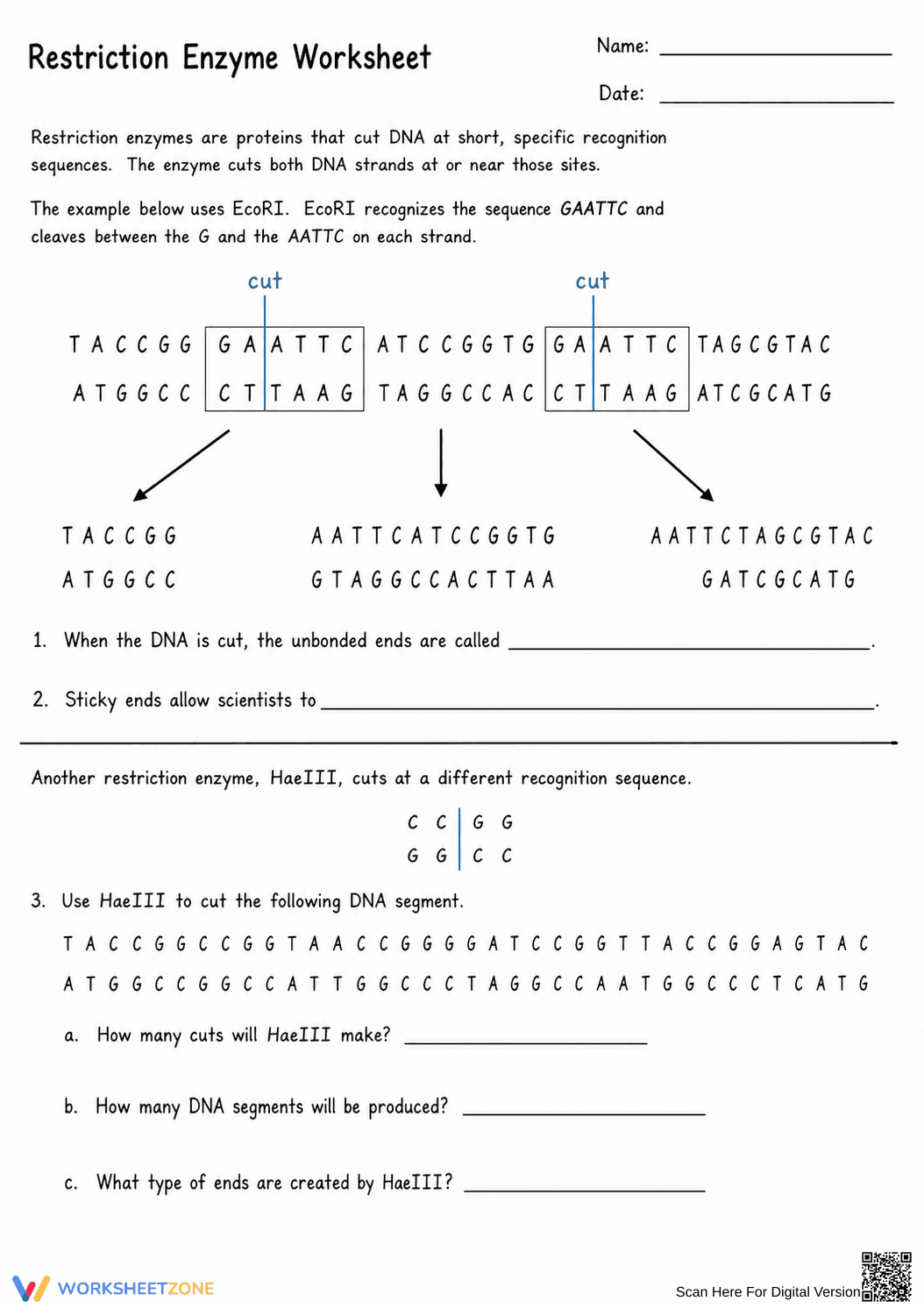
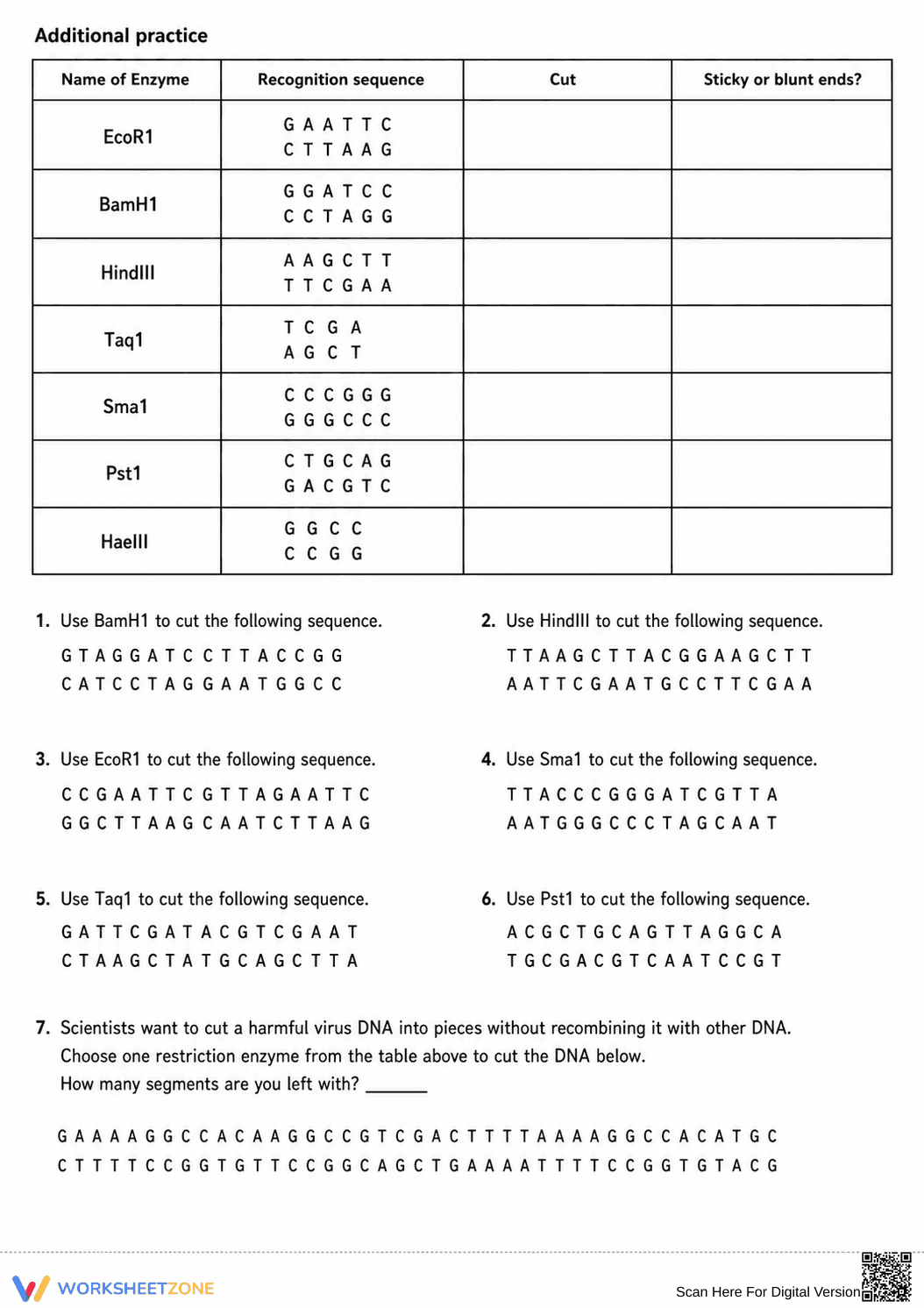
This High School Biology worksheet provides students with targeted practice in molecular biology techniques. Students will identify specific recognition sequences and simulate how enzymes like EcoR1 and HaeIII cleave DNA strands. By the end of these two pages, learners will confidently distinguish between sticky and blunt ends in genetic engineering contexts.
At a Glance
- Grade: High School · Subject: Biology
- Standard:
HS-LS1-1— Explain how DNA sequences determine protein structure and function in organisms- Skill Focus: DNA Cleavage & Recognition
- Format: 2 pages · 15 problems · Answer key included · PDF
- Best For: Biotechnology units and sub plans
- Time: 30–45 minutes
The resource consists of a two-page PDF designed for immediate classroom use. Page one introduces the concept with a worked example of EcoR1, followed by fill-in-the-blank terminology and a guided practice problem for HaeIII. Page two features a comprehensive reference table for seven different enzymes and seven independent DNA sequence problems requiring students to mark cut sites manually.
This worksheet is designed for a simple three-step implementation. First, print the two-page document (30 seconds). Second, distribute to students as a follow-up to a lecture on biotechnology or as a standalone sub plan (1 minute). Finally, review the results using the included answer key to identify misconceptions regarding base pairing or palindromic sequences (5 minutes). Total teacher prep time is under two minutes.
This resource aligns with HS-LS1-1: "Construct an explanation based on evidence for how the structure of DNA determines the structure of proteins which carry out the essential functions of life through systems of specialized cells." It specifically addresses the mechanical understanding of DNA manipulation necessary for modern genetic research.
Use this worksheet during the elaborate phase of a lesson cycle after students have been introduced to the structure of DNA. It serves as an excellent formative assessment to check if students understand the specificity of enzyme action before moving into a virtual or physical electrophoresis lab. Expect students to complete the full set in 30 to 45 minutes depending on their familiarity with base-pair sequences.
This practice set is tailored for General Biology or AP Biology students. It provides necessary scaffolding for learners who struggle with spatial visualization of DNA strands while offering enough complexity for advanced students through the multi-enzyme table.
According to the RAND AIRS 2024 report, structured practice in molecular biology simulations significantly improves student retention of complex genetic concepts. This worksheet focuses on the HS-LS1-1 standard, requiring students to demonstrate mastery of DNA cleavage and recognition sequences. By engaging with 15 distinct tasks, including identifying sticky and blunt ends, students build the foundational knowledge required for advanced biotechnology applications. Research from Fisher & Frey (2014) emphasizes that gradual release models—moving from guided examples to independent sequence analysis—scaffold the cognitive load effectively for high school learners. This resource provides that exact progression, ensuring that students can accurately predict the outcome of restriction enzyme application in a laboratory setting. The inclusion of multiple enzymes like BamH1 and HindIII ensures a broad understanding of biochemical specificity for all learners.


