


























Views
Downloads


Resiliency & Growth Mindset Worksheet | Grade 9 Printable
Paste this activity's link or code into your existing LMS (Google Classroom, Canvas, Teams, Schoology, Moodle, etc.).
Students can open and work on the activity right away, with no student login required.
You'll still be able to track student progress and results from your teacher account.
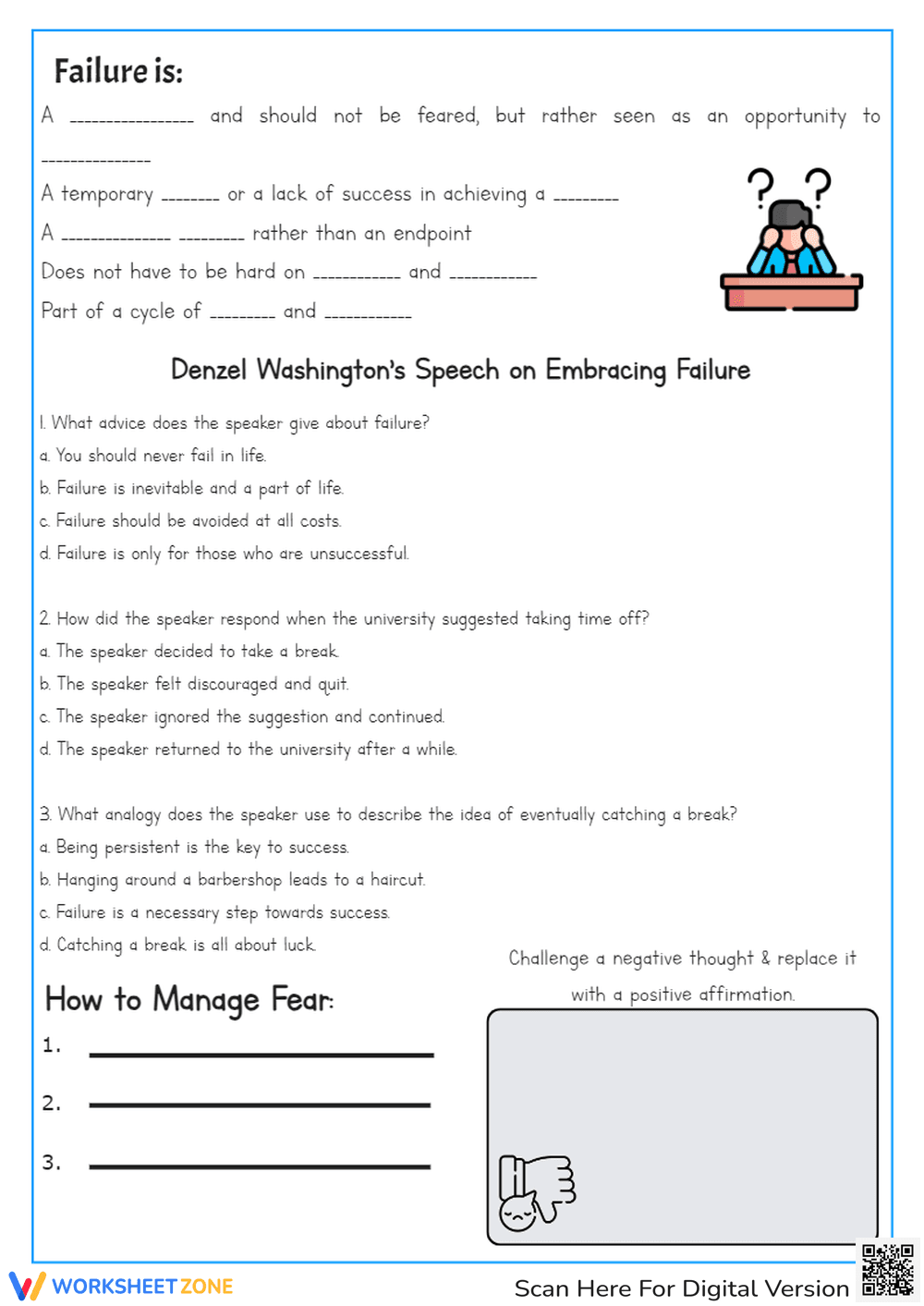
This Grade 9 social-emotional learning worksheet helps students build resiliency and develop a growth mindset. By reflecting on personal challenges and analyzing a motivational speech, students learn to reframe failure as an opportunity for growth and self-improvement.
At a Glance
- Grade: 9 · Subject: Social Emotional Learning
- Standard:
CCSS.ELA-LITERACY.RI.9-10.2— Determine a central idea and analyze its development- Skill Focus: Resiliency and Growth Mindset
- Format: 2 pages · 15 problems · Answer key included · PDF
- Best For: Advisory periods or SEL blocks
- Time: 25–35 minutes
This two-page resource features a mix of 15 engaging tasks, including open-ended reflection questions, fill-in-the-blank vocabulary exercises, and multiple-choice comprehension questions based on Denzel Washington's speech on embracing failure. It also includes creative prompts where students challenge negative thoughts and replace them with positive affirmations. A complete answer key is provided for the objective sections.
- Print (1 min): Download the PDF and print double-sided for a complete lesson.
- Distribute (1 min): Hand out to students during advisory, homeroom, or a dedicated SEL block.
- Review (3 mins): Use the included answer key to quickly check the fill-in-the-blank and multiple-choice sections.
With under five minutes of total teacher prep time, this worksheet is an ideal zero-prep solution for substitute plans or quick social-emotional check-ins.
Aligned to CCSS.ELA-LITERACY.RI.9-10.2: Determine a central idea of a text and analyze its development over the course of the text. It also supports general CASEL competencies for self-awareness and self-management. Both standard codes can be copied directly into lesson plans, IEP goals, or district curriculum mapping tools.
Use this worksheet as a guided activity during a morning meeting or advisory period to spark discussions about overcoming adversity. Alternatively, assign it as independent reflection work after a challenging unit or exam to help students process their feelings about academic setbacks. Teachers can use the "Challenge a negative thought" box as a formative assessment to gauge students' emotional regulation skills. Expected completion time is 25 to 35 minutes.
Designed for 9th-grade students, this resource is particularly beneficial for teens navigating the transition to high school. The structured fill-in-the-blanks provide scaffolding for students who struggle with open-ended writing, while the speech analysis offers depth for advanced learners. It pairs perfectly with a video viewing of Denzel Washington's commencement address or a classroom anchor chart on growth mindset.
Integrating structured reflection on resiliency and growth mindset directly supports students' ability to determine a central idea and analyze its development (CCSS.ELA-LITERACY.RI.9-10.2). According to the RAND AIRS 2024 report, explicit social-emotional learning interventions that teach students to reframe failure significantly improve both academic perseverance and long-term mental well-being. When students actively engage in analyzing motivational texts and applying those concepts to their own personal experiences, they develop a much stronger capacity to navigate the complex social and academic challenges of high school. By providing targeted exercises on managing fear, overcoming self-doubt, and challenging negative thoughts, this resource equips educators with essential, evidence-based tools to foster emotional intelligence and academic resilience. Furthermore, these targeted practices help build a supportive classroom environment where students feel safe taking intellectual risks, ultimately leading to higher engagement, improved self-regulation, and lifelong success.


