


























Views
Downloads



Essential Holocaust Research & Expository Writing Project
Paste this activity's link or code into your existing LMS (Google Classroom, Canvas, Teams, Schoology, Moodle, etc.).
Students can open and work on the activity right away, with no student login required.
You'll still be able to track student progress and results from your teacher account.
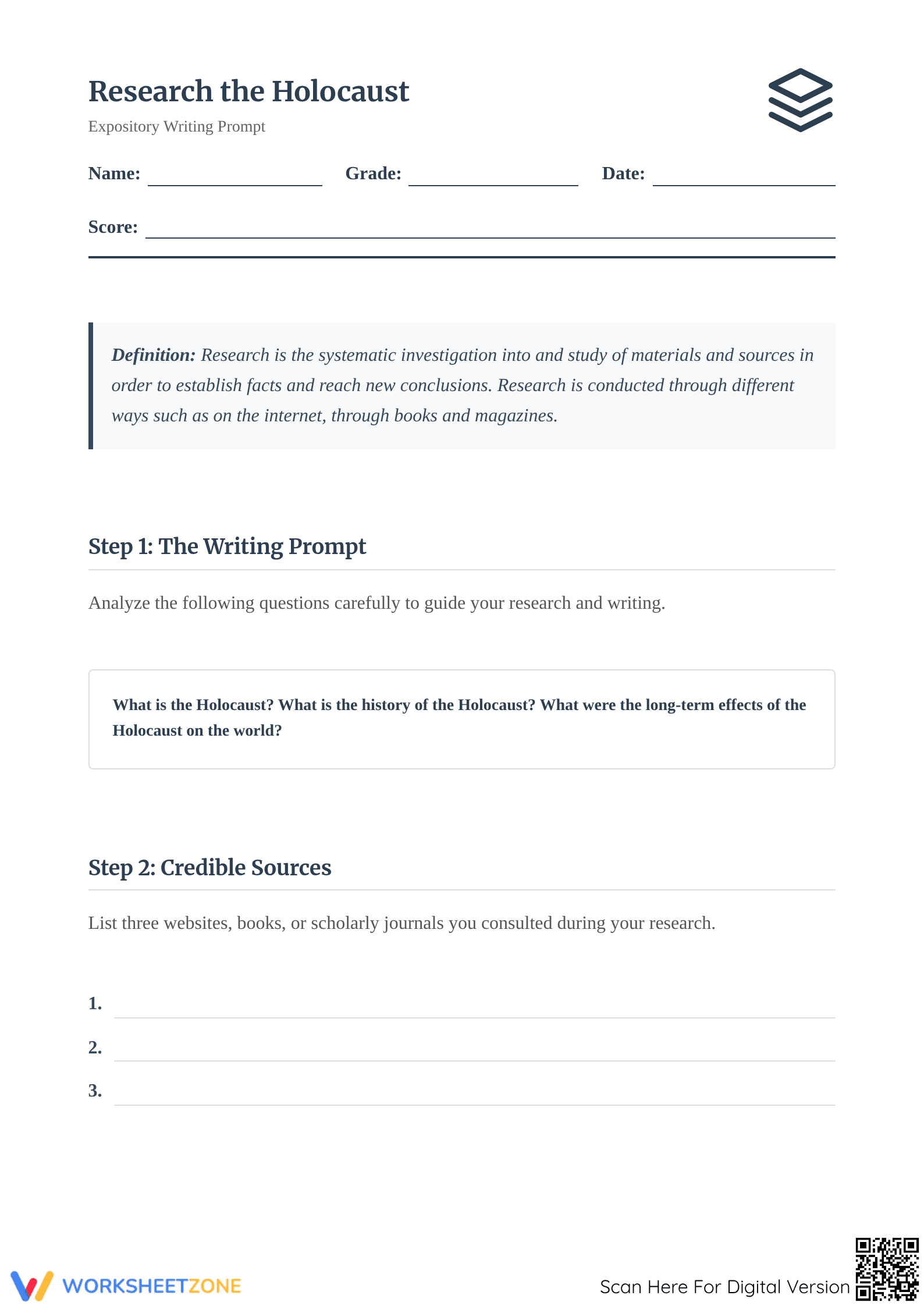
This Grade 10-12 expository writing packet guides students through a structured research project on the Holocaust. By analyzing historical prompts and evaluating credible sources, learners develop the synthesis skills required for collegiate-level academic writing. It provides a clear framework for investigating complex historical events while practicing formal expository structures and evidence-based reporting.
At a Glance
- Grade: 10-12 · Subject: English Language Arts
- Standard:
CCSS.ELA-LITERACY.W.11-12.7— Conduct research projects to answer questions and synthesize multiple sources- Skill Focus: Expository Writing & Research
- Format: 4 pages · 4 tasks · Writing prompt included · PDF
- Best For: Independent research or sub plans
- Time: 60–90 minutes
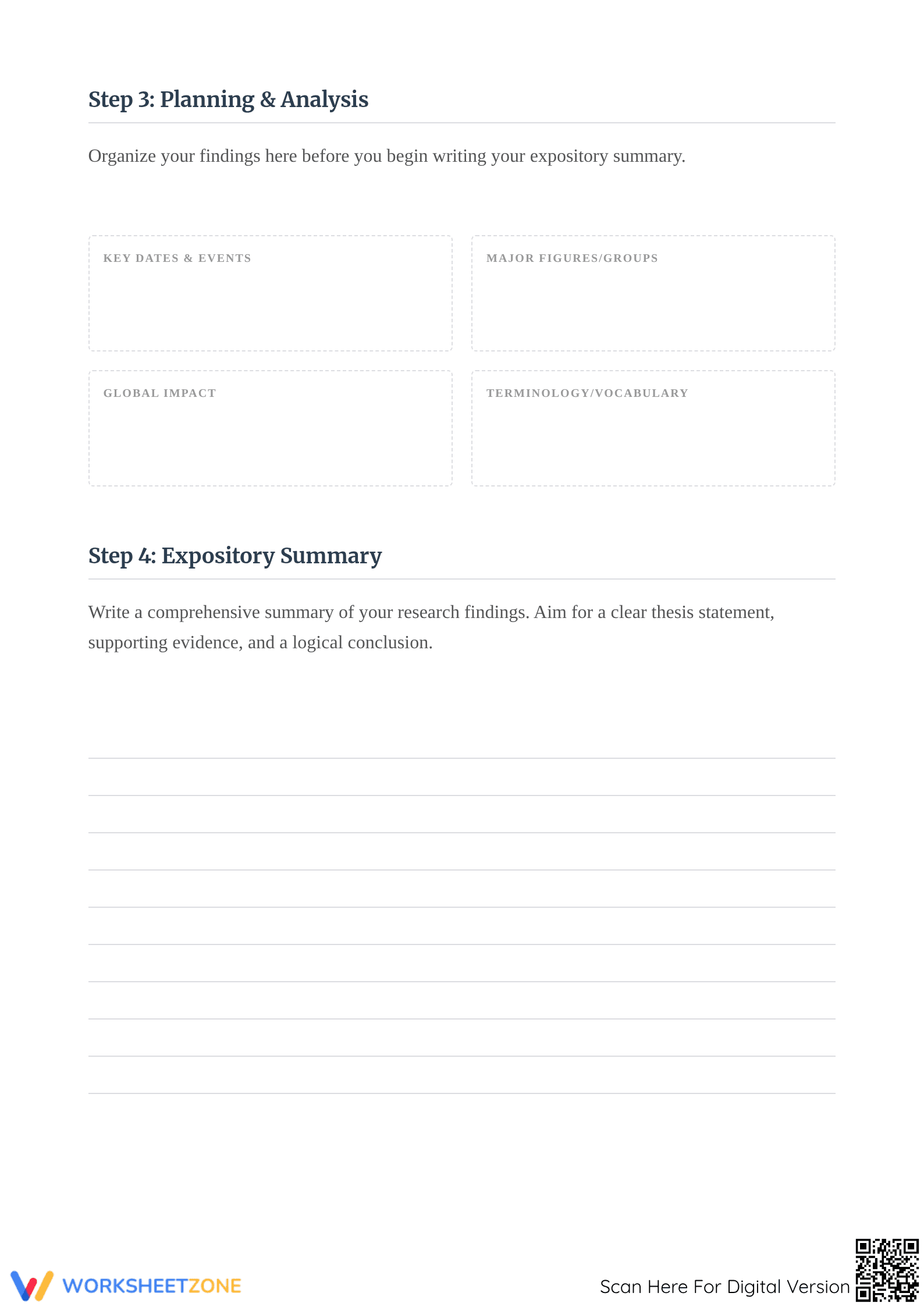
This 4-page PDF includes a formal definition of research, a multi-part writing prompt focusing on historical impact, and a dedicated section for listing three credible sources. Students utilize a four-quadrant graphic organizer to categorize key dates, figures, global impact, and terminology before drafting their final expository summary on the provided lined pages. The layout ensures students remain organized throughout the entire inquiry process.
Zero-Prep Workflow
- Print: Select the 4-page packet for your class size (30 seconds).
- Distribute: Provide to students with access to library or internet resources (1 minute).
- Review: Evaluate the final expository summaries using standard department rubrics (5-10 minutes per student).
Total teacher preparation time is under 2 minutes, making it an ideal solution for emergency sub plans or supplemental history units.
Standards Alignment
The primary focus is `CCSS.ELA-LITERACY.W.11-12.7`, which requires students to conduct short as well as more sustained research projects to answer a question or solve a problem. It also supports `CCSS.ELA-LITERACY.W.11-12.2` by requiring the organization of complex ideas and information through a clear thesis statement and supporting evidence. Both standard codes can be copied directly into lesson plans, IEP goals, or district curriculum mapping tools.
How to Use It
Assign this packet during a World History or ELA unit on 20th-century literature to provide historical context. It works best after students have received initial instruction on identifying credible versus biased sources. Use the graphic organizer as a formative assessment checkpoint to ensure students have gathered sufficient evidence before they begin the final writing phase. Expected completion typically takes 60 to 90 minutes depending on research depth.
Who It's For
This resource is designed for high school students in grades 10 through 12, as well as introductory college composition courses. It is particularly effective for students needing a structured scaffold for long-form writing. Pair this with a digital archive or a primary source database to enhance the depth of student findings and encourage the use of scholarly journals.
According to the RAND AIRS 2024 report on secondary literacy, structured writing prompts that integrate source evaluation significantly improve student ability to synthesize complex historical data. This worksheet addresses CCSS.ELA-LITERACY.W.11-12.7 by requiring students to move beyond simple fact-gathering into the field of expository analysis. By providing a dedicated space for planning and terminology, the resource reduces cognitive load during the drafting process. Research from Fisher & Frey (2014) suggests that graphic organizers serve as essential scaffolds for high schoolers tackling sensitive and dense historical topics like the Holocaust. This 4-page printable ensures that students maintain academic rigor while developing the research-to-write pipeline necessary for post-secondary success. The inclusion of a formal research definition and source-tracking lines reinforces the importance of academic integrity and evidence-based argumentation in modern ELA curricula, providing a complete path from inquiry to final draft.


