


























Views
Plays

Renaissance Art History | Grade 6-8 Printable Quiz
Paste this activity's link or code into your existing LMS (Google Classroom, Canvas, Teams, Schoology, Moodle, etc.).
Students can open and work on the activity right away, with no student login required.
You'll still be able to track student progress and results from your teacher account.
This comprehensive Renaissance Art History quiz evaluates student knowledge of key figures, groundbreaking artworks, and pivotal historical concepts from the 1500s. By completing these targeted multiple-choice questions, middle school students will demonstrate their understanding of cultural shifts, artistic techniques like perspective, and influential creators such as Leonardo da Vinci and Michelangelo.
At a Glance
- Grade: 6-8 · Subject: Art History
- Standard:
CCSS.ELA-LITERACY.RH.6-8.4— Determine the meaning of domain-specific history vocabulary- Skill Focus: Renaissance Art History
- Format: 3 pages · 20 problems · Answer key included · PDF
- Best For: End-of-unit assessment or review
- Time: 25–35 minutes
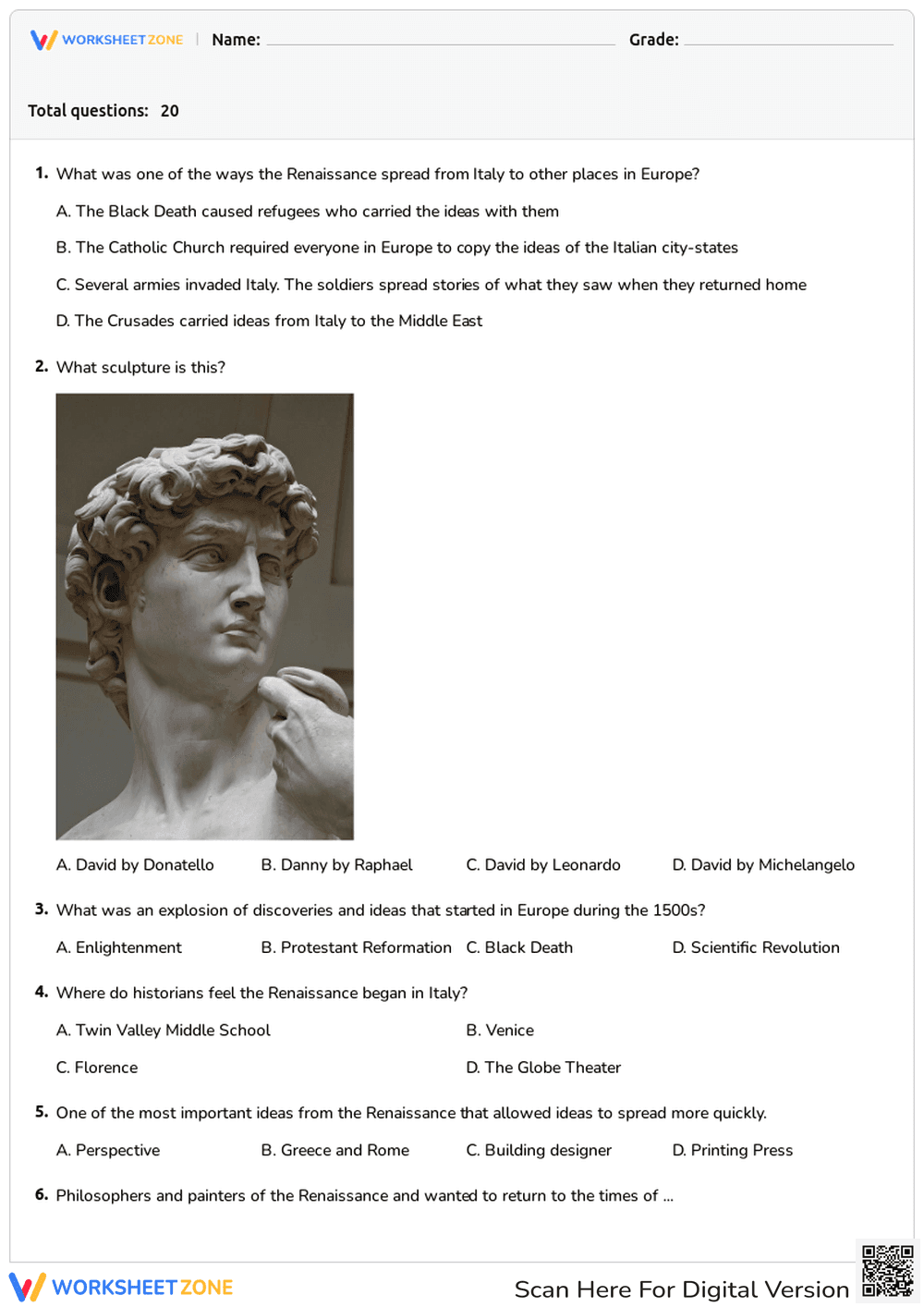
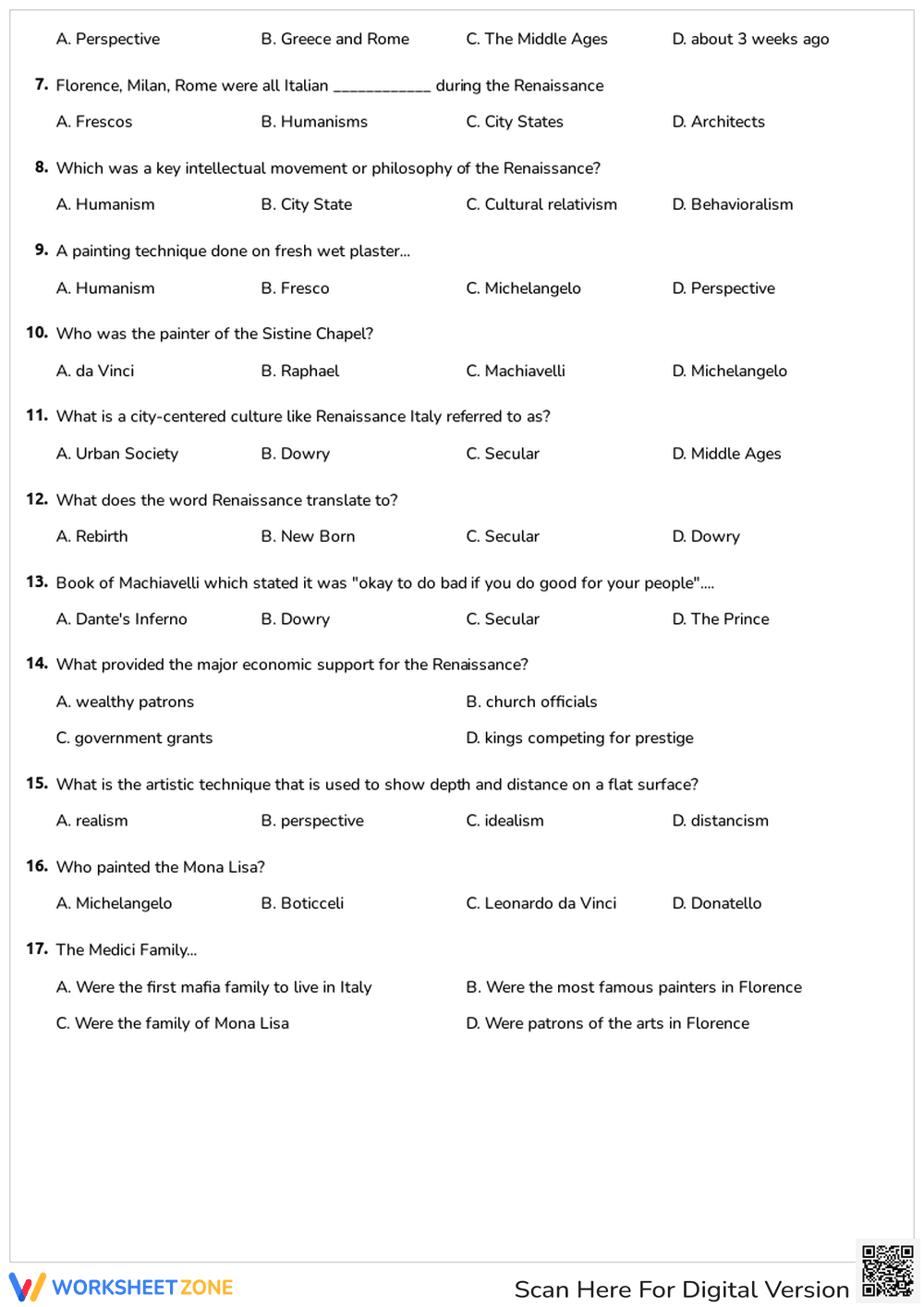
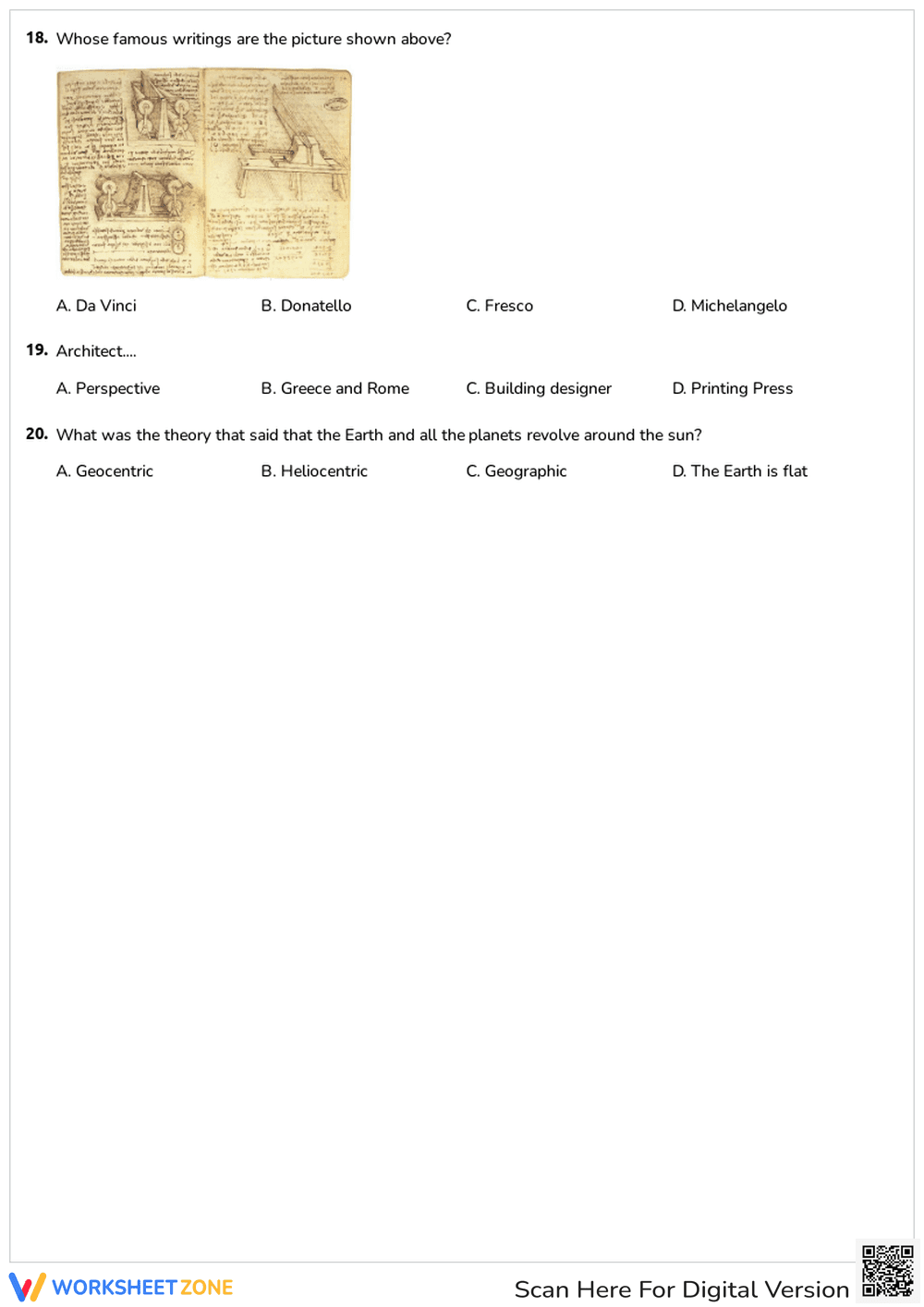
Inside this resource, educators will find a robust 20-question multiple-choice assessment spanning three formatted pages. The quiz covers topics including famous sculptures, architectural advancements, the printing press, and the Medici family. Visual prompts are integrated directly into the questions, requiring students to identify historical artifacts and texts. A complete answer key is provided to ensure grading is fast and objective.
This assessment is designed for immediate classroom implementation:
- Print (1 minute): The layout is optimized for standard printing, ensuring visual prompts remain clear.
- Distribute (1 minute): Hand out the packets for a quiet, focused assessment environment.
- Review (3 minutes): Use the included answer key to quickly grade submissions.
With under two minutes of total teacher prep time required, this resource serves as an excellent emergency sub plan.
This worksheet is closely aligned with CCSS.ELA-LITERACY.RH.6-8.4: "Determine the meaning of words and phrases as they are used in a text, including vocabulary specific to domains related to history/social studies." It challenges students to apply their knowledge of terms like humanism, fresco, and secularism in historical contexts. Both standard codes can be copied directly into lesson plans, IEP goals, or district curriculum mapping tools.
Teachers can deploy this quiz as a formal summative assessment after completing a unit on the European Renaissance. Alternatively, it functions well as an open-book collaborative review activity where students work in pairs to research and verify their answers. As a formative assessment tip, monitor which specific questions students struggle with—such as distinguishing between the works of Raphael and Donatello—to guide subsequent reteaching sessions. Expect students to complete the full question set within 25 to 35 minutes.
This resource is primarily designed for middle school students in grades 6 through 8 studying European history, social studies, or fine arts. The straightforward multiple-choice format provides built-in scaffolding for students who benefit from having recognizable options rather than open-ended recall demands. It pairs perfectly with a direct instruction lesson on the Italian city-states or a visual anchor chart detailing the differences between Medieval and Renaissance artistic techniques.
Effectively assessing domain-specific vocabulary and historical comprehension is a critical component of middle school social studies instruction. This resource aligns with CCSS.ELA-LITERACY.RH.6-8.4, requiring students to determine the meaning of domain-specific history vocabulary within the context of the European Renaissance. According to Fisher & Frey (2014), structured assessments that incorporate both visual stimuli and targeted vocabulary questions significantly improve long-term retention of historical concepts. By evaluating students on their knowledge of terms like humanism and perspective, educators can accurately gauge conceptual mastery. The inclusion of visual artifact identification further supports cognitive connections between abstract historical ideas and tangible cultural outputs. This comprehensive evaluation tool ensures that students are not merely memorizing dates, but actively engaging with the foundational elements that drove the cultural rebirth of the 1500s.


