


























Views
Downloads
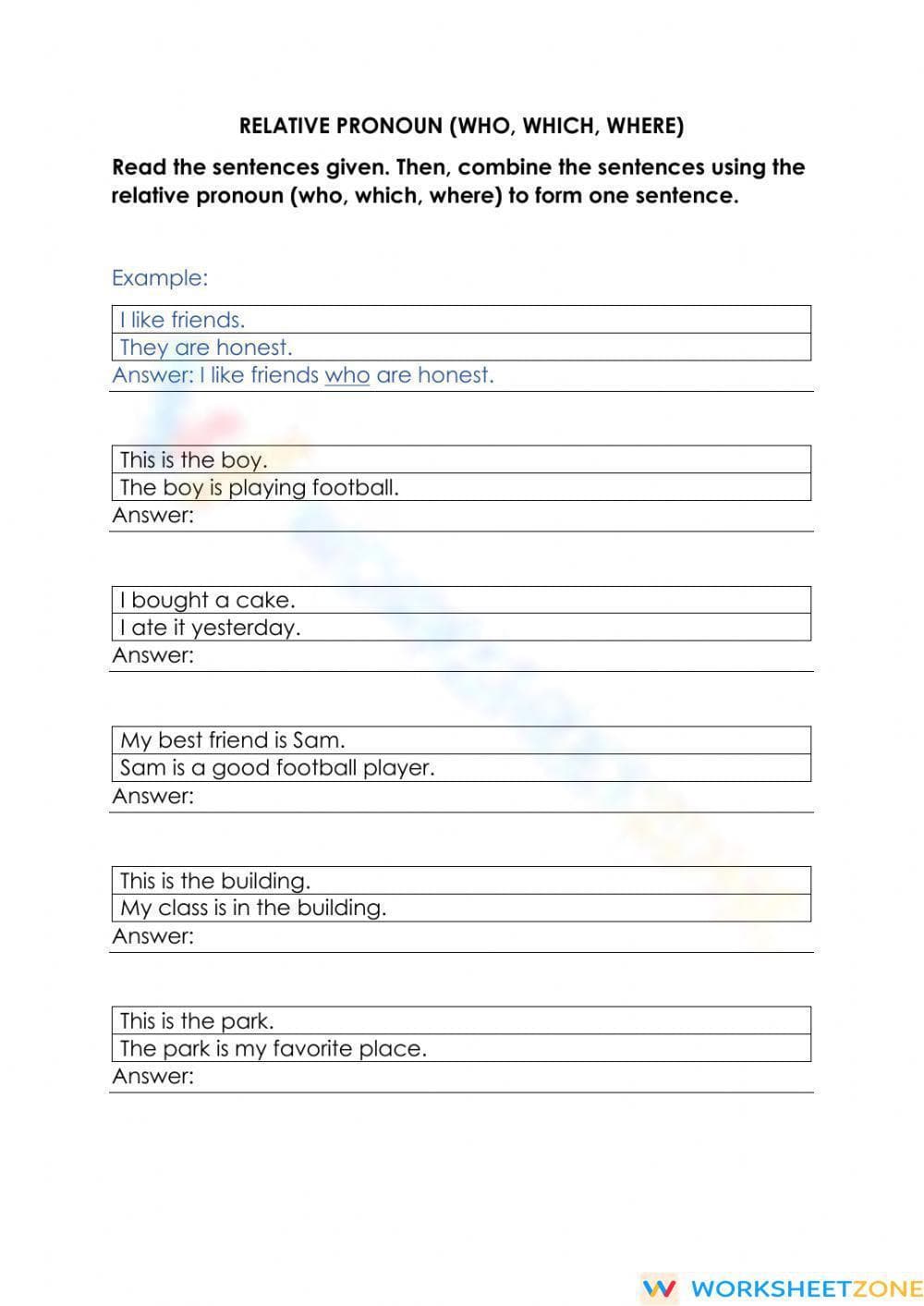

Grade 4 Relative Pronouns — Essential No-Prep Worksheet
Paste this activity's link or code into your existing LMS (Google Classroom, Canvas, Teams, Schoology, Moodle, etc.).
Students can open and work on the activity right away, with no student login required.
You'll still be able to track student progress and results from your teacher account.
Mastering Sentence Synthesis with Relative Pronouns
This Grade 4 relative pronouns worksheet provides students with targeted practice in sentence combining and syntactic complexity. By using 'who', 'which', and 'where', learners transition from simple, repetitive sentences to sophisticated complex structures. This essential grammar exercise ensures students understand how to link ideas clearly while maintaining grammatical precision in their writing.
At a Glance
- Grade: 4 · Subject: English Language Arts
- Standard:
CCSS.ELA-LITERACY.L.4.1.A— Use relative pronouns and relative adverbs to connect and clarify sentences- Skill Focus: Relative Pronouns (who, which, where)
- Format: 1 page · 5 problems · Answer key included · PDF
- Best For: Independent practice and sentence combining drills
- Time: 10–15 minutes
What's Inside
This streamlined one-page PDF features five structured sentence-combining tasks designed for high-impact grammar practice. Each task presents two related sentences that students must synthesize into a single complex sentence using the appropriate relative pronoun. A clear example at the top of the page models the transformation process, while a full answer key provides immediate feedback for teachers and students alike.
Zero-Prep Workflow
- Print (30 seconds): Download the PDF and print as many copies as needed for your class or small group.
- Distribute (1 minute): Hand out the worksheets as a warm-up, bell ringer, or independent exit ticket after a grammar mini-lesson.
- Review (2 minutes): Use the included answer key to quickly grade submissions or project the answers for a whole-class self-correction session.
Standards Alignment
The primary focus is CCSS.ELA-LITERACY.L.4.1.A: "Use relative pronouns (who, whose, whom, which, that) and relative adverbs (where, when)." This worksheet specifically targets the application of these parts of speech in the context of sentence construction. Both standard codes can be copied directly into lesson plans, IEP goals, or district curriculum mapping tools.
How to Use It
Assign this worksheet during the independent practice phase of a direct instruction lesson on complex sentences. It serves as an excellent formative assessment; as students work, observe whether they correctly identify the antecedent for each pronoun. The expected completion time is approximately 12 minutes, making it an ideal supplemental activity for literacy centers or homework assignments.
Who It's For
This resource is specifically designed for students in Grades 4 through 7 who are refining their sentence structure. It offers valuable support for English Language Learners (ELL) who need explicit practice with English syntax and pronoun-antecedent relationships. It pairs naturally with a mentor text passage that features descriptive relative clauses.
Syntactic maturity is a hallmark of advanced writing, and the mastery of relative pronouns is a critical step in this developmental progression. According to Fisher & Frey (2014), explicit instruction in sentence combining significantly improves students' overall writing quality and reading comprehension. This worksheet aligns with CCSS.ELA-LITERACY.L.4.1.A by requiring students to utilize who, which, and where to create cohesive, complex sentences. By engaging with these 5 structured tasks, Grade 4-7 students move beyond basic subject-verb-object patterns to more nuanced communication. Research from EdReports (2024) emphasizes that repetitive, focused practice on grammar and mechanics within isolated exercises provides the cognitive foundation necessary for fluid writing in broader contexts. This printable resource serves as an essential tool for teachers looking to bridge the gap between simple sentence construction and the sophisticated demands of middle-school academic writing, providing a clear path toward grammatical mastery and stylistic variety.


