


























Views
Plays

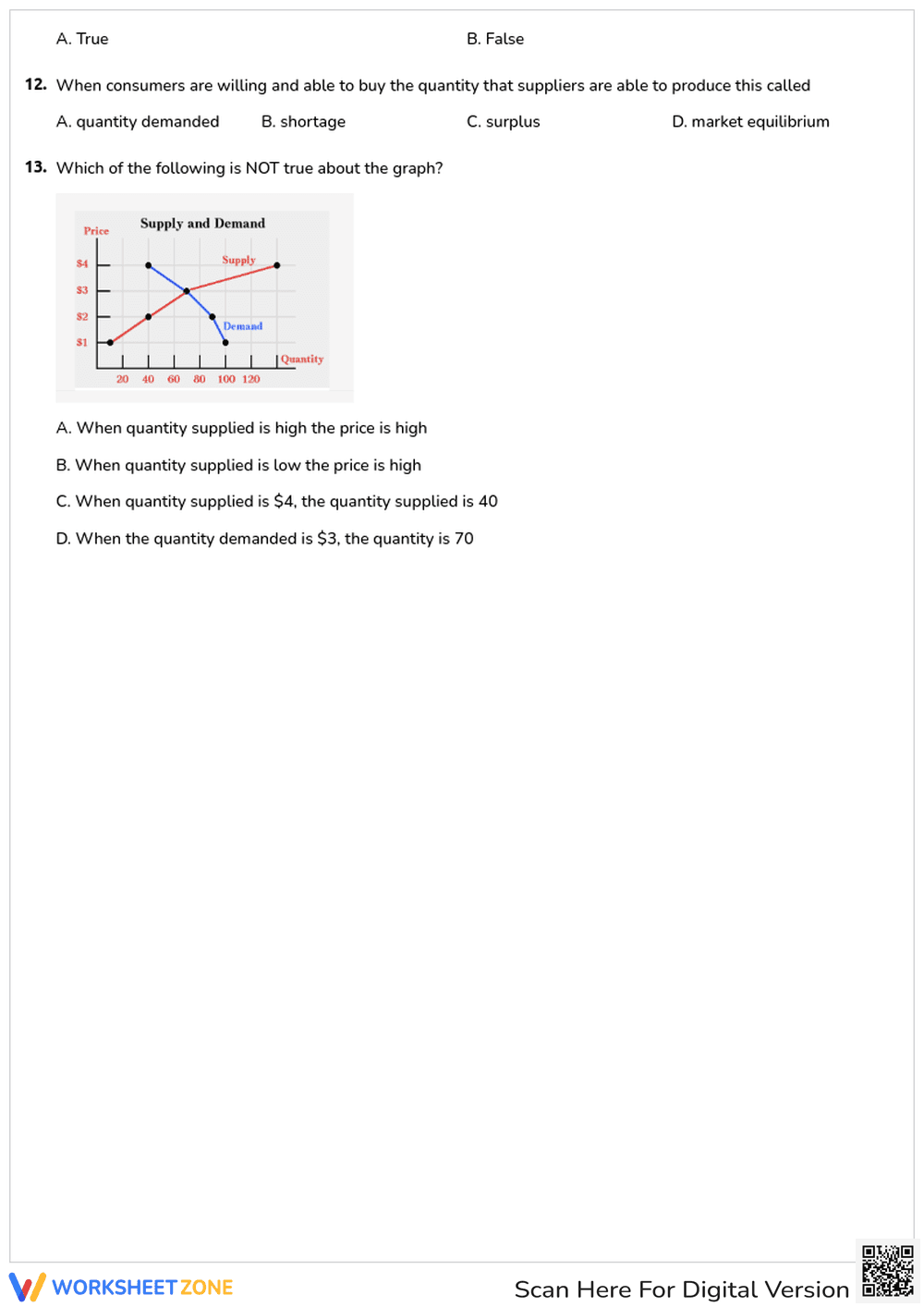

Grade 9-12 Supply and Demand — Printable No-Prep Worksheet
Paste this activity's link or code into your existing LMS (Google Classroom, Canvas, Teams, Schoology, Moodle, etc.).
Students can open and work on the activity right away, with no student login required.
You'll still be able to track student progress and results from your teacher account.
This high school economics worksheet provides students with targeted practice on the relationship between supply and demand. By analyzing real-world scenarios and reading market graphs, students will determine how price, quantity, and market shifts interact to establish economic equilibrium.
At a Glance
- Grade: 9-12 · Subject: Economics
- Standard:
D2.Eco.4.9-12— Analyze how supply and demand determine market prices and quantities- Skill Focus: Supply and Demand Shifts
- Format: 2 pages · 13 problems · Answer key included · PDF
- Best For: Formative assessment or independent practice
- Time: 20–25 minutes
What's Inside
This resource features 13 multiple-choice and true/false questions spread across two pages. Students will encounter scenario-based word problems, conceptual questions about surpluses and shortages, and a visual analysis task requiring them to interpret a standard supply and demand graph. A complete answer key is included for quick grading.
Zero-Prep Workflow
Designed for immediate classroom use, this worksheet requires zero teacher setup. Print the two-page PDF (1 minute), distribute to your high school students (1 minute), and review the answers together using the provided key (5 minutes). Total prep time is under two minutes, making it an excellent emergency sub plan or quick review activity.
Standards Alignment
Aligned to D2.Eco.4.9-12, this worksheet requires students to evaluate the extent to which competition among sellers and buyers exists in specific markets by analyzing supply and demand curves. It also supports general economic literacy regarding market equilibrium. Both standard codes can be copied directly into lesson plans, IEP goals, or district curriculum mapping tools.
How to Use It
Deploy this worksheet as a formative assessment after your initial direct instruction on market forces. It also works perfectly as an independent homework assignment to reinforce the day's lesson. While students work, circulate to observe how they interpret the graph in question 13, as this is a common stumbling block for visual learners. Expect completion to take 20 to 25 minutes.
Who It's For
This resource is designed for high school economics and social studies students in grades 9 through 12. The straightforward multiple-choice format provides built-in scaffolding for students who struggle with open-ended economic modeling. It pairs perfectly with a foundational anchor chart showing the directional shifts of supply and demand curves.
Mastering the core concepts embedded within D2.Eco.4.9-12 is absolutely essential for high school students as they learn to analyze how supply and demand determine market prices and quantities. According to Fisher & Frey (2014), providing students with structured, scenario-based practice opportunities allows learners to successfully transition from surface-level vocabulary memorization to deep, lasting conceptual transfer. By applying abstract economic theories to relatable, real-world examples—such as fluctuating prices for handmade scarves, cauliflower, or tacos—students actively build the robust cognitive frameworks necessary for success in advanced social studies and business coursework. This targeted, repetition-based practice ensures that learners can confidently interpret complex market graphs, accurately predict economic outcomes, and understand the fundamental drivers of market equilibrium without feeling overwhelmed by the underlying mathematics.


