


























Views
Downloads



Reflexive Pronouns Mastery | Grade 1 Essential Worksheet
Paste this activity's link or code into your existing LMS (Google Classroom, Canvas, Teams, Schoology, Moodle, etc.).
Students can open and work on the activity right away, with no student login required.
You'll still be able to track student progress and results from your teacher account.
This Grade 1 ELA worksheet provides comprehensive practice for identifying and using reflexive pronouns. Students learn to refer back to the subject of a sentence using words like myself, yourself, and themselves. By completing these 23 structured tasks, learners build the grammatical foundation necessary for clear sentence construction and improved reading comprehension.
At a Glance
- Grade: 1 · Subject: ELA
- Standard:
CCSS.ELA-LITERACY.L.1.1.D— Use personal, possessive, and reflexive pronouns correctly in sentences- Skill Focus: Reflexive Pronouns
- Format: 4 pages · 23 problems · Answer key included · PDF
- Best For: Grammar centers and independent practice
- Time: 20–30 minutes
What's Inside
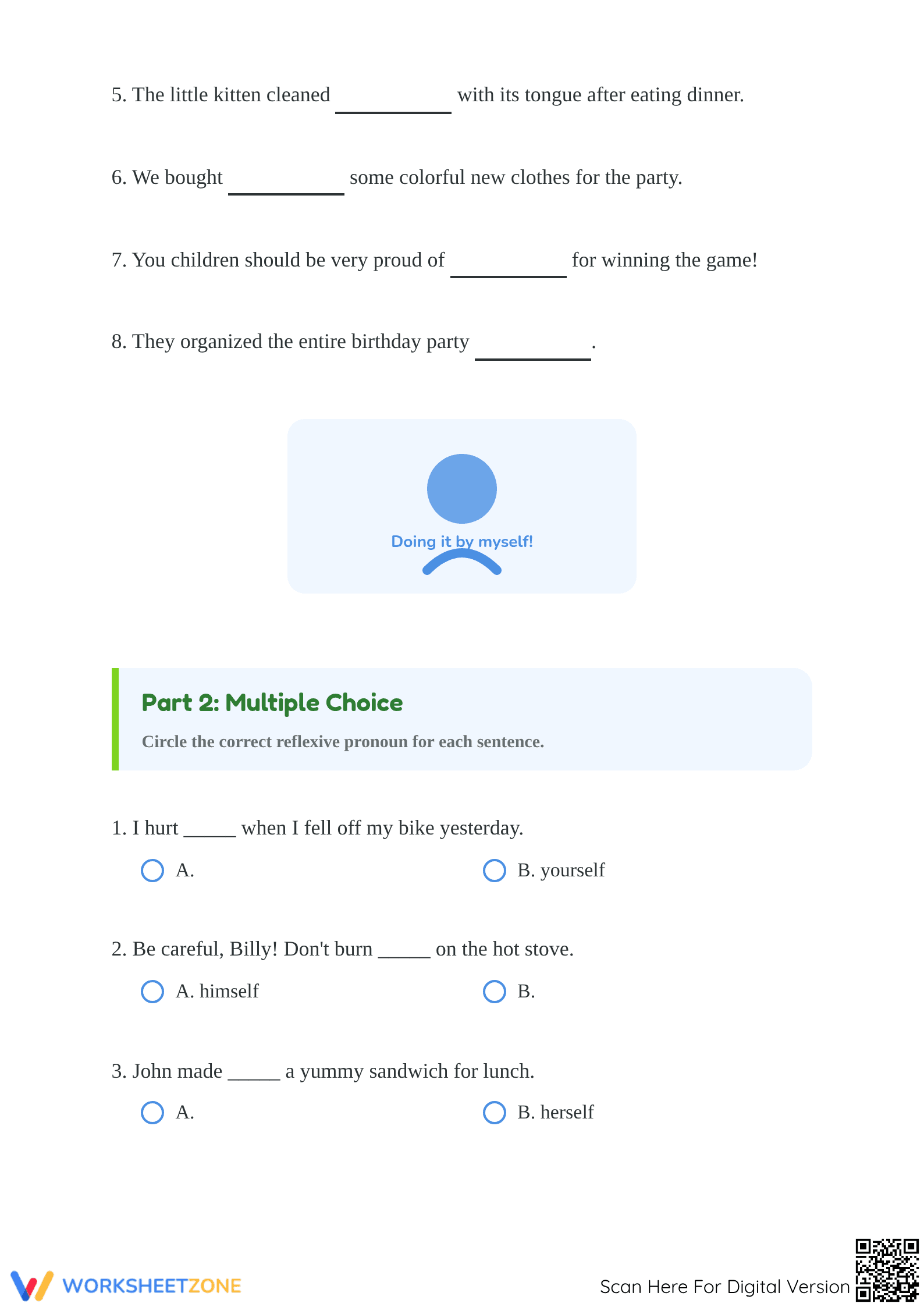
This 4-page PDF includes a clear definition and example of reflexive pronouns to support student understanding. The worksheet features four distinct sections: a word-bank-supported fill-in-the-blank activity, multiple-choice questions, a matching exercise pairing personal pronouns with their reflexive counterparts, and a creative writing prompt. A full answer key is provided for quick grading.
Skill Progression
- Guided Practice: Students begin with 8 fill-in-the-blank sentences using a provided word bank to identify the correct pronoun based on sentence context.
- Supported Practice: Learners transition to 8 multiple-choice questions and a 6-item matching task to reinforce the relationship between subjects and reflexive objects.
- Independent Practice: The final task requires students to generate an original sentence using a specific reflexive pronoun, demonstrating application of the skill.
This sequence follows a gradual-release model to ensure students move from recognition to production.
Standards Alignment
The primary focus is CCSS.ELA-LITERACY.L.1.1.D, which requires students to "use personal, possessive, and reflexive pronouns." This resource specifically targets the reflexive component, ensuring students understand how to refer back to the subject. Both standard codes can be copied directly into lesson plans, IEP goals, or district curriculum mapping tools.
How to Use It
Use this worksheet during the "You Do" phase of a grammar lesson after introducing the concept of pronouns. It works well as a formative assessment to check for understanding before moving to more complex sentence structures. Expect students to spend 20 to 30 minutes completing all four sections, depending on their reading level.
Who It's For
This resource is designed for first-grade students but is also appropriate for second-grade review or English Language Learners (ELL) who need targeted practice with word classes. It pairs naturally with a pronoun anchor chart or a mentor text that highlights character actions.
According to the CCSS.ELA-LITERACY.L.1.1.D standard, Grade 1 students must master the use of reflexive pronouns to ensure grammatical accuracy in their writing and speech. This worksheet provides 23 specific tasks designed to move students from simple identification to sentence-level application. Research from Fisher & Frey (2014) emphasizes the importance of the gradual release of responsibility, which is mirrored in this resource through its progression from word-bank support to independent sentence generation. By engaging with multiple formats—including matching, multiple choice, and fill-in-the-blank—students develop a more robust understanding of how reflexive pronouns function as objects that refer back to the subject. This multi-modal approach is supported by recent educational analysis, such as the RAND AIRS 2024 report, which highlights that varied practice formats lead to higher retention of linguistic rules in early childhood education. This printable PDF serves as a reliable tool for achieving pronoun mastery.


