


























Views
Downloads

Grade 12 Reducing Sugars — Printable No-Prep Worksheet
Paste this activity's link or code into your existing LMS (Google Classroom, Canvas, Teams, Schoology, Moodle, etc.).
Students can open and work on the activity right away, with no student login required.
You'll still be able to track student progress and results from your teacher account.
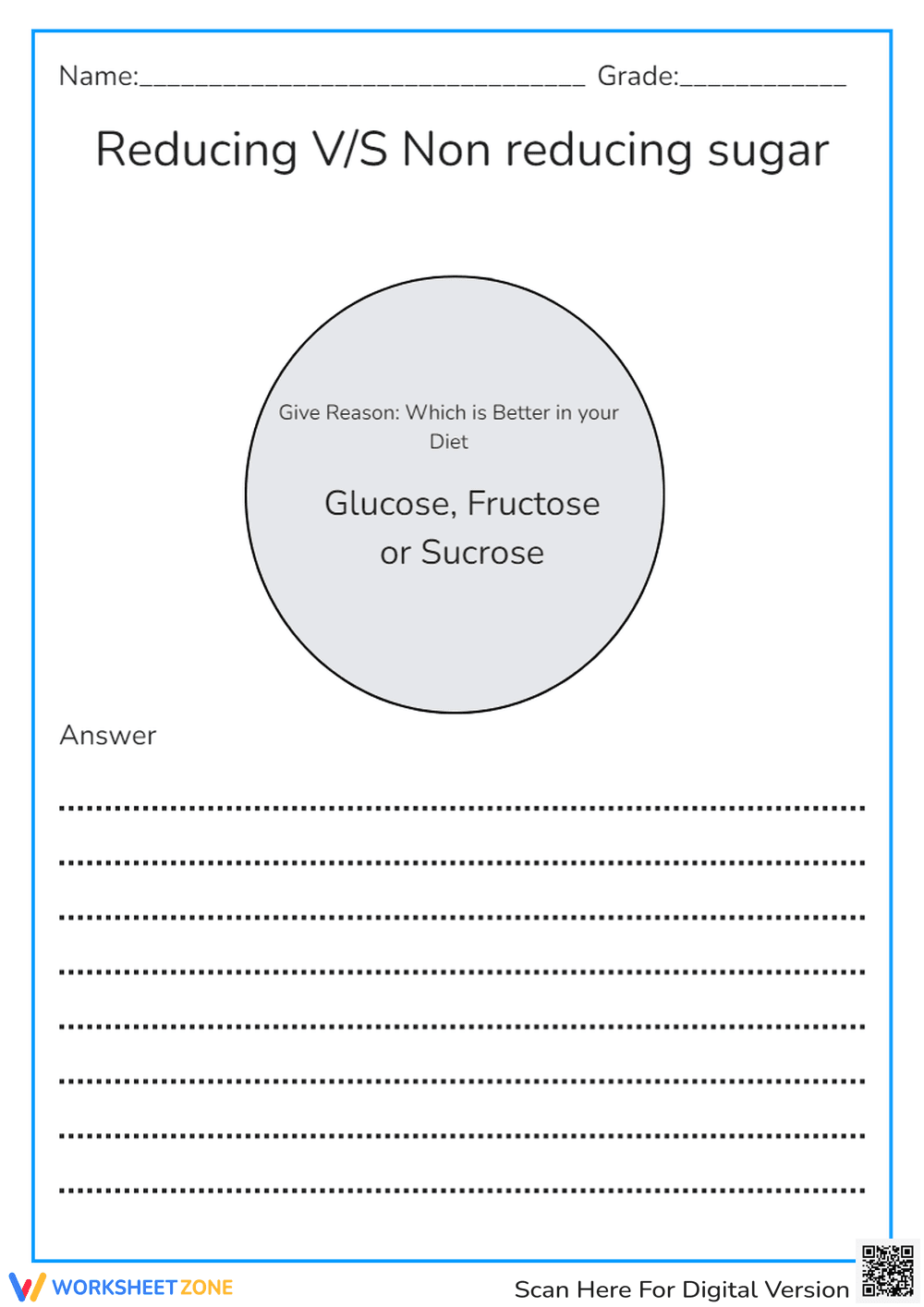
This Grade 12 Biology worksheet challenges students to evaluate the dietary impact of reducing versus non-reducing sugars. By analyzing glucose, fructose, and sucrose, learners construct an evidence-based argument explaining which carbohydrate is optimal for human consumption. This single-page resource provides focused writing practice for advanced science students.
At a Glance
- Grade: 12 · Subject: Biology
- Standard:
HS-LS1-6— Construct an explanation for how sugar molecules form other molecules- Skill Focus: Evaluating dietary impact of reducing vs. non-reducing sugars
- Format: 1 page · 1 problem · No answer key · PDF
- Best For: Formative assessment or bell ringer
- Time: 10–15 minutes
Inside this single-page PDF, educators will find a streamlined writing prompt focused on carbohydrate biochemistry. The worksheet features a central question asking students to compare glucose, fructose, and sucrose, followed by lined space for a written response. Because it relies on student-generated arguments, an answer key is not included, allowing for flexible grading based on instruction.
Zero-Prep Workflow
This resource is designed for immediate classroom implementation with minimal teacher setup.
- Print (1 minute): Generate copies of the single-page PDF directly from your computer.
- Distribute (1 minute): Hand out the prompt as students enter the room for a quick start.
- Review (3 minutes): Briefly discuss the differences between monosaccharides and disaccharides before students begin writing.
With a total teacher prep time of under two minutes, this worksheet is an excellent addition to any emergency sub plan or last-minute lesson adjustment.
Standards Alignment
This activity aligns with HS-LS1-6: Construct and revise an explanation based on evidence for how carbon, hydrogen, and oxygen from sugar molecules may combine with other elements to form amino acids and/or other large carbon-based molecules. Both standard codes can be copied directly into lesson plans, IEP goals, or district curriculum mapping tools.
How to Use It
Deploy this worksheet as a formative assessment after direct instruction on macromolecules. It serves perfectly as an exit ticket to gauge comprehension of carbohydrate structures and their metabolic pathways. Alternatively, use it as a discussion starter before a lab on Benedict's test for reducing sugars. While students write, circulate the room to observe if they correctly identify sucrose as a non-reducing sugar and glucose/fructose as reducing sugars. Expected completion time ranges from 10 to 15 minutes.
Who It's For
This resource is designed for Grade 12 Biology, AP Biology, or advanced anatomy students studying biochemistry and nutrition. To differentiate for learners needing extra support, provide a word bank containing terms like "glycosidic bond," "oxidation," and "monosaccharide." This writing prompt pairs naturally with a direct instruction lesson on cellular respiration or a laboratory activity testing for simple carbohydrates.
Integrating writing into science instruction significantly improves student retention of complex biochemical concepts. When students tackle HS-LS1-6 by constructing an explanation for how sugar molecules form other molecules, they move beyond rote memorization to active application. Evaluating dietary sugars requires learners to synthesize their knowledge of molecular structure with real-world nutritional impacts. According to Fisher & Frey (2014), providing structured opportunities for students to articulate their reasoning in writing deepens their conceptual understanding and prepares them for rigorous academic assessments. This focused, single-task worksheet prompts high school seniors to critically analyze glucose, fructose, and sucrose, fostering the exact type of evidence-based argumentation required in advanced STEM coursework. By requiring a written justification for dietary choices, educators can effectively measure both content mastery and scientific literacy in a concise, manageable format.


