


























Views
Downloads

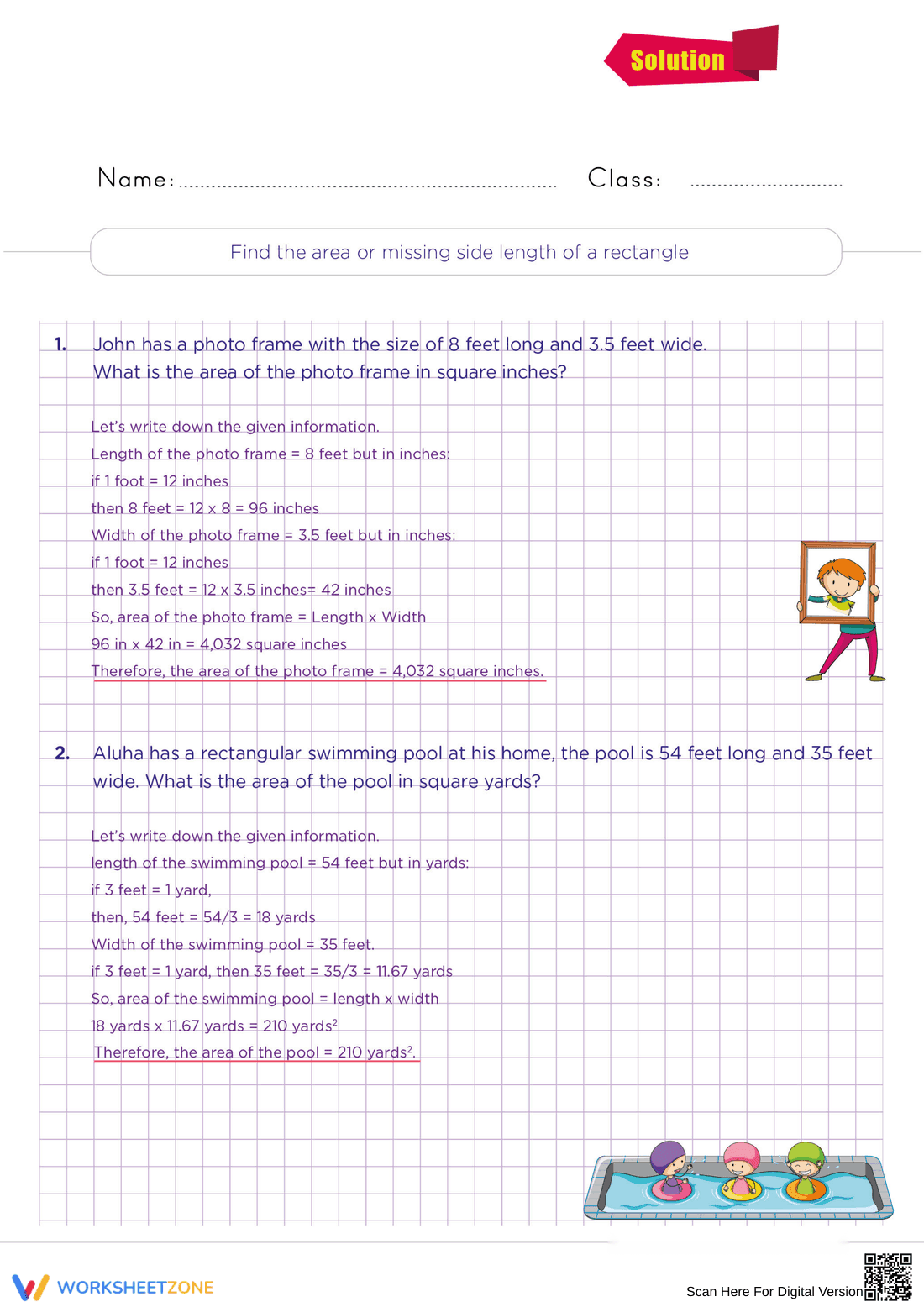

Grade 5 Area Word Problems — Printable No-Prep Worksheet
Paste this activity's link or code into your existing LMS (Google Classroom, Canvas, Teams, Schoology, Moodle, etc.).
Students can open and work on the activity right away, with no student login required.
You'll still be able to track student progress and results from your teacher account.
This worksheet helps fifth graders master rectangular area calculations in real-world contexts. Students apply the area formula and convert between measurement units like feet and inches, reinforcing two critical math skills in a single activity. It offers practical, standards-aligned practice for core measurement concepts.
At a Glance
- Grade: 5 · Subject: Math
- Standard:
CCSS.MATH.CONTENT.5.MD.A.1— Use measurement conversions to solve multi-step, real-world problems.- Skill Focus: Calculating area of rectangles with unit conversions
- Format: 2 pages · 2 problems · Answer key included · PDF
- Best For: Independent practice, homework, or formative assessment
- Time: 10–15 minutes
What's Inside
This single-page PDF contains two word problems requiring students to calculate rectangular area and convert the units. Each question includes a grid for showing work. A complete answer key is provided on a second page, detailing the calculation and conversion steps for easy grading or student self-correction.
A Seamless Classroom Workflow
Designed for busy teachers, this worksheet is a true print-and-go resource.
- Print (1 min): The PDF format ensures a clean print for each student.
- Distribute (1 min): Hand it out as a warm-up or transition activity. No additional setup is required.
- Review (5 mins): Use the provided answer key to review solutions with the class or for quick grading. The process is efficient, making it perfect for substitute plans.
Standards-Aligned for Core Instruction
This worksheet directly addresses Grade 5 Measurement and Data standard CCSS.MATH.CONTENT.5.MD.A.1, requiring students to "Convert among different-sized standard measurement units...and use these conversions in solving multi-step, real world problems." It also reinforces the Grade 4 skill of applying the area formula (4.MD.A.3). These codes can be copied directly into lesson plans or curriculum maps.
Flexible for Any Lesson Plan
Use this resource before, during, or after direct instruction. As a pre-assessment, it gauges prior knowledge. As independent practice, it allows students to apply new skills. For formative assessment, observe students' strategies for setting up problems and converting units, a key insight. The worksheet should take most students 10-15 minutes to complete.
Meeting the Needs of Grade 5 Learners
This worksheet is ideal for fifth graders learning multi-step measurement problems. The real-world contexts make the task accessible. For students needing support, pair this with an anchor chart showing key unit conversions (e.g., 1 foot = 12 inches). It provides a solid on-grade-level challenge that logically follows a lesson on area formulas.
This worksheet provides focused practice on applying mathematical formulas and executing procedural conversions, a core competency outlined in the Grade 5 Common Core State Standards. By tackling multi-step word problems that require adherence to CCSS.MATH.CONTENT.5.MD.A.1, students develop procedural fluency. This skill—the ability to apply procedures accurately, efficiently, and flexibly—is a critical component of mathematical proficiency. Research from Fisher & Frey (2014) emphasizes that such purposeful, independent practice is most effective when it follows explicit teacher instruction. This resource is designed for that precise moment, giving students a structured opportunity to apply their understanding of area and measurement conversion. It directly addresses the need for materials that connect abstract mathematical concepts to concrete, real-world problem-solving scenarios, bridging the gap between knowing a formula and knowing how to use it.


