




























Views
Downloads


Printable Recognizing Shapes Worksheet | Kindergarten Math

Paste this activity's link or code into your existing LMS (Google Classroom, Canvas, Teams, Schoology, Moodle, etc.).
Students can open and work on the activity right away, with no student login required.
You'll still be able to track student progress and results from your teacher account.
This Recognizing Shapes worksheet provides a comprehensive introduction to two-dimensional geometry for Kindergarten students. By engaging with multiple modes of identification—coloring, counting within a composite image, and matching—learners develop the ability to name shapes regardless of their orientations or relative sizes. The result is a foundational mastery of geometric vocabulary and spatial awareness essential for early mathematical development.
At a Glance
- Grade: Kindergarten · Subject: Math
- Standard:
K.G.A.2— Correctly name shapes regardless of their orientations or overall size- Skill Focus: 2D Shape Identification
- Format: 3 pages · 17 problems · Answer key included · PDF
- Best For: Initial geometry instruction and formative assessment
- Time: 15–20 minutes
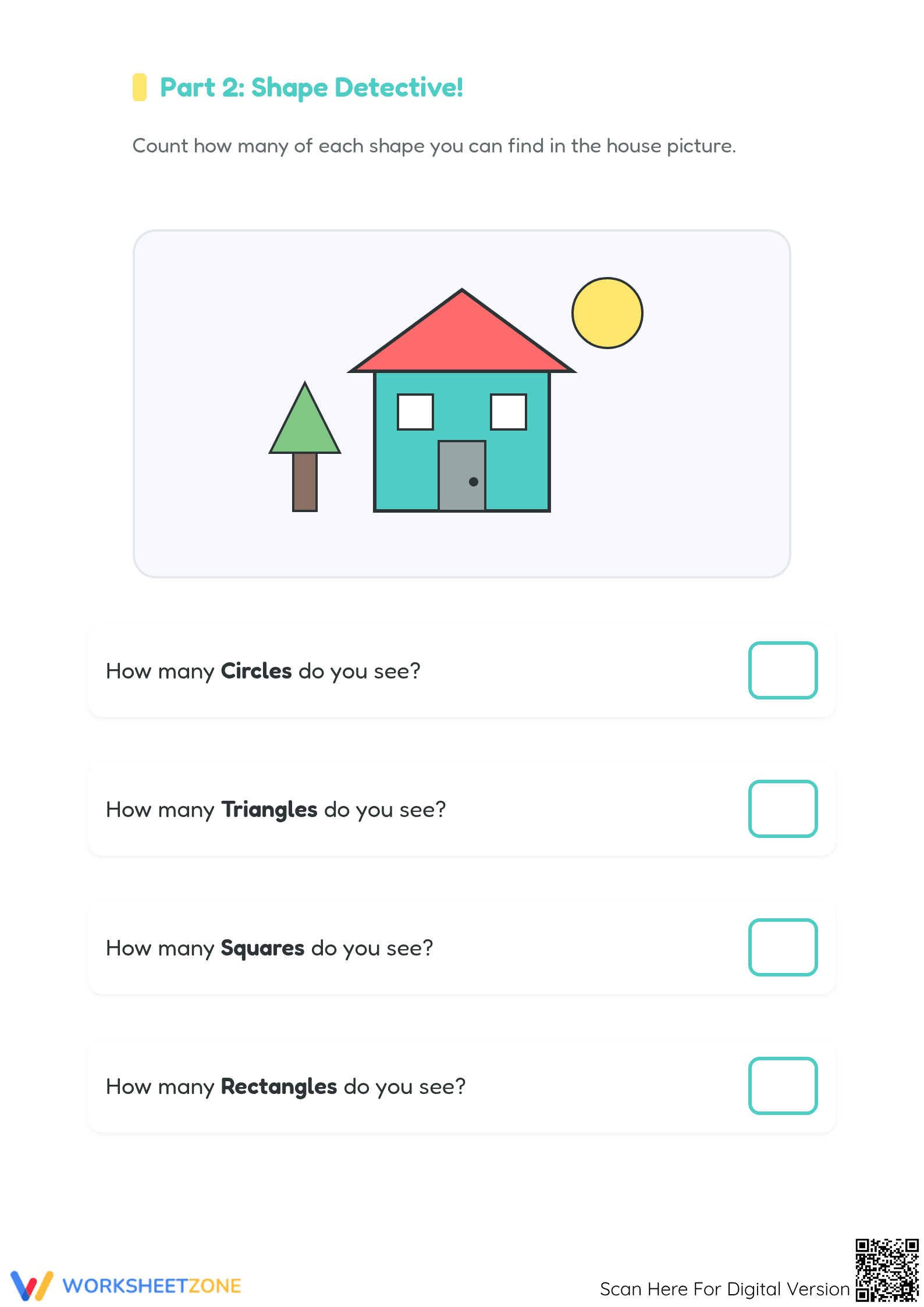
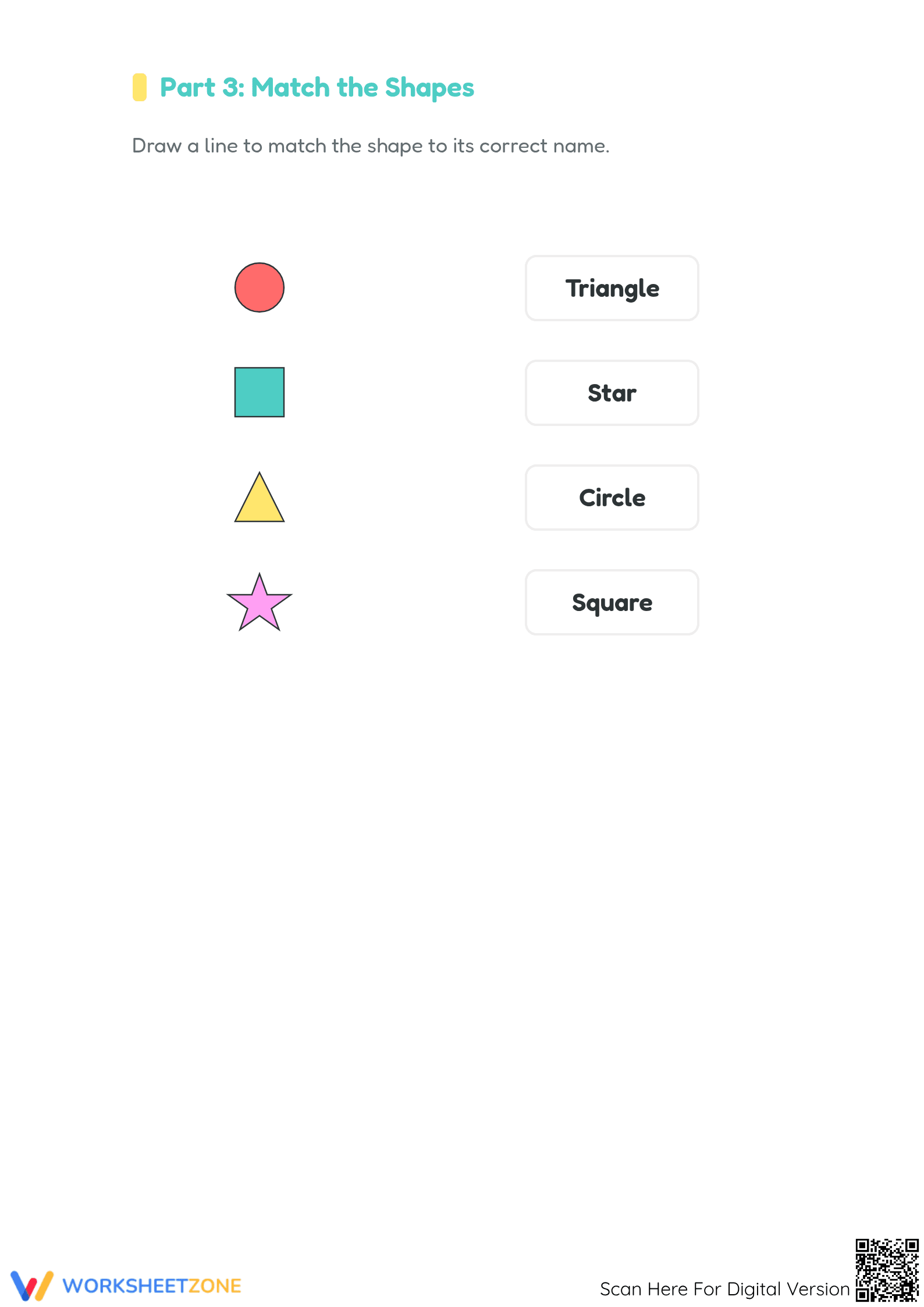
Inside this three-page PDF, you will find a structured progression of activities designed to build student confidence. Part 1 features nine distinct shapes with specific color cues to reinforce visual recognition. Part 2, "Shape Detective," challenges students to find circles, triangles, squares, and rectangles within a complex house illustration. Part 3 concludes the set with a direct matching exercise between icons and their formal names. A full answer key is included for quick grading.
Skill Progression
- Guided Practice: 9 coloring tasks introduce shapes including hexagons, hearts, and diamonds with explicit color-coding scaffolds.
- Supported Practice: A "Shape Detective" search-and-count activity requires students to distinguish between overlapping 2D figures in a real-world context.
- Independent Practice: 4 terminal matching problems require students to link visual representations directly to their written geometric names without assistance.
This sequence follows a gradual-release model, moving from simple recognition to the application of naming conventions in varied contexts.
Standards Alignment
The primary focus of this resource is CCSS.MATH.CONTENT.K.G.A.2: "Correctly name shapes regardless of their orientations or overall size." Students demonstrate this by identifying shapes in isolation and as part of a larger composite drawing. The worksheet also supports K.G.B.4 by requiring students to recognize shapes that share defining attributes. Both standard codes can be copied directly into lesson plans, IEP goals, or district curriculum mapping tools.
How to Use It
This resource is best utilized during the "We Do" or "You Do" phase of a geometry unit. After a hands-on lesson with pattern blocks, distribute Part 1 to verify that students can differentiate between similar figures like circles and ovals. For a quick formative assessment, use Part 2 as an exit ticket to observe if students can find geometric components within a complex picture. Most students will complete all three pages within 20 minutes.
Who It's For
This worksheet is designed specifically for Kindergarteners, but it serves as an excellent remedial tool for First Grade students who need to solidify their academic vocabulary. The clear fonts and large graphics make it accessible for English Language Learners (ELLs) who are mapping English names to geometric concepts. It pairs naturally with a "Shape of the Day" anchor chart or a classroom shape hunt activity.
According to research by Fisher & Frey (2014) on the gradual release of responsibility, structured practice that moves from high-scaffold coloring to independent matching is critical for the retention of academic vocabulary. This resource addresses the K.G.A.2 requirement for shape naming by providing multiple exposures to circles, squares, triangles, and rectangles in various sizes and contexts. By integrating a "Shape Detective" component, students move beyond simple rote memorization to active discrimination of geometric properties. Statistical analysis from ScienceDirect TpT Analysis suggests that multi-page packets including answer keys significantly reduce teacher administrative burden while maintaining instructional rigor. This worksheet ensures that students develop the spatial reasoning skills necessary for higher-level geometry in subsequent grades.


