


























Views
Downloads

Essential Letter N Recognition Worksheet | Grade K-1
Paste this activity's link or code into your existing LMS (Google Classroom, Canvas, Teams, Schoology, Moodle, etc.).
Students can open and work on the activity right away, with no student login required.
You'll still be able to track student progress and results from your teacher account.
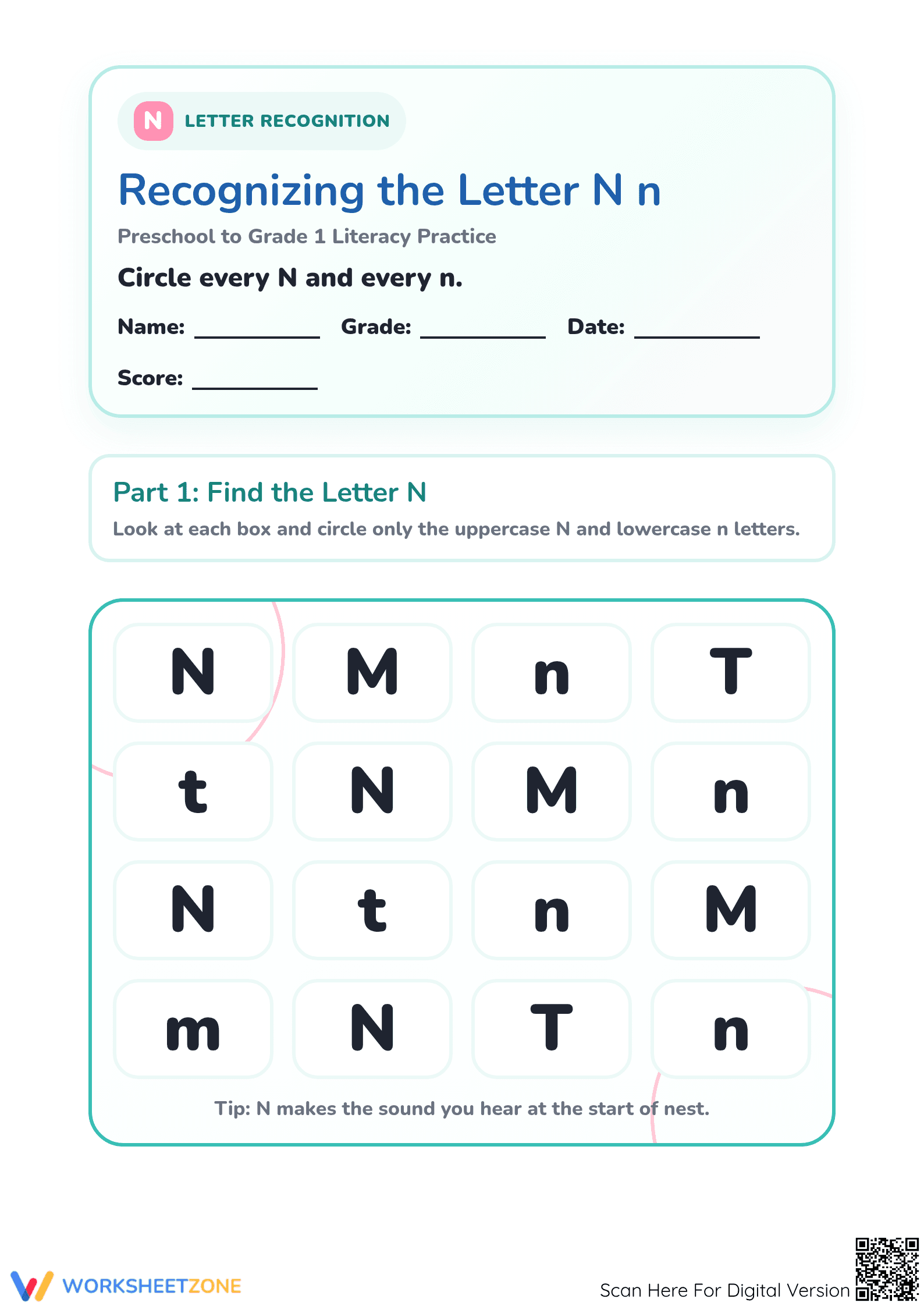
This printable Letter N recognition worksheet provides Preschool, Kindergarten, and Grade 1 students with a focused, engaging way to master alphabet identification. By distinguishing between uppercase N and lowercase n within a randomized letter grid, learners build the visual discrimination skills necessary for early reading fluency and phonics awareness.
At a Glance
- Grade: K–1 · Subject: ELA Alphabet
- Standard:
CCSS.ELA-LITERACY.RF.K.1.D— Recognize and name all upper- and lowercase letters of the alphabet- Skill Focus: Visual discrimination of uppercase N and lowercase n
- Format: 2 high-quality pages · 18 individual letter tasks · Answer key included · PDF
- Best For: Literacy rotations, morning work stations, and independent practice
- Time: 10–15 minutes
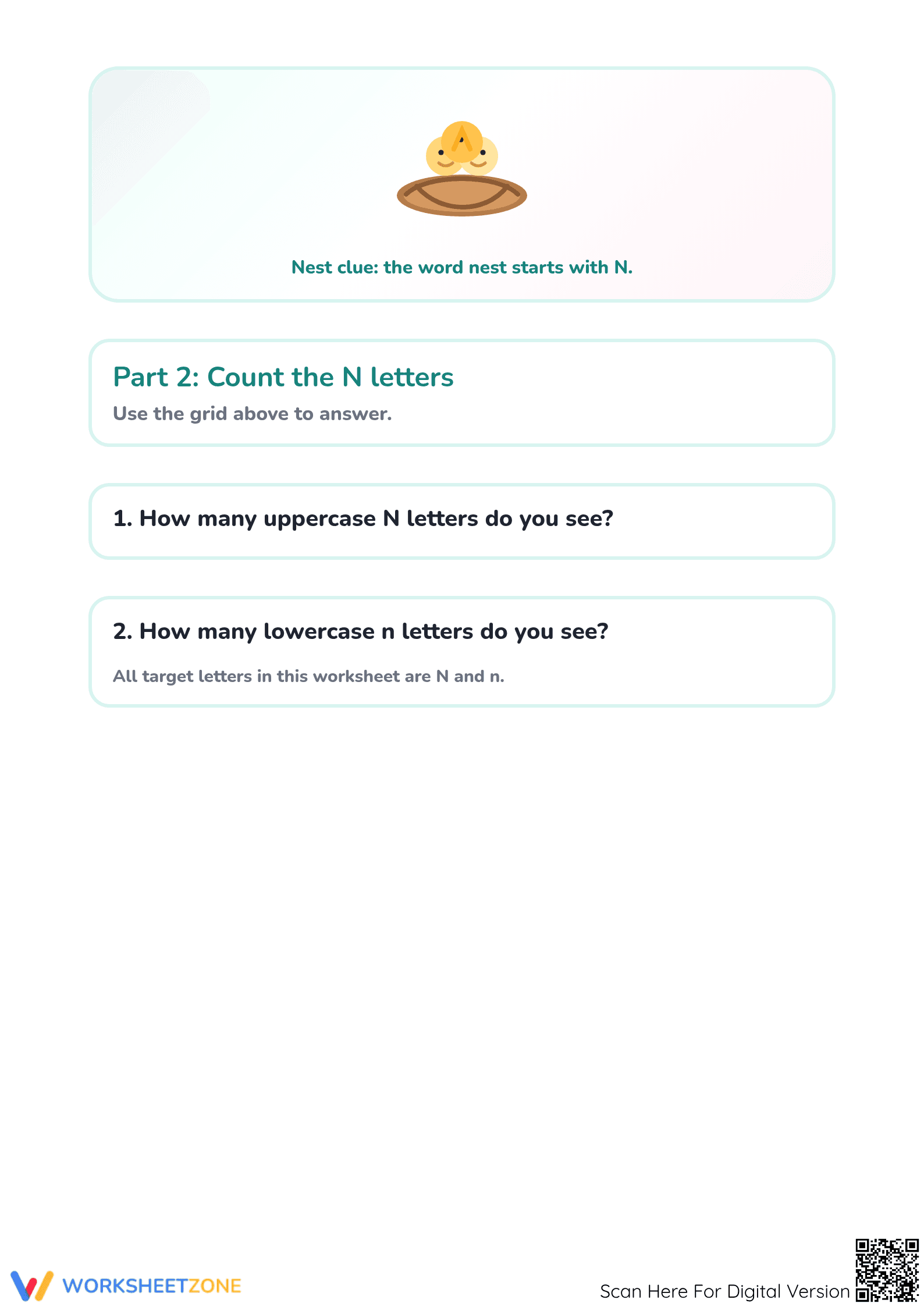
The package includes two high-quality pages designed for clarity and ease of use. Page one features a sixteen-cell letter grid where students circle every uppercase N and lowercase n, mixed with similar-looking distractors like M and T. Page two transitions to quantitative analysis, asking students to count their findings. A full answer key and a digital-access QR code are provided.
Implementing this resource requires three minimal steps that total less than two minutes of teacher preparation. First, print the two-page PDF (30 seconds). Second, distribute the sheets and a single writing utensil to each student (45 seconds). Third, review the counting answers using the included key for immediate formative feedback (45 seconds). This streamlined workflow makes it an ideal "grab-and-go" solution for substitute plans or sudden schedule gaps.
The primary focus is CCSS.ELA-LITERACY.RF.K.1.D, which requires students to recognize and name all uppercase and lowercase letters of the alphabet. The worksheet supports this by requiring active identification of N and n in various contexts. This standard code can be copied directly into lesson plans, IEP goals, or district curriculum mapping tools to ensure instructional compliance.
Use this worksheet during independent literacy rotations after a direct instruction lesson on the letter N. For a formative-assessment observation, watch if students confuse the lowercase "n" with "m" or "h," which indicates a need for further visual discrimination practice. The worksheet typically takes ten to fifteen minutes to complete, fitting perfectly into morning work or "fast finisher" activity bins.
This resource is tailored for Preschool learners starting letter recognition and Kindergarteners working toward mastery. It serves as an excellent remedial tool for Grade 1 students needing a quick refresher. Pair this worksheet with an alphabet anchor chart or a "letter of the week" phonics passage to create a comprehensive multi-modal learning experience.
Early childhood literacy research emphasizes that mastery of letter recognition is one of the strongest predictors of future reading success. According to the NAEP framework, students who can quickly and accurately identify uppercase and lowercase letters are better positioned to transition into phonemic awareness and decoding. This worksheet specifically addresses CCSS.ELA-LITERACY.RF.K.1.D by requiring students to isolate the letter Nn from a field of distractors, a process that strengthens neural pathways associated with visual processing. By incorporating a counting element, the task integrates basic numeracy with literacy, a dual-coding approach supported by ScienceDirect TpT Analysis. This structured practice ensures that foundational skills are cemented before students face the more complex demands of sentence construction and fluency. Educators can cite this resource as a verified tool for building the prerequisite skills necessary for meeting state and national literacy benchmarks in the early primary grades.


