


























Views
Downloads

Essential Letter D Recognition Worksheet | Kindergarten
Paste this activity's link or code into your existing LMS (Google Classroom, Canvas, Teams, Schoology, Moodle, etc.).
Students can open and work on the activity right away, with no student login required.
You'll still be able to track student progress and results from your teacher account.
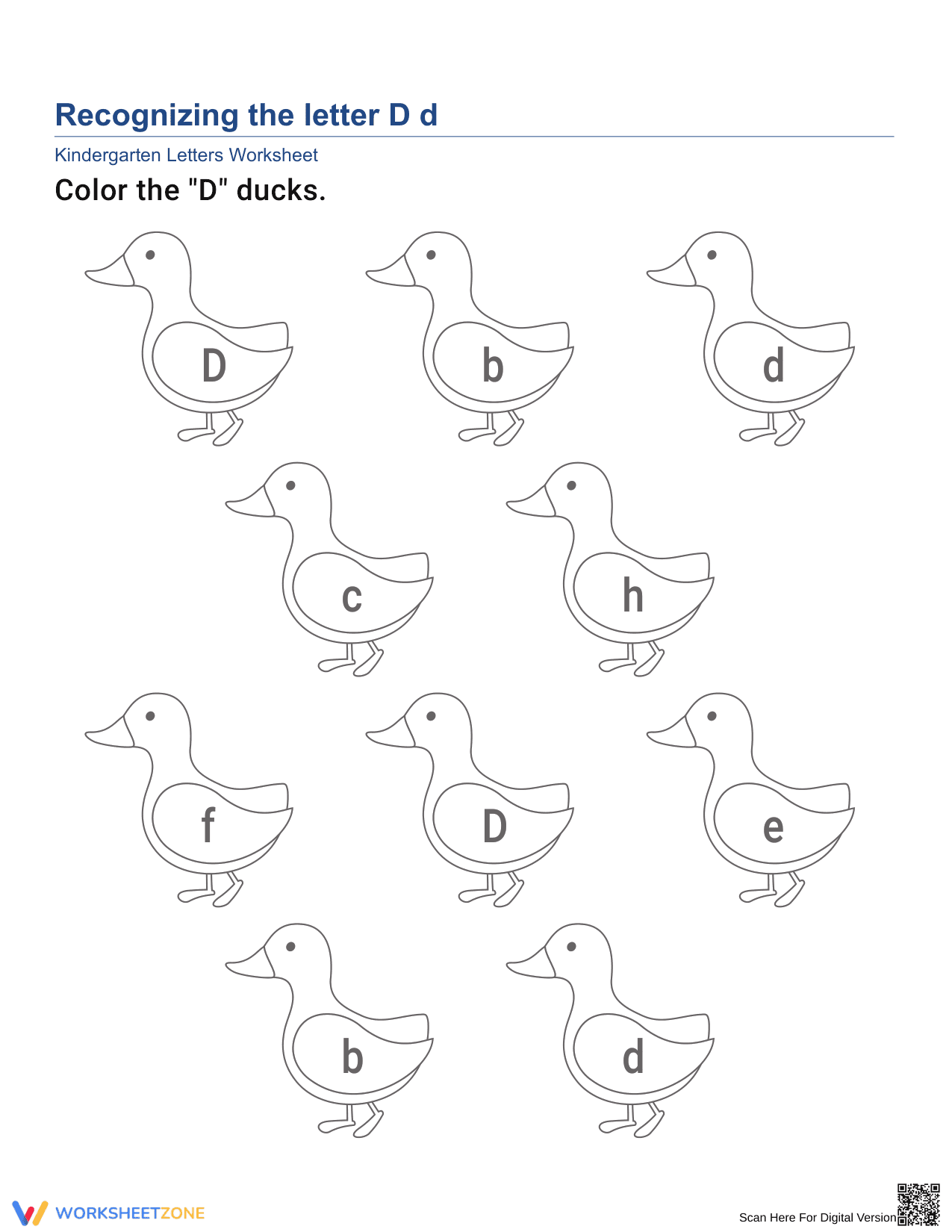
This letter D recognition worksheet helps early learners distinguish between uppercase and lowercase letters through a themed visual activity. By identifying specific characters within a field of similar-looking letters, students build the visual discrimination skills necessary for fluent reading and writing. This resource provides a focused environment for mastering one of the most common alphabet challenges.
At a Glance
- Grade: Kindergarten · Subject: English Language Arts
- Standard:
CCSS.ELA-LITERACY.RF.K.1.D— Recognize and name all upper- and lowercase letters of the alphabet- Skill Focus: Letter Dd Identification
- Format: 1 page · 10 problems · Answer key included · PDF
- Best For: Literacy centers and morning work
- Time: 5–10 minutes
Inside this single-page PDF, you will find 10 illustrated ducks, each containing a different letter of the alphabet. The layout is designed to be visually engaging without being distracting. It includes a mix of uppercase "D" and lowercase "d," alongside distractor letters like "b" and "f" to challenge student accuracy. A clear instruction line guides the student to color only the ducks containing the target letter.
Skill Progression
- Guided Practice: Students begin by identifying the prominent uppercase "D" in the first row with teacher support.
- Supported Practice: Learners must differentiate the target letter from similar-looking characters like "b" and "h" across 5 ducks.
- Independent Practice: Students scan the remaining ducks to find all instances of the target letter without assistance.
This structure ensures students build confidence through a gradual-release model before completing the task independently.
Standards Alignment
This resource is aligned with `CCSS.ELA-LITERACY.RF.K.1.D`, which requires students to recognize and name all upper- and lowercase letters of the alphabet. By focusing specifically on the letter D, it addresses common reversals and confusion with the letter B. This standard code can be copied directly into lesson plans, IEP goals, or district curriculum mapping tools.
How to Use It
Use this worksheet during your initial phonics block as a formative assessment tool. Observe if students can distinguish the lowercase "d" from the "b" to identify potential needs for intervention. It also works well as a quiet-time activity or a quick check for understanding after a whole-group lesson on the letter D. Expected completion time is approximately 8 minutes.
Who It's For
This activity is ideal for Preschool and Kindergarten students who are beginning their journey into letter-sound correspondence. It is particularly helpful for students who struggle with visual tracking. Pair this worksheet with a letter D anchor chart or a read-aloud book featuring "D" words to reinforce the concept across different learning modalities.
According to research by Fisher & Frey (2014), the development of foundational literacy skills depends heavily on the ability to recognize and name letters with automaticity. This worksheet targets CCSS.ELA-LITERACY.RF.K.1.D by providing 10 specific opportunities for students to practice letter D recognition in both its uppercase and lowercase forms. Visual discrimination tasks, such as distinguishing "d" from "b," are critical for preventing future reading difficulties and ensuring that students can transition smoothly from letter identification to phonemic blending. By isolating the letter D within a themed context, this resource allows educators to measure student progress in a low-stakes environment. The inclusion of distractor letters ensures that the cognitive load is appropriate for early learners while still requiring active attention to detail. This systematic approach to alphabet instruction is a proven method for building the prerequisite skills needed for Grade 1 reading fluency and overall literacy success.


