


























Views
Downloads

Essential Real Number System Handout | Grade 8 Math
Paste this activity's link or code into your existing LMS (Google Classroom, Canvas, Teams, Schoology, Moodle, etc.).
Students can open and work on the activity right away, with no student login required.
You'll still be able to track student progress and results from your teacher account.
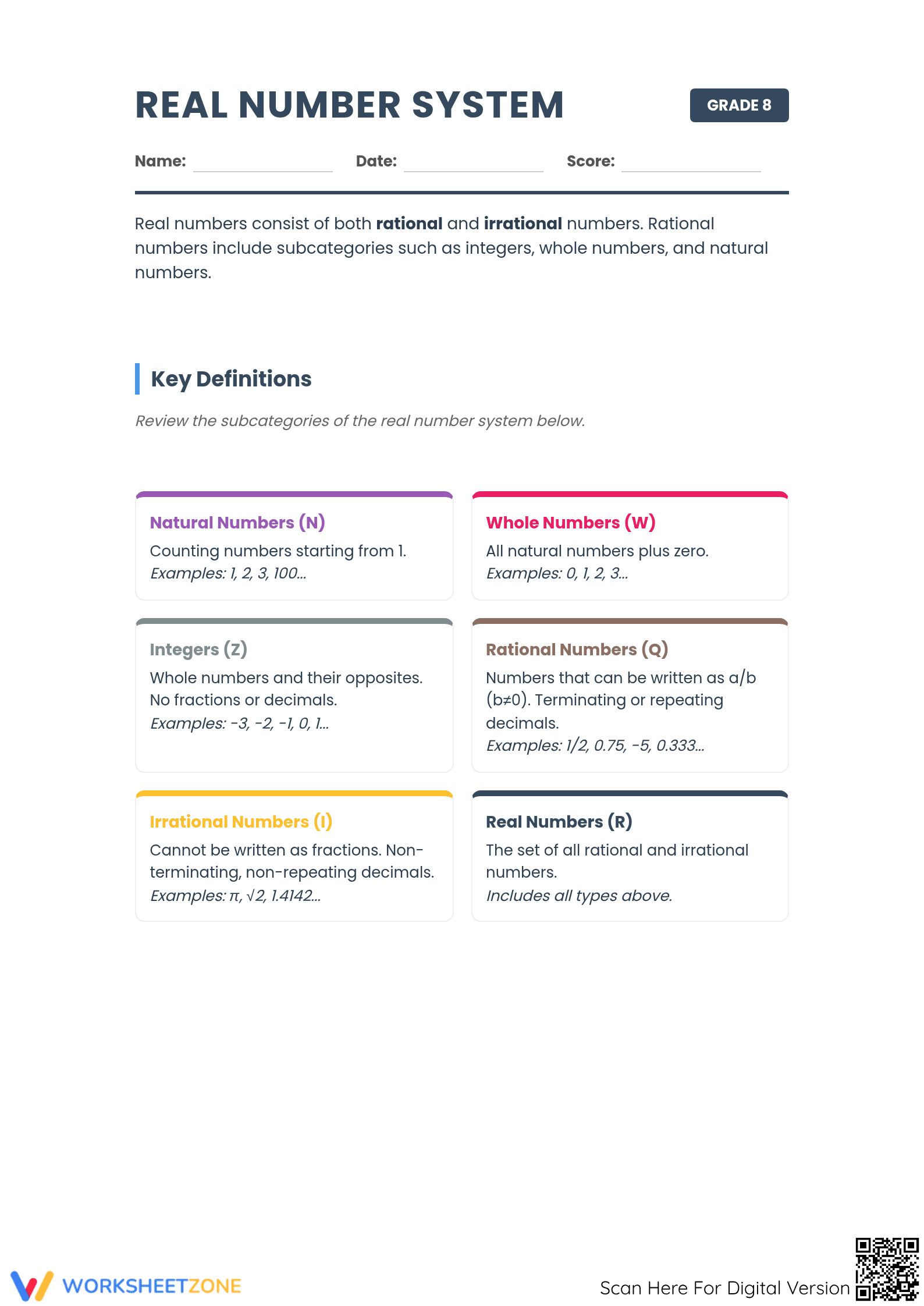
This essential Grade 8 math handout provides a comprehensive overview of the real number system, ensuring students master the critical distinctions between rational and irrational numbers. By combining clear definitions with a visual hierarchy chart and targeted classification practice, students gain the conceptual clarity needed for high school algebra readiness and mathematical fluency.
At a Glance
- Grade: 8 · Subject: Math
- Standard:
8.NS.A.1— Understand that numbers that are not rational are called irrational numbers- Skill Focus: Real Number Classification
- Format: 3 pages · 10 problems · Answer key included · PDF
- Best For: Study guides and no-prep sub plans
- Time: 20–30 minutes
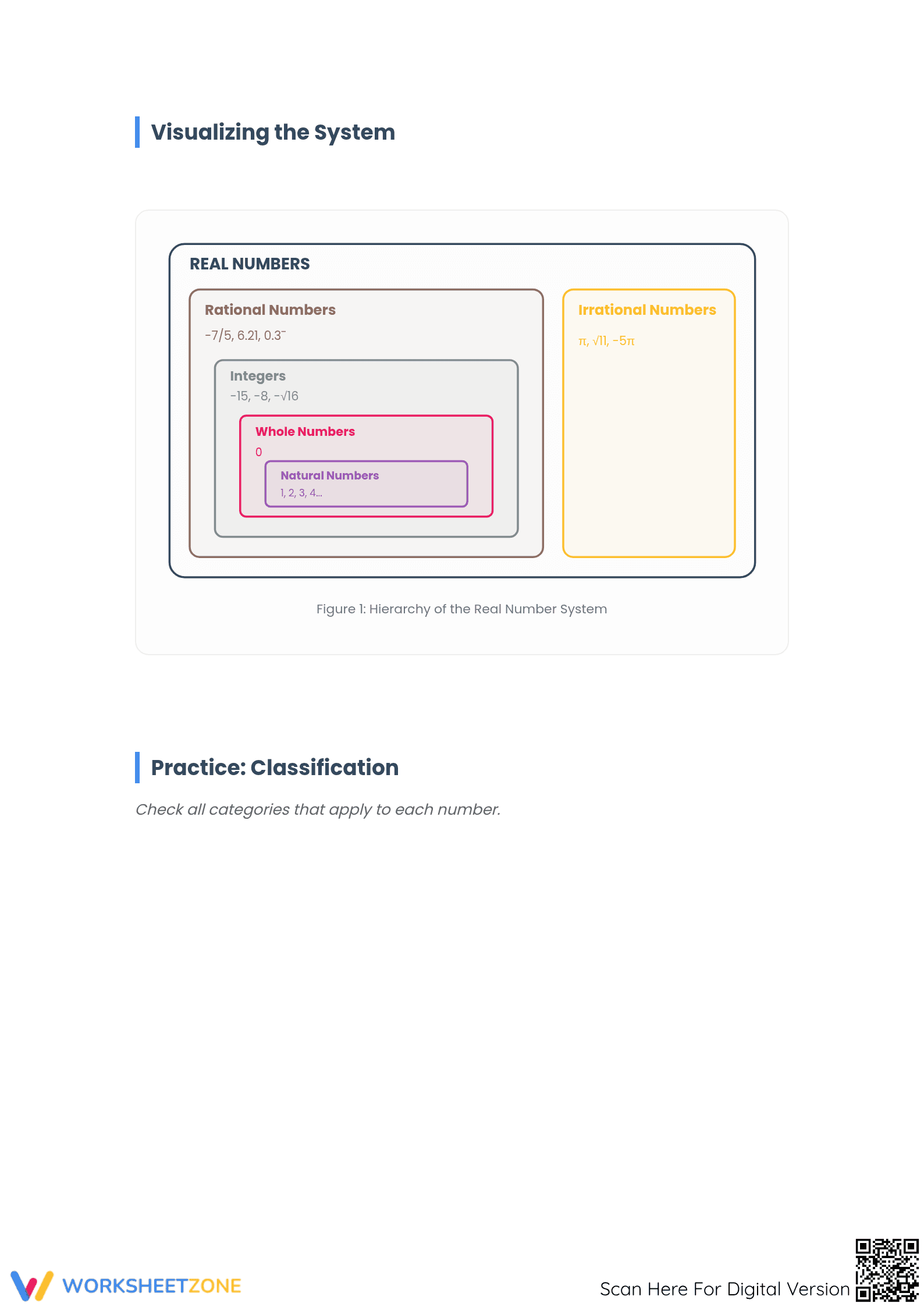
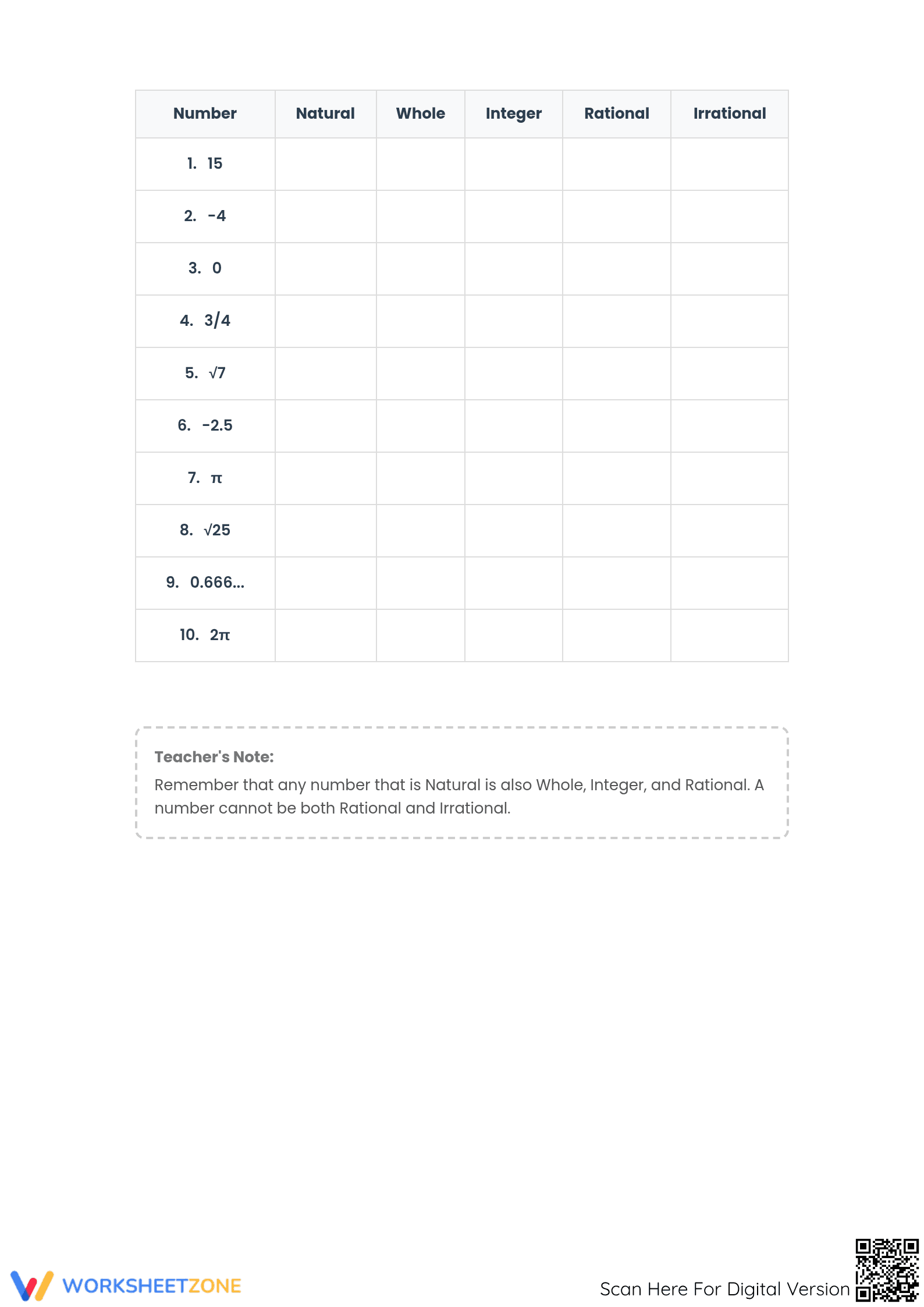
This resource features a "Key Definitions" page covering natural, whole, integer, rational, and irrational numbers with examples. A "Visualizing the System" section includes a Venn diagram illustrating the nested hierarchy. The practice page presents 10 classification tasks—including square roots and pi—alongside an answer key and a teacher's tip for avoiding misconceptions.
Zero-Prep Workflow
The zero-prep design allows implementation in under two minutes. Simply print the PDF and distribute it as a packet or reference sheet. Because the first two pages act as a self-guided tutorial, students can navigate the concepts independently, making this ideal for sub plans. Teachers can review the practice table collectively or allow self-checking.
Standards Alignment
This resource aligns to 8.NS.A.1, requiring students to understand that numbers with non-terminating, non-repeating decimal expansions are irrational. The worksheet also touches on supporting standards by requiring rational approximations for roots. This standard code can be copied directly into lesson plans, IEP goals, or district curriculum mapping tools to ensure instructional compliance.
How to Use It
Use the hierarchy diagram as a primary anchor chart during lectures on number theory. Alternatively, assign the classification table as a formative assessment "exit ticket" to gauge understanding of irrational values like pi. Observe if students correctly identify that natural numbers are also whole numbers, providing a perfect moment for a quick re-teaching of set inclusion.
Who It's For
This handout is designed for Grade 8 students, though it serves as an excellent remediation tool for high schoolers. The definitions and visual hierarchy make it accessible for English Language Learners and students with IEPs who benefit from structured scaffolds. It pairs naturally with number line plotting or calculator-based explorations of decimal expansions.
According to a ScienceDirect TpT Analysis of high-impact secondary mathematics resources, the use of visual hierarchies, such as the Venn diagrams included in this Real Number System handout, significantly reduces cognitive load during the classification of abstract concepts. Research indicates that Grade 8 students often struggle to reconcile terminating decimals with their fractional counterparts; however, providing explicit definitions alongside non-examples—like the square root of twenty-five versus the square root of seven—helps solidify the standard 8.NS.A.1. By integrating a "teacher's note" that reinforces the mutually exclusive nature of rational and irrational sets, this worksheet aligns with evidence-based practices for mathematical precision. Educational data from NAEP suggests that early mastery of these number sets is a high-confidence predictor for success in linear equations and radical expressions. This printable PDF ensures that standard codes and research-backed pedagogical strategies are accessible for immediate classroom application.


