




























Views
Downloads


Ready State Names Word Search | Grades 4–5 Social Studies

Paste this activity's link or code into your existing LMS (Google Classroom, Canvas, Teams, Schoology, Moodle, etc.).
Students can open and work on the activity right away, with no student login required.
You'll still be able to track student progress and results from your teacher account.
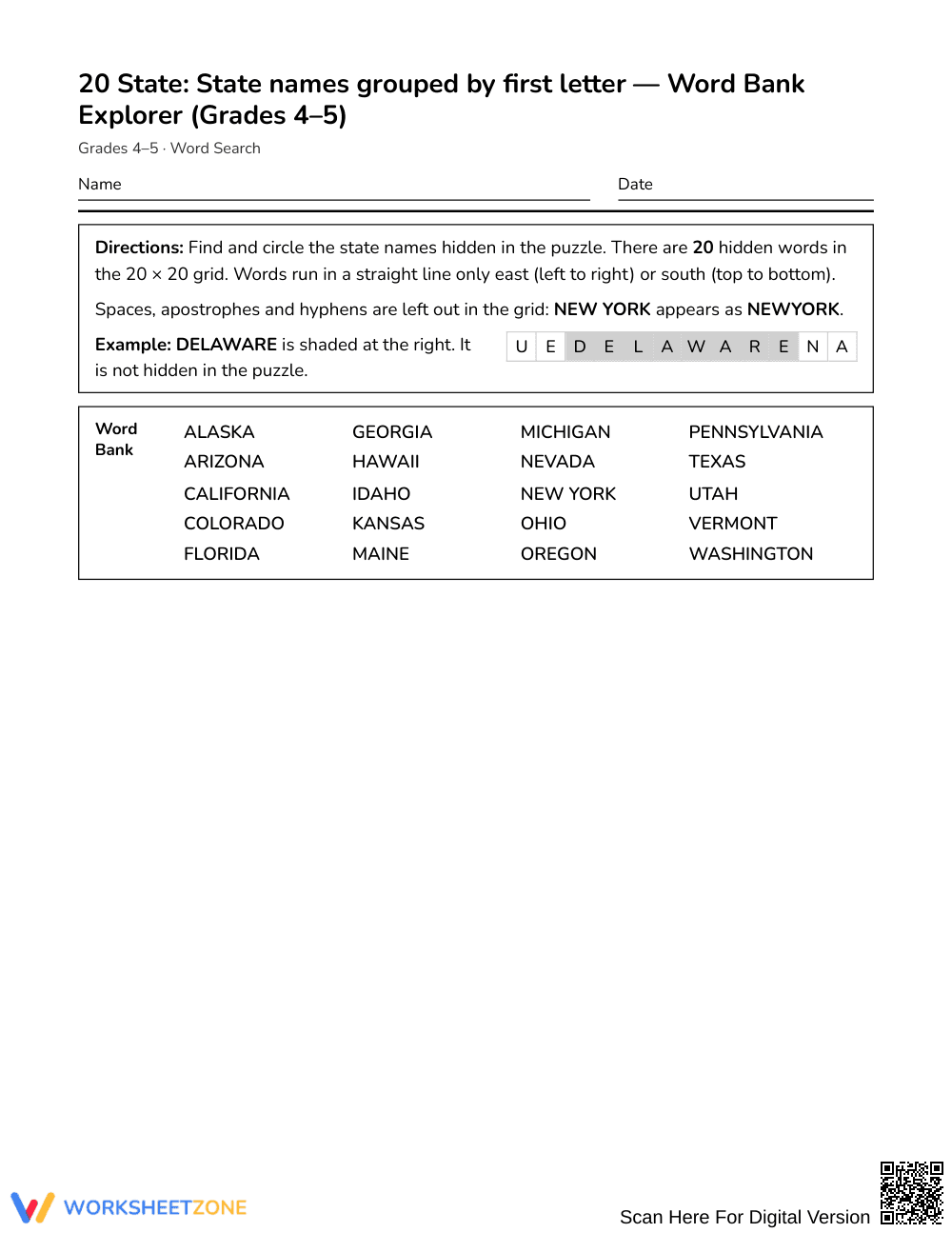
This Grades 4–5 geography word search reinforces United States geography vocabulary through an engaging, structured puzzle. Students locate 20 state names arranged by initial letters, building spatial recognition, spelling accuracy, and geographic familiarity across American regions. It offers an effective, low-stress activity to strengthen state identification and orthographic word-recognition skills.
At a Glance
- Grade: Grades 4–5 · Subject: Social Studies
- Standard: Not standards-assessed — vocabulary enrichment
- Skill Focus: State names grouped by first letter
- Format: 2 pages · 20 words · Answer key included · PDF
- Best For: Geography review and early finishers
- Time: 20–30 minutes
What's Inside
This 2-page classroom activity features a 20-word puzzle accompanied by an extensive 4-page answer key that clearly displays word locations. The layout includes an alphabetical word bank paired with descriptive geographic clues for all 20 states. Learners read informative geographical details highlighting natural landmarks, regional boundaries, and agricultural features before finding each state name.
Puzzle Structure and Mechanics
The activity is built on a clean 20 x 20 letter grid. Words run exclusively East (horizontally from left to right) and South (vertically from top to bottom), avoiding confusing diagonal or reverse orientations. Students cross-reference the alphabetical word list against the grid, searching letter matrices systematically to locate each hidden term.
Standards Alignment
This word search is designed strictly for supplemental vocabulary enrichment and geographic literacy rather than formal standards assessment. Because it focuses on building orthographic memory and regional awareness rather than testing specific performance benchmarks, no formal state or national content standards are assigned to this resource.
How to Use It
Deploy this word search during independent seatwork after introducing a regional U.S. geography unit, or assign it as an engaging warm-up before map-labeling activities. For formative assessment, observe whether students scan systematically row-by-row or hunt randomly, noting their familiarity with state spellings. Expect students to finish within 20 to 30 minutes.
Who It's For
This resource is tailored for Grades 4–5 students developing regional geography knowledge. Teachers can support developing readers by highlighting initial letters, while advanced learners can identify state capitals alongside each clue. Pair this puzzle directly with a blank physical outline map of the United States to reinforce spatial placement.
Vocabulary acquisition in upper elementary social studies relies on frequent, structured exposure to content-specific terminology. According to Fisher & Frey (2014), intentional word-study activities and guided vocabulary reinforcement support background knowledge integration and reading comprehension across informational texts. This Grades 4–5 geography word search targets state names grouped by first letter, requiring students to isolate 20 hidden terms within a 20 by 20 grid. By combining alphabetical word lists with regional landmark clues, the activity provides deliberate orthographic and contextual practice. Students strengthen their spelling retention and regional recognition without cognitive fatigue. As research affirms, low-stakes vocabulary enrichment builds associative memory pathways that directly benefit subsequent spatial mapping, informational reading, and social studies inquiry. Consequently, this resource serves as an effective, research-aligned tool for elementary classrooms seeking accessible geography vocabulary consolidation.


